Showing posts with label sport. Show all posts

Saturday, June 02, 2018

A miserably cold Saturday - start of the NSW GPS Thirds Competition

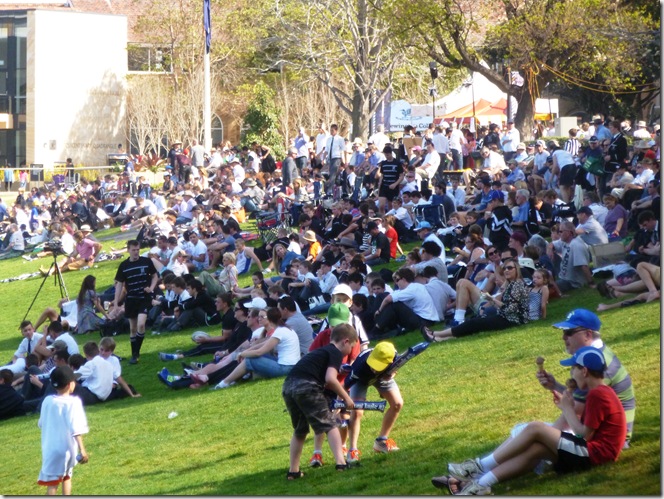
Saturday in Sydney has been windy, cold and miserable, just the day to stay at home to do some writing. Instead I went to watch school rugby, the start of the NSW GPS (Greater Public Schools) thirds competition, with TAS (the Armidale School) Firsts playing Scots College Thirds. It was good rugby, but Scots was just too strong for TAS this year.

The genesis of the the thirds competition lay the combination of the changes that have taken place in rugby and in the schools. Rugby has become more professional, with a greater weight (pun intended) placed upon big, very fast boys. On the school side, some schools have become much bigger; Scots has something like 2,000 boys, more than three times TAS's size. The composition of the student body has changed with an increase in the number of smaller frame Asian kids less suited to rugby concentrated in particular schools. Schools also now offer many more sporting options in the place of rugby as the dominant winter sport.

There are nine GPS schools, with TAS the only country school. TAS used to play against the Sydney schools from time to time, but was not part of the formal rugby competition. Then TAS had a run of strong teams and forced its way in. This had two effects. It introduced a bye that people did not like and it required each Sydney school to travel to Armidale from time to time. TAS traveled to Sydney every second weekend, while each Sydney school visited Armidale every second year. Certain of the Sydney schools, one in particular, did not like this and TAS was forced out of the rugby, reducing the competition back to eight teams.

Then two Sydney schools, High and Grammar, began to lose by very large margins and were finally forced to withdraw from the Firsts competition. This provided an opportunity for TAS. A thirds competition was created that allowed TAS to play along with High and Grammar. For the first time for many years, there was actually a GPS rugby competition that allowed all nine schools to play. Again there was a bye and travel to Armidale once every two years.

 I became involved at this point since I now had a competition to follow. I started commenting on the Green & Gold GPS rugby forum and especially the GPS forum with preseason and match reports and end season summaries. I was unashamedly promoting the thirds comp as the only full GPS competition with my support for the minnows - TAS, High and Grammar - clear but not preventing a broader view. I was sufficiently active that I acquired the nickname of Father Jim, Padre of the thirds! I'm not sure what the schools or indeed the boys would have thought of that, but I was mildly chuffed.

The thirds competition was a considerable success, but again problems emerged. Scheduling was a particular problem Your had the two top levels where six schools were playing firsts and seconds against each other and then the thirds and below where schools were playing different grades. Thus TAS, High and Grammar firsts played thirds,  their seconds played the fifths, their 16As played the 16Cs and so on. The top six rugby schools found themselves playing at different grounds for their top teams and thirds and below, a problem made worse if the games were in Armidale. There was still a problem among the six in diverging standards, while that dratted Armidale trip remained a problem.

The problem seems to have come to a head a bit over two years ago when one Sydney school reportedly said point blank that it would not send teams to Armidale. If TAS wanted to play them, then the school and its teams should come to Sydney. Otherwise, no games.

Faced with all these problems, the GPS took reasonably drastic action. The top competition was shortened to just five games with each school playing all the other six just once. Newington apparently took a hit by dropping out of the formal thirds competition, thus removing the bye, something I still don't think was fair to the boys. The thirds competition was reduced to seven rounds. Apart from Grammar and High who had existing voluntary relationships to TAS, no Sydney school was required to come to Armidale as part of the competition. TAS accepted that this would mean more travel. It also seems to be the case that the school had to reduce the number of teams sent to Sydney to play to fit in with the Sydney schools. Finally, the reduced competition was associated with a broader range of pre-season games especially with CAS (Combined Associated Schools)

This format has been continued into 2018 with pre-season games between three school groups - GPS, CAS and ISA (Independents Schools Association). This has been a considerable success, although it is no mean feat to follow such a large number of schools across multiple grades. This delayed my pre-season report, something that Crackerjack remdined me of on G&G. .
Can we send out a search party for Father Jim of the 3rds? 
We are a mere 62 hours (or thereabouts) from kick-off of the 2018 Hon. Jim Belshaw Plate/Cup, and we are all travelling ‘blind’ here without the benefit of Jim’s entomological xls. analysis of all the 3’s Season’s prospects! 
As Lleyton might say, Jim, “C’mon!!” :)
The first thirds games are now up and it should be an interesting competition. But will it be the last? The rumbles continue in this regard with no decisions apparently made about next year's format.

I know all this is just a school story, if one important to me. But lurking below it are broader issues, nevertheless.

Saturday, August 20, 2016

Saturday Morning Musings - taking pride in the Olympics

The Olympics really haven't grabbed me this year, primarily because I haven't watched it on TV and consequently haven't had that intense exposure.

It's been a messy Olympics, messy in the lead-up, messy in performance. 

There have been the usual positive stories that come from human endeavour. The story of Nikki Hamblin of New Zealand and Abbey D’Agostino of the United States is one such. Real tear jerker stuff. Makes one realise that life is not just about winning.

I do wish the Australian Government had a similar attitude with its KPI (key performance indicator) approach to sport. To focus sports funding on the achievement of Olympic gold is, to my mind at least, not very sensible. There is a real old Soviet block flavour to it, sport as promotion of national prestige. When the approach fails, it detracts from the achievements of the athletes themselves. 

Of course I expect Australia to perform relatively well. Of course I get sucked in by the medal count, although I think the way that is done is distorted. Gold is not all. At the end, its all about participation of kids (and adults) in the whole variety of sports that most interest them.  When, as Australian Olympic chief John Coates has pointed out, sports funding becomes focused just on those things in which Australia might perform best, distortions result.

It seems to me that the target should be not to be the best in an absolute sense measured by medals, but the best we can be at the time. If someone else wins and we have done our best, then that should be enough. 

At the end measured by medals or premierships, competitive sport is a zero sum game. There can only be one winner.  

Around Australia there are millions of Australians who get up to take kids to sports. There are millions of Australian who follow a sporting team even if it is losing. The parents who watch their kids play, the fans who stay with the team even though it it coming last, the people who hope that next week will be better but we have had fun in the meantime, are not dumb. They are participating in a human endeavour where participation is, finally, the end in itself.

If you adopt the KPI approach, what's the point of those fund raising BBQs? What's the point of driving for hours so that you or your children or your friends can play? 

The KPI world gives us, reinforces the world of, those obnoxious parents who abuse a volunteer official because they may have made a mistake. It sucks the life out off the community element, the individual playing because it is a good thing, that is central to so much sport. And for what? Another time consuming official inquiry into why money was wasted, another official inquiry into why we did not perform in that targeted way?

As a nation, we fund sport because we perceive it to be a good thing, something that benefits the nation at multiple levels. Sport is good because it makes us healthier. Sport is good because it gives us an outlet for other aggression. Sport is good because it builds a community. Sport is good because we have fun.

KPIs suck the fun out of sport. KPIs degrade the pleasure we take from an individual doing well. KPIs make individuals feel failures because they have not delivered on a medal even though just getting there is an achievement in its own right. KPIs are a total distortion They really F the system up. 

So to all Olympians from all countries I say thanks. You have got up in the early morning. You have done the hard yards that most of us could never manage. Whether you have won or lost, you can take pride. I hope you enjoyed the experience despite the performance pressures. You can be proud.   


Wednesday, December 02, 2015

That Australian life - woes engulf Australian soccer as fans revolt

Just when things seem so good seems to be the time when the wheels come off.

On Tuesday 17 November 2015, ABC TV ran a documentary, Played: Inside Australia’s Failed World Cup Bid, This piece in The Conversation by David Rowe, The player played: Frank Lowy and Australia’s failed World Cup bid, provides some background. The photo shows Football Federation Australia's Frank Lowy with FIFA's Sepp Blatter in happier days.

I don't agree with all the tone of David Rowe's analysis, but it is clear that Australia and Frank Lowy were taken for a ride.This is not a criticism of My Lowy, his contribution to Australian soccer has been remarkable. Rather, Australia entered a murky pool that we did not properly understand. The documentary came following a long series of revelations about FIFA corruption, triggered in part by the bid Australia lost in such a humiliating fashion. .
.
Four days later, on November 21, Sydney's Daily Telegraph ran a piece,. Red card: The banned football fans from 10 A-League clubs, naming with the intent of shaming 198 people who had been banned from soccer games.As I indicated, I had severe reservations about the Telegraph's actions. Regular commenter 2t remarked what else can you expect from the Tele as the paper is colloquially known? Maybe, but the paper plus inflammatory comments from Sydney radio shock jock ignited a fire storm.
If you do not mind, I will read it out, 'Dear Mr,' and the name has been blacked out:
'Please be advised that Football Federation Australia (FFA) is not a government agency and, as such, the obligation to adhere to the rules of procedural fairness and natural justice does not apply to our organisation. For this reason, FFA will not consider any appeal.' Evidence to Senate Committee Inquiry
Based in Parramatta, the Western Sydney Wanderers have been one of the success stories of the national A-League competition, building a support base that transcends  Problems with the relations between police and fans at  Wanderers games have been building for some time.

On 3 November 2015, the Australian Senate's Nanny State inquiry heard evidence at Parramatta on the extent of the problem, relations between policing and fans and the nature of FFA responses. You will find the full transcript here. It's worth reading in full.
We (our crowd management security company) tendered to a lot of large football clubs in the UK predominantly, including the likes of Manchester City and Leeds United, who back in the dark days were regarded as one of the worst clubs around. I have had the benefit of seeing, firsthand, how an approach of engagement as opposed to authoritarianism, as I perceive it, influences a crowd and a crowd's behaviour. Evidence to the Senate Committee Inquiry
The evidence shows a growing disconnect between the police on one side, the fans and club and indeed civic officials in the middle, and the FFA on the other. It seems clear that the police were adopting an increasingly interventionist approach including the presence of black garbed riot squad police. It seems clear that that the FFA were doing likewise, including banning people without any right of appeal or indeed, in some cases, without the people even being aware of the ban. It seems clear that there was a breakdown in communications and previous cooperative approaches between police, fans and civic officials with with both police and indeed the FFA adopting an activist (to use a phrase from the Inquiry) a "my way or the highway" approach.
Labelled "grubs" by police, likened to the terrorists who committed the horrors in Paris a fortnight ago by radio host Alan Jones and given little support by the governing body in the face of heavy-armed handling by police, the fans simply had enough. SMH report
In naming people as it did, the Telegraph breached privacy rules and also natural justice because those named had not apparently been before any tribunal nor had any appeal rights. They had just been banned. In response, the now furious Western Sydney fans began organising protests and boycotts of games with support coming from other clubs.

The first response of FFA CEO David Gallop was to temporise, to maintain a hard line while saying that fans could submit evidence to overturn their ban . It seems clear, I think, that he was thinking as CEO of the broader place and prestige of soccer with external stakeholders. In so doing, he forgot that the base of the game is the fan. Within hours, the fury engulfed the A-League.

At the weekend, the Sydney Morning Herald's Dominic Bossi reported that just half an hour into the match against Central Coast, the entire Wanderers active supporter group marched out of the ground leaving the scenic Central Coast Stadium at Gosford eerily silent. Even the Mariners' brass band stopped playing as they joined their rivals with a silent protest against the FFA, unveiling a banner criticising their lack of support for their faithful customers. Now Sydney FC supporters propose joining the boycott.

In his initial remarks, Mr Gallop said that appeal processes need to be "fine tuned". This plus the suggestion that fans could submit evidence appears in total conflict with the evidence provided to the Senate Inquiry stating that there was no right of appeal. It also conflicts with Dominic Bossi report (link above) and here I quote:
After years of criticism and pleas from supporters to provide transparency and the right to challenge bans, Head of the A-League Damien De Bohun declared the FFA is developing a system for innocent fans to have their spectator bans overturned. 
This strikes me as a little more than fine tuning!

Writing in today's Sydney Morning Herald, Perth Glory goalkeeper Ante Covic argues that A-League fans need to be treated as critical stakeholders who deserve respect. That's true. It would be sad if the outcome of all this was the destruction of the enthusiasm and character that Frank Lowy worked so hard to create.

Postscript

The dispute rolls on, centered especially on the question of natural justice. This is the motion to be moved in the Senate on the matter:


Postscript 2, 5 December 

The trouble drags on. The ABC has now covered the case of Julian Cumbo who received a five year ban for an apparent incident in a pub that took place when he was sixteen. The ABC story includes the actual ban notice. The ban notice was apparently delivered by a security firm hired by the FFA. It states (among other things) that "your personal details ... are being maintained in accordance with the Football Federation Australia Privacy Policy and relevant Statutes".

As best I can work out from the story:
  • An incident of some type took place in a pub in Melbourne. The FFA ban notice says that Mr Cumbo participated in a violent brawl and that hew was subsequently issued with a police caution "due to your status as a minor." The wording here is ambiguous. Was Mr Cumbo issued with with the caution because he was a minor, for example because he was on licensed premises, or was it limited to a caution because he was a minor?
  • The ban was imposed as part of the FFA's zero tolerance policy. It purports to ban Mr Cumbo from both a variety of matches and a variety of venues 
  • There was no consultation prior to the ban, nor did the ban provide for any form of review or appeal provisions. It was just imposed.
There appear to be a number elements in all this:
  • The nature and extent of the FFA's zero tolerance policy. The issue took place in a pub, not on the grounds. Where does the FFA draw a line between ground incidents and those that might happen elsewhere?
  • The head of power the FFA used in adopting the policy
  • The process the FFA followed in imposing the ban. This is unclear
  • The absence of any review or appeal provisions
  • The failure of the FFA to maintain confidentiality and privacy. This would appear to be a breach of 
I am not a lawyer. However, I have been involved in quasi-legal proceedings in. for example, appeals against decisions of a specialist medical college or the operations of that college's ethics committee. Like the FFA, that college's operations had to meet tests of fairness and be consistent with the law. This imposed costs on the college and sometimes created very real issues where the results were seen by the college or some of its members as inappropriate. However, this was the price that had to be paid for a fair and transparent process.

While I am aware of the problems that can arise with fan behaviour, I don't understand the mindset that seems to have developed within the FFA that has led to a quasi-legal approach that not only breaches basic principles of equity, transparency and fairness, but seems to extend beyond the FFA's role, mission and powers.

Postscript 1 December 2015

Well, the boycott is over. The FFA accepted the complaints and agreed that those affected should have
access to all evidence on which the FFA intends to rely on in any ban process plus access to an appeals process independent of the FFA.  Following this, fan groups agreed to call the boycotts off.

The new process takes into account both due process and natural justice. I still don't understand why the FFA had to be dragged kicking and screaming to this point. 

Thursday, November 12, 2015

US launches rugby union pro-league

This post returns briefly to an old theme that I have been meaning to come back to, the progressive evolution of world rugby union. The  trigger here was an interesting piece by Scotty Stevenson in the Spin-off: Pro Rugby Comes to America – and it Might Just Work

Both Canada and the US have been competitive in global rugby for some time, but both countries suffer from the absence of a professional competition in a rugby world where professional We saw this in the World Cup where the absence of professional competition did impede the minnows in competition against the fully professional sides.

The game evolves. We now have the European national competition with fully pro teams in individual country leagues. In the Southern Hemisphere, the Rugby Championship has expanded to include Argentina, while next year's Super 18 includes teams from Argentina and Japan. The logistics including travel arrangements in this competition are simply mind-blowing. I'm not sure that they are sustainable.

In Europe, Georgia is pressing for involvement in the top level nation competition. Spain is attempting to build its strengths via the sevens, with sevens now included in the Olympics. If a professional league gets underway in North America, then that's another gap filled.

I don't know whether  rugby will ever match soccer as a global game, but its reached the point now where it is a truly global game.

Wednesday, November 04, 2015

Michelle and Stevie Payne - a truly remarkable Melbourne Cup

It's hard not to go past the Melbourne Cup. It was a complete fairy tale that had absolutely everything.

I almost didn't watch. the Cup. I have drifted away during the years when I worked so much alone. The Cup is a thing to be shared. This year a friend put me in her work sweep. I watched. So glad I did.

This was a total fairy tale combining elements that, in total, would be regarded as totally implausible in normal circumstances.

Big racing family, early death of mother, triumph in the midst of hard luck, down syndrome brother, horse rank outsider. first female jockey to win, pretty and articulate, question of whether or not she should ride, woman backed by men and family who believed in her made it possible, earlier life threatening injuries, a total fairy tale package. A story that combines just so many things. I had tears in my eyes.

I really don't know how one could combine so many things in fiction. No one would believe you. Take Stevie Payne, obviously loved and loving whose simple enjoyment in the success of his horse and sister shone through the coverage. This was his triumph as much as hers. I felt so pleased for him. Or the joy of the Payne family members present. For a moment, the industry that is modern racing was totally personalised.

Yes, the world will move on. But we are all better for yesterday's  Cup.  

Sunday, November 01, 2015

End of Rugby World Cup 2015

I fear that I have been greatly distracted by the Rugby World Cup.

Our campaign began in Copenhagen on Friday 18 November at the Globe Irish pub. There in the presence of a large and increasingly well-oiled crowd we watched the opening ceremony and the England play Fiji. in front of 80,000 people.

The next day we flew to Edinburg via a long and somewhat tortuous route involving Ryan Air. That night we watched games in a pub in Leith Walk that we made our temporary World Cup HQ while in Edinburgh. As we traveled through the UK, we watched games in pubs and clubs and motor way service centres as well as the grounds. as well as attending three games at the grounds.

It wasn't all rugby, of course. There was plenty of time for Helen and I to explore our various interest. Helen captioned this one "You can take the boy out of the country, but you can't take the country out of the boy.  I have no idea what she means!

Coming back to Australia, I then spent the following weekends watching rugby!

Last night I watched the finals from Daceyville, Helen from another pub in Copenhagen, exchanging notes during the game.

Watching all these games has certainly improved my knowledge of the modern game; there has been some very good rugby indeed. It's been an interesting and sometimes intense time. Still, it's just as well that it's over.

It's not just that I don't respond to sleep deprivation as well as I once did. It's also time that I moved onto other things. I fear that my writing is now well behind schedule. Despite all this, I'm going to miss the competition and the sharing.  

Tuesday, October 27, 2015

Rugby World Cup musings

As you might expect, the New Zealand papers are covering the World Cup Rugby in blanket fashion. I can understand that. This places New Zealand on a world stage.

Helen and I drove into Cardiff past all the crowds. There we discovered the All Blacks bus. Further comments follow the photo.


People, Helen included, were rushing up to have their photos taken by the bus. This was a mild crowd. Later there was a lengthy queue!.

The New Zealanders have just moved into the HQ previously occupied by England. In a Facebook exchange with cousin Anne, part of the NZ Belshaws, she said that she would still love us despite the results. Just as well. As a part Kiwi, I cheer for NZ in many things including the rugby league. But when it comes to rugby union, I'm one eyed.

I guess it's partly an underdog thing. In league, Australia is traditionally stronger. After all, league is very much a minority sport in NZ. Union is different, a national NZ religion. Both England and Australia actually have more registered players than NZ, but passion and focus trumps this.

This makes Australia an underdog so, as a good traditional Aussie, the underdog status adds to my support. I really doubt that Australia can win next weekend. Still, and despite my growing sleep deprivation. I will be there to support the team.

Will I forgive cousin Anne if we lose? Yes. There is always the next round. But will Anne forgive me, especially given that I am likely to rub an Australian win in? Yes, although I am likely going to have to work on that. I may have to discipline myself!

For both of us, and for Helen too, there is now World Cup Japan in 2019. Helen reckons the two of us should go. It will be the first Asian World Cup, a very different experience. It would be nice to go. Maybe some of the NZ Belshaws might come?        

.  

Wednesday, October 21, 2015

Musings on the Rugby World Cup 2015

Australians and New Zealanders are, to put it mildly, sports mad. The photo shows the All Blacks' haka at Cardiff prior to their game against Georgia at Cardiff watched by (among 72,000 others), eldest and myself. I fear I share that addiction.

I thought of this as Helen and I moved across Copenhagen and the UK watching Rugby World Cup games as we went in pubs and clubs, some live. Of course, we had to take selfies as we went. Helen's caption reads: "Final game live - not so secretly hoping to see the All Blacks run amuck
😉 — Tsk. That girl! Never catch me saying things like that!

One side effect of all this is that Australians and New Zealanders support their national teams regardless of sport. They also tend to cheer for each other except when playing the other. Mind you, as a half Kiwi I split my loyalties. I cheer for Australia in the Rugby Union, but support New Zealand in the Rugby League! 

Sports obsession means that both turn out in droves to cheer their national teams in any sport regardless of the sport. This provides a base that supports a remarkable number of sports at top level. Australia's population is about 24 million. That's quite small for a country that supports globally competitive teams in rugby union, rugby league, soccer, cricket, netball and hockey, to name just a few, in both men's and women's sport. Then you have Australian Rules. Relative to the size of its population, New Zealand arguably does even better.  

When you drop below this, however, tribalism rules. Australian support particular sports and oppose others, unless of course the national team is playing. Australians in particular areas support particular sports. Soccer, the use of which term immediately reveals my affiliations, has national appeal, but no dominance in any particular geographic area. By contrast, Rugby League is strongest in NSW and Queensland, Australian Rules in the southern states. Rugby Union is strongest in NSW and Queensland, but is generally a minority sport - the leather arm patches. Cricket or netball are equally spread.  

The varied sporting landscape combined with the sums of money involved and the competition between codes makes for a very competitive business environment. Each code seeks to extend its dominance across the nation. For its part, women's sport in general attempts to establish its own position, one in which men and women will receive equal reward. There have been big changes here and I expect more to come.  

Of all the sporting codes present in Australia, soccer is the truly global code in terms of reach (and money). This is followed by rugby union. The global rankings for Australian rules lists some 20 playing countries, the global rankings for rugby league lists 36 playing countries, the global rankings for rugby union lists 102 countries. Importantly, the top union group has more countries with more coming though the ranks than either league or Aussie rules. Union is evolving into a truly global game.

The atmosphere at this World Cup was truly remarkable. It was simply fun.There are two rounds to go, and then it's time to switch to Japan and the next World Cup. In the meantime, go the Wallabies!  

Tuesday, October 13, 2015

Rugby World Cup 2015 - soaking up the atmosphere in Cardiff

We had driven down that morning from the Cotswolds to watch two of the Rugby Union World Cup pool matches, Wales playing Fiji, followed next day by the All Blacks playing Georgia.

We found a distinct party atmosphere on our arrival in Cardiff. Rugby is something of a national religion in Wales, and the streets were thronged with both Welsh supporters and those drawn to the event from other countries. We were wearing our Wallaby jersey's and people kept patting us on the back!


We wandered around, soaking up the atmosphere before heading to the Millennium Stadium to watch the game. On the way, we stopped to get a sausage roll. Overpriced and they had run out of onions and were even low on sausages, but we needed the food.


The Welsh team were doing pre-match warm-ups as we entered. Wales normally wear red. This is there alternative stripe. We had watched the previous Wales match (they were playing England) at the Evesham Rugby Club. Somewhat unexpectedly, Wales had won 28-25 to the distress of our English hosts for the win knocked host nation England out of the finals. However, in winning Wales had added further to its injury woes and it was not clear how the team would cope against the big Fijians with their open running rugby.  


The atmosphere in the Millennium Stadium is world famous, and it was humming as it filled.In all, over 71,000 people packed in. Listening to 60,000 Welsh voices singing the national anthem in harmony was quite something.


It was a good natured crowd throughout the match who thoroughly enjoyed the match.


In the end, Wales were too strong, winning 21-13. After the match we took the long work to our car (parking was very difficult) and then went to find our motel  outside Cardiff. Tomorrow would be another day.  

Sunday, August 09, 2015

Sunday Snippets - yet more sport: cricket, netball, rugby union

Much sport around at the moment. Probably least said, soonest mended the better about Australia's performance against England in the Ashes. Definitely not a happy camper on this one.

The Netball World Cup is on in Sydney with sixteen national teams competing. The photo shows the Malawi Queens, an Australian crowd favourite,  playing Sri Lanka. Malawi won 101-18. It's a rags to riches story, with the team's performance featured back home in the Nyasa Times.  

Like rugby, netball is trying to spread as a global games. Like rugby, there is a huge difference in performance between top and bottom national teams. Like rugby, netball provides an opportunity to play what is effectively a niche sport in many parts of the world.

This is lower level international netball, the 2011 Brussels semis, Copenhagen (black) v Switzerland, eldest in centre stage.

On rugby, last night Australia played New Zealand. It was the last game in the Rugby Championship, the Southern Hemisphere competition between Australia, New Zealand, South Africa and Argentina. It was also the first Bledisloe Cup match, the Cup awarded for competition between New Zealand and Australia. 

I really was nervous going into the match. Given my part Kiwi ancestry, I'm quite happy to cheer for New Zealand against Australia in the rugby league; that's an underdog thing, but union is different. New Zealand is such a rugby union powerhouse while the Australian team, the Wallabies, is also known as the Wobblies for very good reason.

Nervously I carted the heater into the lounge room and turned the TV on, quite ready to go to bed if a rout occurred. There was a large crowd (over 74,000) in the stadium to watch the match. 

As always, the match began with the national anthems. The New Zealand anthem is slightly complicated, with differing Māori and English versions. Public presentations usually involve the first verse of both language versions, beginning with the Māori.  I have often heard it, but didn't know the Māori version. This is it in Māori. 
E Ihowā Atua,
O ngā iwi mātou rā
Āta whakarangona;
Me aroha noa
Kia hua ko te pai;
Kia tau tō atawhai;
Manaakitia mai
Aotearoa    
And this is the English translation:
O Lord, God,
of all people
Listen to us,
Cherish us
May good flourish,
May your blessings flow.
Defend
Aotearoa
I guess that's probably more than you want to know, but I was curious! 

From the beginning, it was clear that both sides were a little nervous, with the All Blacks making some unexpected errors. 

At half time, the All Blacks were 6-3 in front. The game see-sawed until, finally, the Wallabies were able to establish a winning position, running out winners 29-19. 

The photo comes from the ABC summary of the match. Happy, I turned the heater off and went to bed. 

Sunday, June 28, 2015

Sunday Essay - musings on women's sport

Again sidetracked this morning by the women's world cup. Again frustrated by the difficulty in actually finding the SBS live feed. Whoever designed the SBS web site deserves a good kick!

I got quite emotionally involved in the game to the point of tears when the Australian girls lost. The Japanese were the better side on the day, but our girls did us proud. Go the Matildas!

That got me thinking about women's sport, men's sport and the broader audience.

This is Aunt Kay on winning the Armidale tennis club woman's championship, It's actually a rather nice shot. Later she would go on to try for Wimbledon in the qualifying rounds. Kay argued, correctly to my mind, that women's tennis was more interesting than men's because of the higher skill levels required as compared to the power and physicality of the men's game.

Tennis was, I think, the first sport where the women's game came to rival the men's in popularity.

We are all formed by our own experiences. In  my case, my interest in women's sport came from my daughters. Outside tennis or athletics, I had no knowledge of women's sport beyond references in schholbooks. Then, with daughters, came almost two decades of watching my girls play.

This is Clare in goal, University of New South Wales defending. Emma. is in the middle. For a number of years Emmas's dad and I met at the hockey. I learned a fair bit about hockey (and Emmas's dad)!  He knew more than I, but together we would walk the sidelines and cheer.

A little later when the hockey world championships were on, I watched the women's matches. I knew enough about the rules by then to have a better feel for the technique of the game and to thoroughly enjoy the spectacle. ..

With Helen came netball and water polo, among other sports. As happened with Clare and hockey, after so many years watching netball, I acquired a real understanding for the game, along with some understanding of water polo. The next time that someone says that boys are rougher than girls, refer them to water polo! What goes on under the water is quite remarkable.

Do more women play sport now that in past years? They certainly spend more time in the gym, perhaps more time than men. But the answer is probably yes overall, although I know of no statistics to measure this.

Both girls and boys now have access to many more sports and at a higher level. The increase in standards has been quite substantial across all sports. In  Rugby, the game I now watch most at school level, my old school firsts now play in the GPS (NSW Greater Public Schools) thirds competition.

There are practical reasons for this. The school is simply not big enough in numbers to be able to compete.at the top GPS grade. Just because the school competes in the thirds does not mean that the boys do not have access to highly professional coaching nor to the latest sport's science. I could just wish that I had their opportunities when I played. Watching the boys play over the last two years, my feeling is that they would have defeated any of the school firsts at the time I played.

In all my years playing school sport, I don't think that my parents came to a single game or meet. The world of school was isolated. That has changed.

My own involvement in my girls' sport gave me much joy. However, the interest in and rising standard of school sport has its downsides. It has given rise to scandals about professionalism and to some very nasty behaviour by parents and other supporters.The idea that you would need guards at matches or rigid codes of conduct for players and especially spectators would have seemed incomprehensible to my parents or indeed me when I was growing up. The idea of drug testing for young athletes equally so.

Returning to my opening theme, there has been a lot of discussion over the last two decades about the limited audience for women's sport and the differential pay rates for men and women athletes. In the end, pay comes back to audiences. If you choose to play hockey at top grade, man or woman,  you will earn less for an equivalent skill level than if you were playing soccer.

As has already happened in tennis, when the audiences are there, pay tends to equalise.
As has already happened in soccer, as women's skill levels increase and where there is a competitive element that people can identify with, audiences grow. As they do, there is more cash.

Netball  is presently the most fascinating case study, for this is almost exclusively a girls' sport. With the possible exception of soccer, netball has the biggest junior playing base in Australia. It has a Trans-Tasman competition attracting growing attendances, including men. They may have begun as fathers, boyfriends or partners, but they remain attracted to the game.

Whether netball can make the final jump to a mass viewing audience of men as well as women is still an open question. I think that the code has a pretty fair chance of doing that.      .  

                    .
      

Saturday, May 30, 2015

Saturday Morning Musings - introspection flowing from schools and Rugby


This morning's muse has been sidetracked by schools and rugby..

My old school TAS (The Armidale School) has decided to go co-educational.There have been girls in the primary section for some time. As an old boy, I was invited to comment prior to the decision. I decided not to. There was nothing useful that I could say. Personally, I would have preferred the school to remain single sex, partly for sentiment, more for reasons that were irrelevant to the primary question.

Thinking of the school as a business entity, I could see the reasons that were driving the decision. My concern lay in the way that it might affect Armidale's two remaining girls boarding schools in an increasingly localised education market place. We have already lost one girl's, one boy's, boarding school.How do you say this makes perfect sense from a business perspective, but I don't want you to do it because of its potential adverse effects on NEGS and PLC? How do you say that I hold that view even though it may add to your problems in developing TAS?

 The draw for the NSW GPS (Greater Public Schools) rugby competition has been released. TAS Firsts are playing in the thirds competition. It is very hard now for the school to compete at the first level because of differences in the number of boys playing at TAS as compared to the Sydney schools. The Thirds competition is a new competition to ensure inclusion of the minnows (Sydney Boys High, Sydney Grammar and TAS) in the competition.

I have attended most games for the last two years and wrote last year's competition report for the Green & Gold Rugby Forum. TAS won the inaugural competition, were equal first last year and should be competitive this year on pre-season form. My feeling is that the school will win, although this is the first time I have said so in public.

I have just entered the match dates in my forward plan. However, I find my enthusiasm down. I have written before about the strangeness I feel on attending matches. It's good sport, I get excited because I do support my old school, but I now have no direct connection.

I think that sport is a shared thing. This is a shot from the last Rugby World Cup in New Zealand. Helen (eldest daughter) with Rugby friend. Helen paid so that we could go to watch at least one match together.

Wandering round the sidelines at the GPS matches, I see no-one I know Living in Sydney and with the passage of time, I am too far removed now to know people. Unless I know people or have adopted performance mode, I am also naturally shy. People don't always realise that, for I have learned to perform when I have to.

I exchange some remarks on the sideline, but basically spend the hours alone. Then I come home and try to write up the results. At that point, I get some interaction.

This post has become a little more introspective than I had intended when I started writing. This weekend I need to work out just how I am getting to Europe, again to see some Rugby World Cup games with Helen. The trip itself is another present, but there are all sorts of consequential and cash issues to be resolved. Still, I am looking forward to it.


Wednesday, April 01, 2015

That Australian life - the ASADA mess

One of the reasons why we need to keep politicians and indeed law enforcement agencies out of public grandstanding on specific legal or quasi-legal proceedings is the mess they create. The ASADA (Australian Sports Anti-Doping Authority) Essendon etc sport in drugs issue is a case in point. For the benefit of international readers not familiar with the Australian scene, this ABC piece by David Marks describes the case I am talking about.

In this case, I have no idea what was legal or illegal, what was un-ethical as compared to illegal. In grandstanding in the way they did at the start of the case, the politicians and ASADA blurred the line between legal and illegal and between ethics, regulation and public policy. It was a failure in due process.

This was not the first such case we have seen, nor will it be the last. It's just another example of the public policy and personal mess created by created by current approaches.

Sunday, July 20, 2014

Sunday Essay – NSW GPS rugby: when excellence destroys

P1010803

The NSW GPS (Greater Public Schools) rugby competition is on again, so I spent much of yesterday watching my old school, TAS  (The Armidale School) play St Joseph's College. TAS is in the blue and white.

It’s a big logistics exercise for the school. Every second week during the rugby season, some 150 boys board buses on the Friday afternoon for the seven hour drive to Sydney. They spend Friday night camped in school facilities such as gyms, Saturday play their games and then re-board the buses for the drive back to Armidale.

On the other weekend, a Sydney school repeats the exercise by coming to Armidale. While in Amidale, the 150 or so Sydney visitors are housed and fed at TAS, again a big logistics task. There are eight Sydney schools in the competition, so they only have to do the trek once every two years, but TAS is involved every weekend. 

Why bother, one might ask? Surely the resources so involved could be put to better use?

It’s partly a matter of tradition and sentiment. TAS is a traditional rugby school, although other sports including soccer are strong and growing. The boys want it, while the parents and old boys support it. TAS is also quite important to the Australian Rugby Union.

The school competitions that act as feeders to the game at national level have become quite unbalanced. Unlike New Zealand where the sheer dominance of rugby means that every school participates so you have a wide spread of top schools, a huge gap has opened in Australia between the smaller schools and the bigger ones with their large student bases and capacity to afford professional coaching. The number of boys playing rugby has dropped as a consequence.

The NSW GPS competition can be taken as an example. There were eight teams in the Sydney competition, with TAS participating on an irregular basis, limited by distance and the unwillingness of some Sydney schools to travel. Faced with cricket score results as well as dangers to the boys from the increasing speed and physicality of the modern school boy game, first Sydney Boys High School and then Sydney Grammar school, both once big rugby schools, pulled out of the first grade competition. Even among the remaining six, differences in standards made for a potentially unbalanced competition.

I mentioned the increasing speed and physicality of the modern school boy game. While I was writing, this video came up of Saturday’s Scots (yellow) vs Shore game. Scots won 64-7. Scots is playing some very good running rugby, but look at the size and speed of the Scots’ boys. 

   Returning to my main theme, the NSW GPS had a problem. Would rugby survive as a core GPS sport or would it become a sport played among just six of the nine GPS schools? All this created an opportunity for TAS. First it joined with Sydney Grammar who wanted to stay in top grade, playing some TAS teams in place of Grammar in lower grades. Then when Grammar pulled out of the top two grades in the face of continuing losses, TAS supported moves to create a new official NSW GPS competition level, the thirds. This allowed the TAS, Grammar and High First Fifteens to participate by playing against the Third Fifteens of the other six schools, thus continuing the involvement of all nine schools in rugby.

I said that TAS was quite important to the Australian Rugby Union. This is true over and beyond any  involvement in the NSW GPS. The school’s numbers make it difficult for it to consistently field teams that can match the Sydney big six. the total number of boys playing Rugby at the bigger schools is larger than the total number of TAS boys, far larger than the number of TAS boys who play Rugby. However, it is a high quality rugby school with facilities and coaching staff that match those in Sydney.  Further, as a traditional boarding school its facilities allow it to host major competitions.

The TAS Rugby Carnival is, I think, the largest junior rugby carnival in the country for 11-12 year olds open to both schools and clubs. In 2013, the Carnival hosted 48 different schools and clubs with over 1,000 kids plus management staff. The school hosts visiting school teams such as the Fijian schoolboys side; it acts as a feeder for country and indigenous representative sides; its coaching staff coach a number of representative sides; while it provides facilities and personnel to support ARU development activities in Northern NSW. All this is important in keeping rugby union alive as a participation sport.

Beyond sentiment and TAS’s contribution to rugby as a sport, rugby is important to the school for economic reasons. While TAS now attracts a large number of day students from its immediate region, boarding is still very important because, among other things, it supports the physical infrastructure that allows the school to offer a wider range of facilities and services.

The boarding marketplace has become incredibly competitive. The number of schools offering boarding facilities has increased; the number of of schools offering options such as week day boarding as increased, something of a problem for TAS located away from the metro centres; the absolute number of boarders has declined. Rugby is one, not the only, edge TAS has to offer in a highly c1962-2nd-XV-Rugbycompetitive marketplace.

Rugby has been in decline as a school game. As someone who loves rugby, who played in the school seconds against those Sydney schools for no less than three years, I want to see the game grow. Oh, I am sitting middle row, second on the left, in this photo.

One of the things that worries me about the constant emphasis on performance is what do you do when the good starts crowding out the not so good to the point that it starts destroying the very thing that the competition is all about in the first place?

I don’t have an answer. I wish I did. Meantime, I will enjoy watching my old school play.  

Sunday, June 15, 2014

Sunday snippets – a crazy sporting day, a new Australian carbon date and the tyranny of 500 words

Yesterday was certainly a sporting day, with three Australian teams playing internationals in three sports in three countries! Crazy, really. It began in the morning Australian time with the world cup soccer match against Chile in Brazil. It was an exciting match in which Australia actually did better than expected, going down 3-1.

In the evening, Australia played France in the rugby, grinding out a 6-0 victory at the Docklands Stadium in Melbourne.  It wasn’t exciting rugby, too many kicks, while the application of the scrum rules seemed to slow the game down. The most exciting phase came right at the end when the French, threw everything at the Australian line in a desperate bid for a converted try to that give them a win.

Then at 11pm eastern time came the finals of the Hockey Women’s World in the Netherlands. While I knew that it was on, I hadn’t realised that it was going to be broadcast until kvd alerted me to the possibility.

The Dutch had cruised through the tournament, including an earlier 2-0 defeat of Australia during the qualifying rounds. The Orange showed their class from the start of the game, rattling the Australian side. This photo from the Official Hockey World Cup site shows Australian goal keeper Lynch in desperate defence. In bringing the Dutch player down, Lynch incurred a penalty that led to the first Dutch goal.  After that initial period when the Dutch scored twice, sound familiar?, the Australian side settled down and managed to hold the Orange girls.  Lynch played an absolute blinder of a match, helping keep the Australians in the game.

539c68bd42d1a_2014-06-14

Changing tracks entirely, across in Western Australia preliminary dating results from an archeological dig at the Ganga Maya Cave in the Pilbara suggest that the site may have been first occupied more than 45,000 years ago and then used from time to time up until about 1,700 years ago. The site therefore joins other older first occupation sites:

  • Devil’s Lair: Limestone cave south-west Western Australia – 41-46,000 years old
  • Lake Mungo: Dry lake basin, Willandra Billabong Creek, western NSW 43,000
  • Nauwalabila: Rock shelter Arnhem Land 200 kms East of Darwin – 40,000
  • Malakunanja: Rock shelter 45 kms north of above, east of Darwin – 45,000

The long period of human occupation of the Australian continent spans massive climatic and sea level changes. My personal historical interest remains focussed on Northern New South Wales. There we know that about 5,000 years ago the area, like other parts of Australia, went through a period of technological change and population expansion that has come to be called intensification. But what happened before that? What happened during the cold mini-ice age?

The oldest confirmed nearby site that I am aware of is in Southern Queensland, dating from around 22,000 years ago. We simply don’t know what happened in Northern NSW, although it seems possible that human occupation (if it were there) ceased on the cold dry sub-glacial New England Tablelands. Part of my difficulty is that, to make reasonable guesses, you have to understand the likely pattern of the past climatic and sea-level change at local or regional level. If you know that, you can at least develop reasonable hypotheses, I don’t, not at level of detail required. Sigh.

Moving North, the Australian Government has released its Green Paper on the development of Northern Australia. Not unexpectedly, the Australian Conservation Foundation’s take on the whole thing is quite negative. I have yet to read the paper. 

Finally in these short  Sunday Snippets, interesting discussion on ABC Radio National on the changing length of news pieces, I can’t give you the link because I heard it in passing and don’t even remember the program, It appears that 500 words is now the desirable maximum. As it happens, the required maximum word length of my weekly history column is just that, 500 words, so my attention was caught.  

The point of the piece is that 500 words is not a lot in which to provide a full report. There is a very special discipline required in compressing detail to that length while keeping it interesting and factual. It requires careful selection of the words and facts to be included.

In my case, I can see the paper’s point. The column is there to interest, to attract readers to the Wednesday magazine section of the paper. The paper adds a photo and headline plus, depending on the story, another photo, featured quote or some other subheading. My column is generally the only content on the page, the support for the advertising; the actual space occupied varies depending on the advertising mix. The  subeditors rarely change my wording beyond sometimes compression. Their skills lie in presentation. Generally, not always, they do a pretty good job.

I hadn’t actually realised the extent to which my column supports a page until I came to write this piece, looking back over the last dozen columns or so. The same pattern holds for other featured columnists. The feedback I get on the columns from the paper itself and readers suggests that the column is reasonably popular, especially among older readers and longer term residents. You would expect that demographic, given the history focus.

The columns aren’t on the on-line. For that reason, I publish them on my history blog with a lag. You will find the 2014 series here. The blog version is far less pretty, in part because I don’t always have access to the same photos, in part because of layout constraints.

Returning to my main theme, I know from experience just how hard it is to compress a story to 500 words, especially when you have to write stories week in week out. So much is lost. I get around it to a degree by writing series, although that’s complicated because I know that many who might read simply won’t have read the previous piece or pieces. But in news reporting, 500 words on a topic is sometimes all you will get.

For a news junky like me, that’s very dissatisfying!     

Tuesday, May 20, 2014

Mrs Stace’s jump

Today I feel like a break from more serious stuff. Well, not too serious anyway.

One of the issues at present in Australia is whether or not Prime Minister Abbott might choose to call a double dissolution election. ABC commentator Antony Green had a useful piece on the mechanics involved. My thanks to Don Arthur (@donattroppo) for the lead. As an aside, I’511px-STACE-Esther_Mm inclined to agree with Don’s piece on Club Troppo, Humiliation and the dole: a forgotten debate.

One of he things that I enjoy about history are its byways.

This photo shows Yarrowitch woman Mrs Esther Stace setting  a world record for a sidesaddle jump of 6’ 6” (1.98m). The year is 1915, the place Sydney’s Royal Easter Show.

Yarrowitch lies to the east of Walcha on the Oxley Highway, so a local connection so far as I am concerned. I know nothing about Mrs Stace beyond the apparent fact that she came from Yarrowitch.  

I hadn’t realised now recent the modern sidesaddle was. It was invented in the 1830s by Jules Pellier. It was revolutionary, for it allowed women to ride at a gallop and to take part in equestrian events.

By time time Mrs Stace jumped, the sidesaddle era was coming to an end as changing concepts of modesty along with changes in women’s clothing allowed women to ride astride. I wonder if her record was ever beaten?

Update 16 September 2017

A comment from La Chienne Shady Lady provided a partial answer to my question, was Mrs Stace's record ever beaten? This fascinating 2012 piece from Flora Watkins, Side saddle high jump record broken, in Horse & Hound provides a partial answer. As an aside, I didn't know that when William "Will" Thacker (Hugh Grant) in the film Notting Hill said that he was from Horse & Hound I didn't realise that it was a real magazine!

Returning to my point. With the exception of one reported higher jump in the US which does not appear to be properly documented, Mrs Stace's jump is still the highest. But, and it is a big but, the height is challenged because the horse jumped off a springboard. I have no idea whether or not this is true, but it appears to be a major issue in the competitive world of sidesaddle jumping.

Update 10 June 2019

Cheryl Castle was quite cranky on this one. I promised to bring her comment up int main text:
"Hi Jim. There is no debate over Mrs Stace's use of a Springboard. One was NOT USED ! The jump was done at the Royal Show not a circus and a quick question to the R.A.S. would quickly debunk that ridiculous theory. If you knew how horses jump you would know that jumping off a springboard would slow them down as they jump off four legs not two like a human. This crap was made up by some American woman on her blog and is totally unfounded and a scurrilous LIE. Please stop perpetuating it. Horse and Hound UK also based their info on this LIE without ever checking the facts which is just LAZY JOURNALISM. It is easily fact checked!
Cheryl Castle"

Monday, April 07, 2014

A day at the Scots’ Rugby Sevens

P1010321

I spent most of Saturday watching the Scots School Boys Invitation Rugby Sevens competition.   It was quite fun. This shot shows the Armidale School (TAS) in attack against Canberra Grammar.

Rugby sevens is a spin-off from the main fifteen a side game. While still part of rugby, rugby sevens has a become a game in its own right with greater international penetration than the main game because its rules make it easier for smaller rugby nations to participate successfully. Reflecting this greater mass reach, the game is a Commonwealth and now Olympic Games sport.P1010310

While played on a full size rugby field, each side has seven instead of the usual fifteen players. This requires a modified game.  For example, because there are only three forwards as compared to eight in the main game, scrums, rucks and mauls are necessarily simplified.

For non-rugby players, when a player is tackled carrying the ball, you need a process for releasing the ball to one side or the other. In League, this is the play the ball, in Union a ruck. 

This photo shows a ruck in the Canberra Grammar vs  TAS game. The player who has been tackled, the TAS number 4, has placed the ball on the TAS side. He is allowed to do this, but he cannot protect the ball beyond that without incurring a penalty. The forwards have formed a protective shield to allow them to get the ball back to the backs.

I often write about the importance of, and impact of, rules. Rules and the breaking of rules determines how activities flow and form specific cultures. My frequent concern lies in the in the way that over-prescription of rules, regulations and penalties can affect what we do in often very perverse ways.

P1010308 In rugby sevens, the smaller number of players on a full size field makes for a very fast game. The rules are designed to support this.

A smaller number of players playing a big game across a large area makes for exhaustion. To accommodate this, games are broken into two short halves. seven minutes with a one minute half time break. The final’s time is increased to ten minute, with a two minutes break. At Scots with school boys playing, the games had six minute halves, increased to seven for the finals.

A tournament in which a side came to play for just twelve minutes and then got knocked out would, from a player perspective, be a very dull game. Even with pools before quarter or semi finals allowing more games, it would still be dull for the losers. To accommodate this, many sevens tournaments have a competition for a cup, a plate, a bowl, and a shield. As a team is knocked out, they can continue playing for a trophy at a specific level. This allows many teams of different standards to avoid leaving empty handed. TAS won the bowl this year.

One of the reasons why sevens is so entertaining beyond the speed and spectator elements is that the action is continuous. As one game finishes, the teams for the next are ready to run onto the field. The Scots’ program had five ten minute breaks when nothing was happening, but beyond that action was continuous from 9am to about 5pm.

This allows a largish number of teams to participate. At Scots, there were twelve teams from four countries and four Australian states/territories participating. Because each team played a number of times, you got to know each team just a little adding to the interest.

In all, it was a fun if very tiring day.

Saturday, September 28, 2013

Saturday Morning Musings - school sport in a professional measurement world

This post is a brief follow up to Sydney school sports' wars. The bigger post that I wanted to write is taking time. There is a very big story here about the evolving world of sporting and indeed academic competition among schools.

I stumbled across all this because my old school (TAS - The Armidale School) re-entered the GPS Rugby competition. I started going to the games. Then I stumbled across the Green & Gold Schoolboy Rugby Forum. one of a number of Rugby Forums. I go to see these games on my own, meaning I have no-one to share with. I have really enjoyed the games, but its actually quite lonely, For that reason, I started to post on the Green & Gold NSW GPS forums from a TAS and then broader country perspective.

It's been quite rewarding, although very distracting in time terms. Game time plus writing time takes away from my other priorities, but I like it from both a sharing viewpoint and because, perhaps, I provide a different perspective from those embedded in what is really a Sydney competition. Like all forums there are fire fights, strong views, but my fellow commenters have been very kind to me. I try to be balanced, to keep a focus on the fun side. to share. 

Before continuing these brief comments, here are two links. Number one is a story by Malcolm Knox in the Sydney Morning Herald, Schools learn lessons of sporting world. The second is a video celebrating Newington College's 2013 Rugby success. You don't have to watch the whole video, but do look at the first few minutes. Further comments follow the video.


Eldest daughter is fond of US school and college sporting underdog films. You know, new coach comes in in difficult and leads the team to triumph to the benefit of all. In a way, this video fall in that class with its focus on triumphalism. But that's not what I want you to focus on.

Look at the power and speed of those boys. Remember, this is school boy rugby. We live in a performance focused, measurement focused, competitive world. As the best get better, the gap between them and the pack widens. TAS is a rugby school, a centre for Australian Institute of Sport rugby development in Northern New South Wales. Its approach to rugby is as professional in coaching terms as that holding in Sydney, But it is half the size of the Sydney GPS schools. Our firsts played and won the Sydney GPS thirds competition, but would have been demolished in the firsts. 

The competition between schools is not limited to the GPS, nor too sport.  All the schools, state as well as private, try to compete within the limits set by budget and focus. They also adjust at the margin.

For example, as a selective High School and the only state school in the NSW GPS, Sydney High attracts the academically inclined kids and the driven parent kids, those driving and indeed sacrificing so that their kids can get the best professional start. This creates an imbalance problem in other areas like sport or indeed just the demographic and social balance in the school itself,  So Sydney High is changing its rules to give local kids a better chance to get in,

In sport, the problem is further complicated by the professionalisation in adult sport. All teams in all codes look to their feeders, the schools and junior competitions. They want first shot at the boys and increasingly girls who might give them that later edge. This gives rise to what is called warehousing, the paid placement of kids at schools by sports or sporting teams. Of course the schools like this, for they get the kid and cash, as well as the kid's contribution to school sporting success.There are no instant rights or wrongs in all this.

At present, I am working in an Aboriginal organisation.  Sport provides an opportunity for Aboriginal advancement. I talk proudly about TAS's role in this area. Two TAS boys are playing in the national indigenous team about to compete in the national under sixteen rugby competition. I am proud of the boys and of my school for giving them the chance. But where do I draw the line in terms of the broader debate?

My feeling is that we need a proper analysis of the complexities that we find ourselves in, not the simplistic focus of the recent SMH stories with their focus on economic and social inequality.Do we ban Aboriginal sporting scholarships? I would have thought no, but that may well be the outcome of the current debate.   

Thursday, September 26, 2013

Sydney school sports' wars

Here in Sydney, the issue of the professionalisation of sport in the GPS (Greater Public Schools) competition has finally broken into the open. This is an example of the coverage. I have been following this one for a while, watching it slowly boil over.

The problem is not unique to the Sydney GPS competition. I have been collecting material to write an interpretive piece, but will wait until the dust settles. It's actually a rather interesting case study of the way that management and measurement systems affect institutions in a competitive environment.  

Sunday, September 08, 2013

Saturday at the football - and TAS wins the NSW GPS thirds

A hot day yesterday in Sydney for the football and election. I wandered off to see TAS (The Armidale School) play Newington in the last game of the NSW GPS (Greater Public Schools) thirds competition. The game was held at Newington which was celebrating its 150th anniversary. It was a pleasant crowd sitting on the banks overlooking the main oval. TAS Score 1 TAS vs Newington 7 &eptember 2013 8

I wandered around in the bright sun eating a sausage and onion roll watching the various games. Eldest had promised to come with me to this last TAS game of the season, but had to pull out at the last moment because she was unwell. 

In the first part of the Thirds game, the TA First Fifteen was clearly better than Newington Thirds, although Newington were holding them. The following photo show's TAS's first try. I fear that this round my photos were not as good as usual, but you will get the picture' TAS Score 1 TAS vs Newington 7 &eptember 2013   Walking away from the game along the raised mound beside the field I saws a great celebration in the distance. This photo, not mine, captures it. The boys had just learned that in another game Saint Ignatius had defeated St Joseph's and that, consequently, they had won the first GPS third division competition. This was TAS's first win since they entered the GPS in 1897. For much of that time. It's just been too hard for an Armidale team to play in remote Sydney.      TA War cry Newington, premiership

I still had to vote, so I left the gathering. It's been a fun year.