Friday, February 15, 2008

DON'T PANIC - the hitchikers guide to a multicultural world

While I sometimes describe myself as old fashioned and talk often about the past, I actually live just at present in a throughly modern polycultural urban world. This sometimes gives me a fair bit of fun, especially in my self-appointed role of bridge between present and past.

This week I have been a bit manic. I work in a project environment, we are building a new team, so I tend to perform a bit.

With new work coming in I have been rushing around, pointing in grand gestures to the end of the office (the Executive Suite) and saying can't you see those huge words at the end of the universe, DON'T PANIC.

This always gets a laugh and eases tension, which was my objective. But it was only this afternoon that I thought to ask my immediate boss L., a rather nice Chinese women, if she had ever heard of the Hitckhiker's Guide to the Galaxy. She had not. I then checked with some other Chinese colleagues. They had not either.

I then tried to explain, struggling a little. I quote from the description of the film:

While purists will pout at this feature film version of Douglas Adams' classic sci-fi satire, fans and the uninitiated will laugh all the way to Ursa Minor. Arthur Dent (Martin Freeman) is having a bad day. He's just discovered that his best friend, Ford Prefect (Mos Def) is an alien and Earth is about to be demolished to make way for an intergalactic highway. Thankfully, Arthur and Ford escape before the planet is destroyed. To stem Arthur's rising panic, Ford introduces him to The Hitchhiker's Guide to the Galaxy (narrated by Stephen Fry), which is full of useful facts and figures about life, the universe and everything. Douglas Adams was a certified genius and bringing his brilliantly bizarre universe to the silver screen was not going to be easy, populated as it is by Marvin, a manically depressed robot (voiced brilliantly by Alan Rickman); Zaphod Beeblebrox (Sam Rockwell), inventor of the Pan Galactic Gargleblaster and President of the Universe; and megalomaniac prophet Humma Kavula (a character created by Adams especially for the film, played with relish by John Malkovich).

How does one make sense of this?

Then, too, I was talking to our executive assistant. She is a nice Indian woman who has been in Australia for a little under two years.

She really struggled when she first arrived because she could not understand the social isolation of modern urban Sydney. After finally becoming the little mother of the block of flats they lived in, the person who provided the social glue now so lacking in many parts of Sydney, she and her husband have moved to a new development marked by a sense of community. She is as happy as larry.

M did something for me, and I said that she was worth her weight in little gum nuts. I had to explain. Now I have to find a copy of Bib and Bub for her so that she can read it to her new child.

I find that many new arrivals have an absolute fascination with this country's past and current strangenesses, a fascination not easily satisfied in a world dominated by current concerns.

Dz is a Bosnian who works closely with me. Back in January 07 I ran a story on the burqini. I showed this to Dz and she bought one. She thinks that it it the greatest thing since sliced bread because she can now going swimming with her kids for the first time since she was covered.

Dz and her husband have fallen in love with the Australian countryside. They take the kids out to Young to get cherries. I entertain Dz with stories about Australa and told her about the moleskins that my daughters had bought for me. Today I wore them to work for the first time, and she noticed at once.

C. who is Chinese works across the row from me. She was the front end of the Chinese dragon I mentioned in my post on Quong Tart back in February 07. She was also the source of my story on the ABC of Cultural Change.

In return for my stories (including stories on the Chinese past in Australia) and help, she agreed to answer all the questions I could think of on the current Chinese in Australia. She reminded me of this today. I will do so next week.

There is a large map of NSW in our office. Over the last twelve months I havs spent hours there suggesting travel spots, explaining points about life and history. And not just to overseas born staff.

I find that there is an enormous hunger to find out about Australia, current and past, one that is simply not being fulfilled.

Our current new arrivals are no different from those Europeans who came after 1788 nor, I suspect, the first Aborigines who arrived on the then vacant continent.

All new arrivals have to adjust to their new environment, to new light and colours and smells. All have to overcome the barrier of strangeness.

Links to home and the familiar help. But the process of assimilation, and I use that word advisedly and in the technical sense, depends upon finding things in the new that you can link to. Otherwise you remain, as I sometimes feel in Sydney, a stranger in a strange land.

I find the interest in Australia among our new migrants very reassuring. I just wish that I could do more to meet the apparent need.

Thursday, February 14, 2008

The emotional power of the Aboriginal connection

This will be a funny, mixed up, personal post. I want to put a simple point, what I see as the emotional power of the indigenous connection.

I hate to admit it, but it is now 42 years since I started my honours thesis on the economic basis of traditional Aboriginal life in New England. By then, I had been on multiple survey missions and digs.

In retrospect, I was very lucky, because there were none of the emotional overlays that now exist. While I had an ethnohistoric focus because of the evidence I was using, my focus was traditional.

Some of my colleagues, Brian Harrison's pioneer thesis on the Myall Creek massacre is an example, were working on issues involving the European/Aboriginal interface. Again, I did not have a problem.

The facts were just that, facts. This was the first time that Europeans were tried for murdering Aborigines. Important in historical terms, but still facts.

I was interested in writing a history of New England. I thought that I should write the first part from an Aboriginal perspective, the invasion, then switch.

As a then avid science fiction reader interested in alternative history, I experimented with novel forms, trying to work out a scenario that would have seen the Aborigines create their own country. I struggled here.

One issue that I had to work out was just how the federated Aboriginal communities might integrate migrants, because it was clear that Aboriginal populations on their own were not large enough to survive in the face of European empires. The device I came up with was the formal adoption of migrants by specific Aboriginal tribes, so that every person in the Federated Nations had a tribal connection.

Soon after arriving in Canberra I started buying first editions of all the early texts, especially the anthropological studies, on the Aborigines. I loved the feel and the smell of the books, as well as the subject matter.

This actually created a bit of a problem for me just weeks ago when I saw Ten Canoes for the first time. I was so interested in what people did and how they did it that I tended to lose track of the story!

During this time I was also interested in Aboriginal art. At the same time I was also buying broader Australian art and books. One of my interests was the process of European adaptation to the landscape, to the Australian environment. I bought paintings and books that had a contextual link. Again, I saw no contradiction between my Aboriginal and broader historical interests.

Now how does all this link to my point in the heading to this post, the emotional power of the Aboriginal connection?

I think that very few Aborigines actually understand the emotional power of their history and connection to the landscape. This is a completely different issue from things such as ownership. Instead, it comes from a capacity to express landscape in a particular way.

I need to clarify this point because Neil in a comment (see below) misread me. I am not suggesting that the Aborigines do not understand their own connection with country. My point is that that they do, and that connection can have very strong resonance among those in the non-Aboriginal commmunity who also have a connection to country.

I am using the word country here in two different senses; one in the sense of the continent and nation, the second in the context of specific locations and areas.

It is, I think, no coincidence that it is Aboriginal painting that has become something that most Australians, at least those born here, can understand. Aboriginal painting has become part of our central culture because it is something that we can understand, to enjoy.

My argument to our indigenous people is that they need to turn some current arguments on their head. How do you reach out, to involve, to assimilate, the broader population?

Wednesday, February 13, 2008

The Apology - now for the next steps

Preamble

The following post has caused me more personal angst than anything else I have written.

After putting it up first, I took it down. Then I republished it with a postscript. Then at 3am this morning (Thursday 14 February) I got up, took it off-line, and then went back to bed. Now I am putting it back up again, this time with this preamble.

Noel Pearson's op-ed piece in the Australian captured many of the things, the conflicts, that I feel. If you look at these posts from Ken Parish and Jacques Chester on Club Troppo, these are centre left views that I can engage with.

Neil Whitfield wrote:

I feel pity for those reported talk-back radio hosts and callers yesterday, and contempt for the one reported on ABC Local Radio this morning who said the day was a “betrayal of all white Australians”. Actually that is beneath contempt, and if you want to use the word, evil. Others who saw it as “political correctness gone mad” are themselves more than a little mad, in my view. We are moving beyond all that, and not before time.

Forget the carpers. They have nothing to offer. Focus instead on anyone who sincerely wants to move the whole business forward.

I certainly want to move things forward. The difficulty I have with Neil's position can be seen if you look at the story itself. There are, apparently, a very large number of Australians who oppose or at least have reservations about Parliament's actions.

These Australians cannot all be dismissed as racists zenophobes, although some are. Many, like me, see themselves as victims of the earlier culture war, that which began in the seventies and eighties and left them bereft of their past. As I pondered in a past post, Australia's culture wars appear to have been a uniquely Australian phenomenon.

As something of a public intellectual if only in the blogging world, I can at least use my brain, my pen and interaction with those who disagree with me in what I have called civilised discourse to work my own way through issues. That has eased the pain I felt. Others are not so lucky.

I have written a fair bit about demographic change in Australia. I find the topic fascinating, but I also write with serious intent.

No one should assume that the concensus, the common things that bind us together, will continue. If you look at the pattern of change, you will see growing divergence between areas along every dimension - ethnicity, religious views, attitudes to social issues and Australia as a country. If we are to move forward without serious social dislocation, then we have to bring the population with us on key issues.

This is where I see the real potential importance of what Mr Rudd has just done, and so far I think that he has done it well. The Aboriginal issue can unify, while addressing real indigenous problems.

But if he fails, if a significant proportion of the population - and 116,000 people in an on-line poll felt that what Mr Rudd said was historically inaccurate - concludes that this is just another example of the trashing of their past, then we may see a right wing party of a scale never before seen in this country's history. If that were to happen, it could tear the fabric of Australia apart.

I do not think that this will happen. I have always believed in the common sense of the Australian people. But I do believe that it is a risk.

In the meantime, the best way of handling all this is to move forward to solve problems and redress past wrongs.

The Post

I could not take pleasure in the apology, not matter how hard I tried. It was a bit like a dose of epsom salts, something one had to go through for the benefit of the body but without pleasure.

I supported the apology because I concluded that there had been systemic discrimination on the grounds of ethnicity and that this was something that the Government, the Parliament, must apologise for. But as I listened to some of the coverage in the last few days I writhed, getting very angry at the distortion of history.

My wife says that I should enjoy the day, the redressing of a historic wrong. I find that I cannot. How do I enjoy something that mixes the right with gross distortions?

Now that we have been through the necessary purge, I have a very simple view. I want results that both address indigenous deprivation and ensure effective integration between Australia's long past and the present, but an integration achieved without historical distortion.

I have expressed views on this before. I will do so again.

Central to those views is a position that recognises the diversity of the Australian experience, indigenous and non-indigenous. Central, also, is my view that resolution of the past depends upon redressing current problems.

Postscript

I took this post off-line because it sounded so negative, raining on a parade that is important - and a time of joy - to so many people and which I also consider to be important. Neil's joy at the event is well captured in his post.

I have decided to let the post stand because it does reflect how I feel. To any Aboriginal Australians who read this post I apologise, and ask you to look at the last three paragraphs of the post.

I also say this.

I will continue as best I can to pursue the truth, no matter how unpalatable to me or others. I will continue as best I can to make the Aboriginal story more accessible, recognising that I inevitably write from a non-Aboriginal perspective. I will continue as best I can to argue for new approaches to the development of our indigenous peoples.

I think that I can say these things because I have demonstrated them in my writing.

In all this, I will not accept what I perceive, rightly or wrongly, to be trashing of elements of the Australian past. I will not accept the mind-sets of recent years that have, again as I see it, failed the Aboriginal peoples.

If we are to have new beginnings, we require new ways of thinking. I will do what I can to pursue this.

Tuesday, February 12, 2008

Musings - Inflation, Volunteering, Child Welfare and Educational Standards

This has, in many ways, been a quite remarkable week for someone like me who likes reading the entrails to get a picture of life and society. Here I can do no more than to give a taste for later discussion.

At national level, the big story has been the forthcoming apology to the stolen generation. This has cascaded down in a variety of ways. While I recognise the historical significance of it all, I have nothing to add beyond previous posts. My thinking has now switched to next steps. I will deal with this once I know how things have gone.

Australia's Reserve Bank is seriously worried about inflation because of continued growth in the Australian economy. You can find the Bank's latest statement on monetary policy here.

I am not sure why there should be surprise, and there is in some quarters, at the Bank's actions in raising official interest rates. The Bank has been saying for a long time that we must save more.

Of far more interest is the way in which market rates are decoupling from official rates. We do live in a market economy, so when the supply and demand for loanable funds gets out of kilter you have to expect private interest rate changes.

In the meantime, the real estate asset bubble continues, as do rises in rents. It may sound hard, but this will continue until the economy contracts.

Dr Healy said the assumption multiculturalism would automatically lead to strong cohesive communities without government assistance may have been naive.

Back last December I started preparing a post on problems Australia was facing in maintaining the volunteer ethos. In essence, the proportion of the population engaging in volunteer activities was the same. However, the average hours involved had shrunk.

In today's Sydney Morning Herald there was a story about a study, by Ernest Healy, senior research fellow at the Centre for Population and Urban Research at Monash University, that challenged the notion that ethnic diversity leads to a stronger, more cohesive society. The story said in part:

Migrants from non-English speaking countries are less likely to be volunteers than Australian-born people or migrants from English-speaking nations, a new study shows.

Ethnically diverse neighbourhoods have lower levels of volunteering - even among their Australian-born residents.

Now this should not have come as a surprise and has absolutely nothing to do with ethnic backgrounds.

Anybody who has been involved with volunteer work would know that you recruit - and all voluntary groups must recruit to survive - from your contact network, those that you come in contact with. Further, in recruiting you also depend upon the local media to tell your story.

Now traditionally country areas have had higher degrees of volunteer participation than metro areas. Country areas tend to be more uniform, have greater social cross-links, as well as a very targeted local media. This makes it easier to involve people.

City people do get involved in volunteer work. You only have to look at local schools or sporting groups. However, these activities tend to be focused around very specific needs and institutions. It is much harder to cross groups to capture a general need.

The presence of distinct ethnic groups living and mixing as groups tends to complicate volunteering because it adds an additional division to overcome. This is not a criticism, simply an observation on social dynamics.

In Sydney, the two dailys have continues their constant drip, drip, drip attacks on the NSW Labor Government. I will talk about one specific case in a moment.

At the moment we have inquiries or reviews going into at least the Department of Community Services, the Health system and the Department of Housing. The volume of inquiries is now, I think, affecting the very business of Government itself.

I used to support the idea of longer periods between elections. I no longer do so. With four year fixed Parliamentary terms in NSW, it will be March 2011 before the next elections. Unless the Government can pull its self together, we face another three years of partial paralysis.

I have a particular interest in the inquiry into the child welfare system from both a historical and public policy perspective. Here, for example. When I look at the material that has emerged so far we can, I think, draw centain tentative conclusions.

The first is the importance of early intervention, action to solve problems before kids enter the child welfare system. This involves an articulated approach integrating actions across agencies. This does already exist to some degree through things like inter-agency joint service agreements, although these tend to be cumbersome in operation. More can be done.

I have just looked at the time. I will need to finish this post tonight.

My thanks to Neil for putting up a post containing more links to stories about the current child welfare problems, as well as some useful comments.

I finished this morning's part of this post with a comment about the need for articulated approaches. I also suggested that such approaches tended to be cumbersome in operation.

Dealing with articulated approaches, first.

From a child welfare perspective, you can think of approaches to the welfare of children in terms of a continuum.

We start with the need to avoid situations that place children in care. This is best achieved by general social mechanisms.

Then we have family situations that might lead to children being placed in care. Here we have a need for early intervention, as well as a need for emergency responses should children be placed at unacceptable risk.

Should children in fact have to be placed in care, we have to have approaches for managing this. We also want kids out of the system as soon as possible.

All this involves a number of agencies. Here we need effective inter-agency integration. This is very hard to achieve. To understand this, you need to understand decision making processes in the NSW Public Service.

In the past, and to a degree still, much is achieved through informal or semi-formal cooperation. However, this is harder today because of institutional factors.

Decision making processes in Government agencies have become institutionalised and formalised. We start with Departmental executives. This cascades down through division or business unit executives. Then there are a range of other decision making bodies.

Each body meets on a regular basis and keeps minutes. Now who could complain about this? The problem is that decision processes have to be fitted into this.

Add to this formalised agreements between Departments. Bodies meet, then recommendations have to go up through two Departmental chains before coming back down for action. Each step in the chain takes time. Each has to take into account different positions.

This whole process takes place in a world of of perormance agreements and performance measurement centred on past specifics. We have agreed in the past that we shall do x measured by y. Obviously people take changing circumastances into account, but you still have to deliver on previous targets.

The net result is slow decision making, combined with slow response times to new developments. Now factor in two further factors.

The first is the current obsession with risk management and risk avoidance. What are the risks with this course, how shall we manage those risks?

Again, at one level there is nothing wrong with this. Pretty obviously, risks have to be taken into account. But decision making, doing, is all about risks. Things will go wrong. Once fear of risk starts distorting decisions, once risk avoidance becomes the central theme, then the chances of doing new things are much reduced.

The second is the need to respond to immediate pressures or problems. Again, systems must adjust to meet immediate needs. But when systems, as has happened in NSW, become driven by immediate needs and political pressures, then we have a problem.

There is a very particular issue here. As a community, we expect problems to be solved even where the problems may be insoluable.

I will finish this post tomorrow.

Monday, February 11, 2008

Attack in East Timor


Photo: Jose Ramos Horta.

Like all Australians, I heard of the attacks on East Timorese President Jose Ramos Horta and Prime Minister Xanana Gusmao with a sense of dismay.

Now, and rightly in my view, we are sending more troops and police to support the Government. However, the situation does illustrate a point I have been making for some time about the need for Australians to become more sensitive and subtle.

It would be unfair to President Horta, Prime Minister Gusmao and their families, indeed to the East Timorese people, to use the current situation as a base for personal pontificating. Instead, I will pick the point up more broadly in my next Saturday muse.

Sunday, February 10, 2008

Birthday shopping with my girls - moleskins and double pocketed shirts


Photo: R M William's moleskins

Now anybody who reads this blog will know that I am a tad, some would say a lot more than a tad, old fashioned.

In buying clothes, I am very cautious about ever buying anything in high fashion. Instead, I go for a more conservative cut because experience has shown me that this is more likely to be long-term wearable.

For a number of reasons I have bought very little new clothing in recent years, no more than a few pairs of socks or some undies. So my wardrobe is in an absolutely parlous condition.

This year for my birthday my daughters took me clothes shopping. This was a major event in its own right because they were paying! But it was also a chance to start filling some gaps.

My first targets were some double pocketed shirts plus some moleskins.

Now the double pocketed shirts are easy enough to explain. This country style shirt is both efficient and effective. Efficient in that you have pockets to put things in (to men, pockets are the equivalent of a women's handbag) , effective in that the shirts are dressy enough to wear with a tie as smart casual.

But could we find any suitable ones at Bondi Junction, a major Sydney shopping centre? No. Fashion has shifted. The ones that were there were simply not dressy enough, too checky, to meet my dual needs.

I had more luck with moleskins. Now I have a new pair of pants from bush outfitters R M Williams.

But what, I can hear international readers wondering, does he mean by moleskins? Well, as I said, they are pants that form one element in Australia's national garb as popularised recently by Prime Ministers Howard and Rudd.

According to R M Wlliams, when French King Louis XIV revoked the Edict of Nantes in the mid-17th century, ending religious tolerance of Protestantism in France, many Huguenots, as French protestants were called, fled to England and other parts of Europe taking their business acumen and trades with them. One of these skills was a special method of weaving cotton into a fabric so soft that it felt like the velvety fur of a mole.

Moleskin quickly became the preferred work-wear of agricultural workers in southern England because of its hard-wearing qualities and low cost. The fabric then became a firm favourite in the newly established Australian colonies.

R M Williams suggests that throughout the 19th century, moleskin rapidly moved into first place as the apparel of choice of drovers, rural labourers and shearers. So much so that it was included in old folk songs like "The Banks of the Condamine" in lines like - "I'll wash your greasy moleskins on the banks of the Condamine".

In the early days of the company, R.M.Williams imported the finest English "Beaver" moleskin to manufacture "Stockman Cut" trousers, jodhpurs and jackets. By the 1950s, a specialist Australian weaving mill was supplying the company with our "national cloth". Since then, R M Williams suggest, moleskins remain the official uniform of stockmen, graziers, drovers and shearers. However, many professional men also routinely wear R.M.Williams moleskins with shirts and ties to the office (especially on Casual Fridays) because they look just as good in a meeting as they do in the saddle.

Now there is a bit of a story in all this from my perspective.

As the company suggests, moleskins were favourite wear in the grazing community. I grew up in a world in which many country people wore double pocketed shirts, wool ties, moleskins and wool sports coats at social functions and on official business.

Now while I had country links, I was also a townie - someone who lives in town. So while I had a wool sports coat and indeed still do, I did not wear moleskins. There are many social overlays here that I will comment on further at some point. At this point, I would simply note that to do so would not have felt right.

I was 25 and living in Canberra before I bought my first pair of moleskins. Then it was a conscious act of identification with the country tradition. I became addicted, and have worn them ever since!

R.M.Williams itself now claims to be the only company to craft clothes from heavyweight 15oz moleskin fabric in Australia and possibly the world. Moleskins last for years, but the fabric is difficult to work with. Now here R M Williams makes a strong claim.

That's why only a traditional bush outfitter like R.M.Williams enjoys such pre-eminence in the manufacture of moleskins, because companies looking for the quick turnover of assembly line clothing wouldn't put in the time and effort it takes to make the finest moleskins. You still can't beat natural fibres for maximum breathability and moisture absorption - and R.M.Williams moleskin fabric is 100% cotton. The light construction and weave allows moleskin to not only withstand the snags of barbed wire and spinifex, it also offers protection and soft comfort. R.M.Williams moleskin - the all-Australian fabric by which all others are measured.

There is actually a fair bit of truth in all this. Moleskins are very comfortable, if also quite hot in the heavy weave. Jeans are cooler. Moleskins do last for a long time, making them good value despite the higher starting price.

Yet in all this there is an irony that I am very conscious of.

Moleskins have largely vanished from the community that I grew up in, their place taken by jeans. This change is partially a matter of price, partially one of changing social and cultural patterns. So the boy who would not wear moleskins on principle now stands out as one of the few people wearing them!

Mind you, I have no intention of changing my dress. I do have jeans, but they are scratchy. My country style outfits are dressier and more comfortable. I also have the satisfaction of being one of those rare beings who from the hat to the shoes is actually wearing Australian made. Only socks and undies are imported!

University of New England Entry page

I have begun to put up an entry page for a consolidated list of all my posts linked in some way to the University of New England. You will find it here.

So far I have 27 posts up, with perhaps the same number to go.

I am quite pleased with it. Obviously it is personal and biased. But it will, I think, provide a unique picture of one institution and the life that surrounded it.

Saturday, February 09, 2008

Saturday Morning Musings - drought, food prices and indigenous issues

It's raining as I write. Hard to believe that six months ago we were worrying about what appeared to be one of the worst droughts on record in parts of southern Australia. Mind you, the picture is still patchy, simply because the drought was so prolonged. We can see this if we look at some of the NSW dam storage data.

For the benefit of international readers, the Great Dividing Range runs for over 3,500 km along the eastern edge of Australia from Cape York in the north into Victoria in the far south. The range creates a rainfall divide, with generally higher rainfall on the coastal strip tailing away into arid lands on the west. The Range is the source of both eastern and western flowing rivers, including the Murray-Darling River system.

In NSW, the western flowing rivers have fourteen major storage dams - six in New England - supporting irrigation across the Murray-Darling basin, Australia's major food bowl.

During the drought, water levels in these dams collapsed, leading to an irrigation crisis. As the drought started to break, much of the initial rain was simply absorbed into the dry soil. Only now are run-offs increasing.

The chart below shows water levels in the Hume Dam, a major storage on the Murray River. The green line shows the precipate decline in water levels from 60% in February 2006 to less than 5% in February 2007. This decline triggered the water wars, including the attempt by the Commonwealth to take control over the Murray Darling basin.

Since the low of February 2007, water levels have increased. However, they remain well below normal levels.


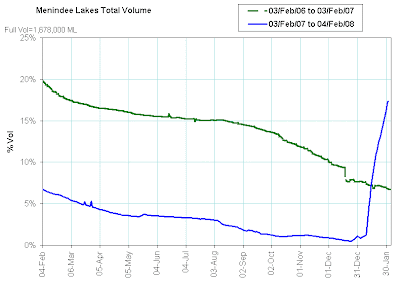
The chart below shows water held in the Menindee Lakes on the Darling River. Storage here depends upon rainfall far up-stream in the headwater rivers. Water storage, already low in February 2006, declined steadily, finally bottoming out in December 2007. You can also see the very sharp upwards spike as floodwaters from New England and Southern Queensland finally arrived. As at today, the Australian Bureau of Metereology has flood warnings out for the Condamine-Balonne, Macintyre, Castlereagh, Warrego and Paroo Rivers. All these rivers feed into the Darling River, so levels far downstream at Lake Menindee should continue to rise.

But will the rains continue? Here the Bureau's latest projections for the period February to April 2008 suggest some weakening, with 50/50 chances of above or below average rainfall. I will be interested to see the next projections due to be released end February.

The breaking drought links to two issues that I have been meaning to write about.

The first is Australian food prices. The few earlier posts that I wrote on this continue to draw hits. There is a fair bit of interest out there in information about food prices.

The second issue is the major increase in food prices internationally. Even though Australia is a major food producer, high international prices still feed through into local supermarket prices.

On the surface, there appears to have been a very major structural shift in the terms of trade for primary products due to two very different things.

The first is simply an emerging global imbalance between population growth and food production. The second is changing consumption patterns in India and China associated with rising incomes. As in so many areas of global life, this is feeding through into increased global demand.

Australia remains a very lucky country, short term issues such as inflation notwithstanding.

Back in October 2006 in Water, Drought and the Environment - working from facts I discussed Australia's continued real dependence on agricultural and mining exports. I haven't checked the latest stats, but I do not think that the position has changed.

In the past this made for considerable economic vulnerability. At one level this is still true. But just for the present, the outlook remains good for key export products.

In my last Saturday Morning Musings, I talked about some searches I had been doing on the Dainggatti people. The following day in Report of the NSW Aborigines Welfare Board, year ended 30 June 1940 I looked at an official report at a pivotal time in evolving attitudes and policies in NSW towards our Aboriginal peoples.

In today's Australian, Keith Windschuttle had an opinion piece on the curent apology issue. If you can get below the rant, and I admit that's very hard to do, to the underlying evidence he presents, you will see that he is addressing the same type of issue that I was raising in my post on the Board's report.

At present it is absolutely impossible to have any sensible discussion on the evolution and impact of official policy towards our Aboriginal people. It's all too sensitive.

Yesterday, as a case in point, I happened to mention the NSW report in discussion. All I said was that there was an asymetry between the stats in the report and some of the "stolen generation"' discussion. I had my head bitten off.

I have made my own position on the sorry question very clear. I support an apology. I did not just come to this position. I had to work it through.

Further, I came to it in spite of, not because of, some of the arguments on the sorry side. I see many of these as a-historical and wrong. Because of this, my instinctive reaction was to oppose an apology.

I do not know how long it will be before we can have a proper discussion on the history of our Aboriginal peoples in the post 1788 period. Thirty years perhaps? Things are presently just too twisted.

I am an insatiably curious person who just wants to understand. I am also a person inclined to question any current orthodoxy. So what do I do in the current climate? Do I put all Aboriginal history or policy aside as just too hard?

The answer is no, but I am trying to focus what I say and do in areas where I can make a contribution. I am also focusing on those things in which I am interested.

This is not, as some of it may seem, all pontification or academic clap trap.

Last year I worked for a brief period with an Aboriginal colleague from New England. Both smokers, we used to coincide outside the office in that small social world occupied by smokers. I could at least talk to her about her area and people. I learned, but then so did she simply because I had researched her group. We could talk.

Then the post I did on CHIP meant that I could supply a copy of the report plus supporting data to a colleague who had to do some work on the issue. This had no affect on the discussion, simply reduced search time.

I suppose my point in all this is that I feel helpless in the face of the broader discussion. I don't want to play there. I want to play where what I say may have some impact.

I would much prefer to write about the Dainggati, for example, where I can satisfy my own curiosity while also helping those who have some connection or interest.

Postscript

Re-reading the last bit, I am not sure that I have the tone right. I am not shooting at anybody in particular. I just find the present tone of the discussion very difficult in a personal sense.

Examined independently and objectively, there are many things to be sorry about in the way that our indigenous peoples were treated. Yet there are also many ways in which the story can be presented.

I really want to know the story, what actually happened and why. I find it difficult when I have to deal with today's overlays on the story because, at least as I see it, this detracts from the story itself.

Tuesday, February 05, 2008

The ABC of Cultural Change

It is coming up on twelve months since I wrote my post on Quong Tart and the Chinese in Australia, a post triggered in part by a lion dance done to celebrate Chinese new year. In the post I also referred to the arrival of visitor 10,000.

Now we are coming up on Chinese new year again. Visitor 23,000 arrived this morning - someone from Holland searching via Google on Jeff Dunham: he/she only stayed for a mili-second. Still, welcome. And something has happened that made me laugh, while reminding me of the complexity of Australian society.

Last week I was chatting to a Chinese colleague. Active in a Church group, she had taken out two very different groups into the bush.

Now she had just started the story when she used the phrase ABC. From the context this seemed to be a phrase that I knew from my past, one that I had stopped using in this sensitive age because I wasn't sure that it was acceptable anymore.

Growing up, we used the phrase ABC - Australian Born Chinese - to describe a locally born Chinese as compared to one coming from overseas, an immigrant. Now the phrase was descriptive, but even so. So, very tentatively, I said do you mean Australian Born Chinese. The answer was yes.

Turns out my colleague was leading these two very different groups into the bush. The overseas born group in soft shoes straggled along, the ABC's strode forward.

There was a creek at the end of the walk. The ABC's waded over and set up on the other side. The oveseas born said why, let's stop here!

A little later I was listening to a radio discussion about Sydney's Chinese New Year festival. The two organisers were both ABCs, both used the term. So I guess its okay.

A postscript.

Last night was very wet in Sydney. My colleague and her mum and had spent the night bailing to stop water flooding the house. At lunchtime, she went out and bought a small pump! Her mum was not impressed.

I commented that she could always use the pump (it was very small) to spray people. She looked at me and said that Chinese people did not like water. There was a pause. Then she said maybe the ABCs would like it!

Sunday, February 03, 2008

Report of the NSW Aborigines Welfare Board, year ended 30 June 1940

I had not intended to do another post, I am meant to be having a break on this blog, but in my searching I came across the report of the NSW Aborigines Welfare Board for the year ended 30 June 1940. I thought that some readers at least might find an overview of the report interesting. You can find the full report here.

Background

At the time of this report, the United Australia Party/Country Party Coalition Government that had been in power since 1932 was coming to the end, going down to electoral disaster on 10 May 1941 . Watched in glum silence by the Country Party, the UAP (the then Liberal equivalent) had been tearing itself apart through infighting and leadership rivalries.

Over the previous eight years, NSW had gone from depression through recovery to war. Constrained at the beginning and end of its term through external events, the Government had still overseen considerable change in NSW.

This was also a period in which attitudes towards the Aborigines began to shift, partially through the influence of Professor A P Elkin.

Formation of the Aboriginal Welfare Board

In 1937 a Parliamentary Select Committee had been formed to inquire into the administation of the former Aborigines Protection Board. While it did hold hearings, the Committee apparently lapsed (I have not checked the reasons) early in 1938. In its place, the Public Service Board was asked to carry out a detailed investigation.

Following a detailed investigation of the Board's activities both as regards Head Office Administration and the conduct of its Stations, Reserves and Homes, the Public Service Board recommended changes including:

(1) Amendment of the Aboriginal Protection Act to provide for reconstitution of the Board and the appointment of a Superintendent who would be Senior Officer of the Board's staff and an executive member of the Board.

(2) Reorganisation of staffing arrangements, including the separation of the duties of Manager and Teacher on the larger stations and the appointment, as far as possible, of fully qualified teachers. Board staff should be subject to the provisions of the Public Service Act.

(3) The development of the Stations to their fullest extent for the production of crops and foodstuffs as a means of augmenting the diet of the aborigines and training them in rural pursuits.

(4) The provision of additional funds over a period of years to enable the organisation of a planned building campaign, with a view to improving the housing conditions and the provision of other necessary building.

(5) The incorporation of a policy which would result in the gradual assimilation of aborigines into the general and social life of the general community, special attention being given to each individual aboriginal familty and their suitability for assimilation by virtue of education, training and personal qualities.

Other recommendations covered such matters as health and hygiene, education and training, issue of food and clothing and the administration of family endowment.

Some recommendations were implemented immediately, but it was not until 14 June 1940 following passage of legislation in May that the Aboriginal Protection Board was abolished and replaced by the new Aboriginal Welfare Board. Professor Elkin was one of its members.

At the time of this report, the Board had been in existence only a few weeks and had yet to define its policy; the report "is confined to matters of a general and statistical nature."

Those "matters of a general nature" will seem very familiar to a modern reader.

NSW's Aboriginal Population

According to a census conducted by the Government Statistician on 30 June 1940, the number of Aborigines in NSW was 10,861, up from 9,831 in 1931. Of this group, 690 were full blood.

In all, 3,068 Aborigines resided on stations, 2,121 on reserves, with 5,569 living privately, residing in camps or pursuing a nomadic existence.

Housing

The Board notes that for 'many years past, the provision of housing accommodation for aborigines, both on and off the Reserves, had been regarded as one of the most urgently important of the Board's administration." Pointing to past inadequate funds for housing purposes, the Board expresses the hope that adequate funding will be made available.

Health and Hygiene

The Board notes that in recent years increasing attention has been paid to the necessity of safeguarding the health of aborigines throughout the state. "Aborigines, as citizens of the State, are entitled to receive the same medical attention in public hospitals as any other member of the community."

In a rather startling comment, the Board reports that medical officers from the Health Department had made a survey of of the general state of health of most Stations. While "many important recommendations were made concerning housing, sanitation and other important matters, it was interesting to note that the health of of the aborigines generally compares very favourably with that of the white community."

Mind you, this was not necessarily the case in town camps. Still, it is startling.

The Board was concerned with the high incidence of dental caries. A small grant had been obtained during year to allow dental work to be carried out on stations and some reserves. Aborigines living in or near Sydney could access free dental care from the United Dental Hospital.

Children's Homes and Apprenticeships

"The care of aboriginal children committed to the Board's care because of cruely, neglect or loss of parents, is still regarded by the Board as one of the very important features of its administration."

"All children received into the Homes are admitted either by the consent of the parents or next of kin, or by committal by a duly constituted Children's Court, after the circumstances have been investigated."

As at 30 June 1940, there were 2,312 Aboriginal children in NSW of which 98 were classified as full blood.

At 30 June 1940, there were 40 girls at the Cootamundra Girls' Training Home, of which 7 were under school age, 26 of school age, 7 over school age. During the year there were 3 admissions and 2 departures.

As at 30 June 1940, there were 43 boys at the Kinchella Boys' Training Home near Kempsey. Of these, 40 were of school age, 3 over school age. During the year there was 1 admission, 1 departure.

As of 30 June 1940, there were 21 children ranging from babies up to 10 years (13 boys, 8 girls) at the Bombaderry Children's Home run by the United Aborigines Mission.

Under the Act and Regulations, the Board "may by indenture apprentice an Aboriginal child to an approved master. Every child so apprenticed is under the supervision of the Board." This is the type of apprenticeship I described in my post on the NSW child welfare system.

The Report notes that in recent years most of those who have become apprenticed to employment have been sent out from Cootamundra or Kinchella after having reached the age of 14 and a half to 15.

As at 30 June 1940, there were 10 male and 40 female apprentices. During the year 19 people were apprenticed, nine terminated their apprenticeship. The report noted that the "Board intends to revise the arrangements for apprenticeships, so that the conditions will be similar to those laid down by the Child Welfare Department for white children."

I should note that there is no reference in the Board's report to foster care. I have not checked Child Welfare records, so I do not know the incidence here (if any) under the ordinary child welfare system.

Education

I plan to do a fuller post on education. For the moment, I would just note that the new Act transferred the responsibility for the education of aboriginal children from the Board to the State Education Department.

Stations, Reserves and Camps

As at 30 June 1940, the Board had 19 Aboriginal Stations under its control spread across the State, varying in area from 50 to 4,500 acres with aboriginal populations ranging from 60 to 300.

The report records the Board's reluctance to establish new Aboriginal stations -

"the Board is well aware of the desirability for restricting the expansion of its aboriginal settlement and prefers to see a decrease in the aboriginal population under its control, rather than the reverse, provided of course that such families who leave the Board's control establish themselves under satisfactory conditions in the general community."

During the year, stations at Kyogle and Ulgundahi Island (Clarence River) were closed because a drop in numbers below 60 meant that it was no longer economic to maintain resident oversight.

At Menindee, unsaitsfactory conditions led to the decision to build a new station. The site was chosen taking into account 'the wishes of the people, fertility of the area, proximity to employment and economy in administration."

A new station was opened at Boggabilla with 31 homes, some four roomed, some three, together with an up to date school, officers' residence, store and other offices. Funding was obtained to create a new station at Walgett.

As at 30 June 1940, there were fifty Reserves throughout the State. "In general, these reserves carry aboriginal families who prefer to live their own lives away from the control of Station Management."

It is clear from the wording that the Board had in mind a process in which people would move from Stations into the broader community with the reserves as a possible intermediate step.

This left the problem of the town camps. The report describes them this way:

On the outskirts of certain country towns throughout the State, aborigines exist in camps under unsatisfactory conditions, their dwellings usually being shacks of flattened kerosene tins and bagging, similar to many of the habitations constructed by unemployed whites in similar locations. These aborigines always constitute a difficult problem for the Board for generally they resent any attempt to place them under control on Stations, and prefer to live under sordid conditions, whilst enjoying the proximity to the town and its amenities.

Councils placed pressure on the Board to act to shift the people. The Board was clearly very reluctant ineed to take any action, although in cases brought to its notice it would try tp persuade people to consider removal to an Aboriginal Station.

The report finishes on a plaintive note:

The task of caring for the aborigines of this State is no easy one; indeed, it may be regarded as one of the most difficult to adminster of all the Social services. A considerable amount of publicity and criticism has been hurled at the Board in past years, but it is pointed out that the Board is doing its utmost with the funds at its disposal for the good of people placed under its care. Whilst criticism of a constructive nature is welcomed, the co-operation of the general public must be regarded as essential to the successful execution of the Board's responsibilities.

Postscript

Please do not construe this post as a contribution to the sorry discussion. I have said all along that one needed to look at the variety of the Australian Aboriginal experience.

What the post does do is to present a snapshot of the official position at a point in time, an important point, but still a point. There are issues raised by the Board's report that interest me and which warrant further investigation. At this point, I would only say that it is a helpful caution about some of the more sweeping universalist views.

Saturday, February 02, 2008

Saturday Morning Musings


Photo: Burnt Bridge Aboriginal Reserve school class.

This really should be Saturday afternoon musings. I have been gardening, driven in doors by the heat.

Dear I find it hard to stay cranky with Neil. I was just about to berate him over Go to the top of the class, Ifan Yusuf! when I noticed that he had had my name translated into Chinese. The post here (I am an add on) is worth a read. Certainly it made me laugh.

In terms of my Chinese name, I do like the translation of Jim as peaceful visionary. I would like to think that it is true!

Why was I cranky with Neil? I thought that Yusuf's post and Neil's support added little to the discussion on the sorry issue.

In the meantime, I have been involved in something a little different.

A while ago Rhonda came in with a comment on an earlier stocktake post I had done on my posts about New England's Aboriginal peoples. She wrote in part:

Thank you for pulling all of your aboriginal posts together, it will make it easier for me to read up on the history. My mothers adopted family were based in the New England area and I always thought they were Biripi but was corrected by a cousin in Kempsey quiet a few years ago that they were in fact Daingatti, I haven't had the opportunity to really venture into the history as it is so difficult to trace. My gran was born in 1913 at the Railway Reserve, Walcha.

When I looked at Rhonda's material, the thing that interested and to a degree puzzled me (as it did Rhonda) was the fact that an Aboriginal women legally adopted a white baby at a time covered by the stolen generation in NSW.

I cannot resolve this without a fair bit of work. However, what I thought that I could do for Rhonda was to look further at the Dainggatti, their history and their linkages with the New England Tablelands. Here I was influenced by another comment on my post on Malcolm Calley, Anthropology and Australia's Aborigines.

C wrote:

Hi Jim,

I am interested in what you have been writing here. I live in Armidale and have done some research and writing in a grad dip on the local Aboriginal people. Particually the role of the Catholic church here in the mid 50s onwards in providing support for the people living in east Armidale. I feel that Armidale is unique. So much culture has been retained that people don't see. They still meet and camp down at a river site towards the coast as their ancestors have done for centuries.

I too get frustrated with the reactions from the general public in response to some history writing or the issue of welfare payments and other financial assistance.

My husband works with Aboriginal youth through sport on an voluntary basis and
has made many friendships and contacts in the community. They are a strong people.

In response, I wrote:

This is fascinating C. I would love to hear more about your research.

I do not think that Armidale is unique in the retention of historical memories by local aborigines, I think that is also true of other areas.

Armidale may, however, be unusual if not unique in the nature of interactions between the aboriginal and non-aboriginal community.

I am not suggesting that this is in any way perfect. After all, I grew up in Armidale during the fifties, so remember the original shanty settlement in East Armidale.

I do have a strong feeling, however, that Armidale's traditional aboriginal families have achieved a degree of community prominence and at an earlier date than seems to have happened in many other places.

C responded:

The great thing about this area is that although there were many experiences of families being held in missions such as bellbrook and burnt bridge at Kempsey, the family and tribal groups have largely been held together. Many families moved to Armidale from the coast and Bellbrook in 1956 when you would remember a surge in the numbers on the town dump over east side.

We spent 6 years in Wagga where I taught as a casual teacher. The Aboriginal people there had suffered more dislocation through the housing commission's policies of the 1960s-70s and through the removal of children prior to that. There were a few elders who had been through Cootamundra Girls Home. Although there were many Wiradjurri people, they were from many different areas within that nation. From Yorta Yorta as well.

Armidale is a great place to live. For me with my interests in helping Aboriginal youth, I couldnt be happier and we hope to stay here for a good while. The kids here are very easy to get along with.I came to Armidale to go to uni up here in '89 and have spent most of my time here since.

Now there is a lot of insight in C's response, things that interest me in thinking about the Aborigines as a people, more correctly peoples.

One was the way in which at least some of New England's Aboriginal peoples have been able to retain their linkages with the past.

Part of the reason for this is that Aboriginal numbers in New England - remember that I am talking about the broader New England, not just the Tablelands - were so large. In resource terms, New England's coastal strip was the wealthiest area in NSW at the time of European intrusion.

I think that part of the reason also lies in the possibility that there were simply more refuge areas available. Today, we are used to thinking of the North Coast as a high population growth area. This was not always the case.

As recently as the 1950s, the major towns on the coast and inland were comparable in size. The huge coastal population grow is relatively recent. Today, New England's coastal Aborigines risk being squeezed out, again made strangers in their own land, by urban development and rising house prices.

I do clearly remember the sharp increase in Armidale's Aboriginal population during the 1950s that C referred to. Suddenly, we went from a small Aboriginal presence to one that was quite noticeable. Today the same thing is happening again, with in-migration from the west.

But why did it happen in the 1950s? And why were the people all apparently drawn from one tribal group, the Dainggatti?

Now this is where I return to my response to Rhonda's comment. Here I have begun putting up a series on the New England's History blog. These are something of a pot pouri, but even at this stage some patterns emerge.

The first post I put up was New England's Aboriginal languages. This repeated a map that I had put up earlier, this time with a supporting discussion on geography.

If you look at the map, you can see the heavy concentration of Aboriginal languages on the North Coast centred on the river valleys and adjacent headwaters.

The Dainggatti themselves occupy the Macleay Valley. Now the headwaters of this river lie on the Tablelands between Armidale and Walcha. In a direct line, the Upper Macleay in particular is not far from Armidale. Groups from the Upper Macleay would certainly have visited the Tablelands.

The next post I put up was Emma Jane Callaghan (1884- 1979) - Aboriginal nurse and midwife. Born at la Perouse, Emma Callaghan moved to the Nulla Nulla Aboriginal Reserve at Bellbrook in the Upper Macleay around 1905. There she played a major role in trying to improve conditions, marrying a local in 1909.

In 1928 she moved to Armidale to be closer to medical facilities for her husband who was suffering from TB. There she continued her role.

Finding that Aborigines were living in appalling conditions on the fringes of the town, she lobbied the mayor and the Anglican bishop until her family obtained a house. Her home soon became an impromptu hospital; she practised as midwife to her people and nursed them without charge. Dr Ellen Kent Hughes visited the Callaghans' home to see patients and any local Aboriginal family in need of treatment. Highly respected among the White community, Emma encountered no personal prejudice.

From Armidale Emma returned to Sydney. There she maintained her role with her people, but passes out of my immediate story.

Since I knew Kenty, Dr Kent Hughes, my next post was Kenty - Ellen Mary Kent Hughes (1893-1879), medical practioner and alderman. From the time of her arrival in Armidale in 1928 to her death, Dr Kent Hughes provided medical services to the Aboriginal community. In 1968 she was awarded an OBE in part for her services to Aborginal children. In 1975 she was awarded the freedom of the city because of her services to the community including her role in local government.

My next post was Pat (Patricia) Dixon (?-2001). I must flesh that title out.

A Dainggatti woman, Pat Dixon was born on the Macleay River near Kempsey and raised on a reserve near Bellbrook, presumably the Nulla Nulla Reserve. After a period working in domestic service in Sydney, Pat and her husband moved to Armidale where Pat worked as a cleaner. I am not sure of the date, but I am guessing late sixties, early seventies.

From the 1970s Pat became active in Labor politics. In 1983 she was elected to Armidale City Council, becoming the first Aboriginal person elected to a local council in NSW. In all, Pat spent over 17 years on the Armidale City Council as a member including, for three years, Deputy Mayor.

In addition to her party and community roles, Pat campaigned with with Lowitje (Lois) O’Donoghue to increase the number of Aboriginal people participating in local government. Here she saw the numbers of Aboriginal people participating in local councils nationally build to over 600 in 1998. At the time of her death in 2001, she was the endorsed Labor candidate for the Federal seat of New England, the first Aboriginal candidate endorsed by the ALP for a Federal seat.

Even at this early stage in the series, we can see the linkages between Armidale and the Aboriginal people of the Upper Macleay in particular. We can also see, I think, some of the deep texture of the life of New England's Aboriginal people.

However, I am also having some problems with material because of distortions caused by discussions in recent years on Aboriginal/non-Aboriginal relations. This affects both Aboriginal oral memory and writings about the Aborigines.

To a degree I have to accept things because I am trying to put together an overview and am therefore reliant on secondary sources. However, I am hopeful that I can balance this with specific spot-checks.

Despite any problems, I am finding the research very interesting. I am also finding my knowledge of the area, as well as my own past research and writing, a considerable aid in defining questions and issues.

Friday, February 01, 2008

Blog Performances January 2008

Overall total visitor numbers across the blogs follow as at end January. The totals exclude my own visits.

Assuming my maths is correct, early morning calculations are not always accurate, total visitor numbers of 3,656 were well up on the previous month's 2,844, back to the level of November -3,612. December 2006 saw the same type of decline.

Page views in January were 9,485 as compared to 7,447 in December, November 9,239. Since November was a record, I have held at the higher level.

Small beer I know in the wide world of blogging, but still okay.

I have been through performance blog by blog, but I won't bore you with this. I do intend, however, to make some minor changes in focus and posting patterns to fix up obvious problems.