Interesting piece on the Indi grassroots campaign by Barrie Cassidy,The story of how Cathy McGowan stormed Indi. There were a couple of points in the story where I disagreed with his analysis, I might pick them up later, but it's well worth a read as as a case study in grass roots politics.
Monday, September 16, 2013


Sunday, September 15, 2013
Sunday snippets - crisis response to the GFC, the Australian party system with a dash of rising sea levels
Quite a gripping piece in the Sydney Morning Herald by Elizabeth Knight, 'They came with suitcases for cash': Westpac chief. The introduction follows. Its worth a browse.
Westpac boss Gail Kelly has described scenes of customers arriving at bank branches with suitcases looking to withdraw their cash as the global financial crisis hit its nadir five years ago.
On the fifth anniversary of the collapse of US investment banking giant Lehman Brothers, Ms Kelly reveals the depth of Westpac's concerns, its crisis management and the extent of collaboration between the big four bank chiefs, government and the Reserve Bank.
I was in China that September as handbag at, of all things, an international conference of insolvency practitioners where my wife was a delegate. As the situation worsened, those attending started to leave, called back to their various home bases. Crises are good for the insolvency business.
I remember being surprised when I got back to Australia at the depth of local concern. It was that that really drew me back into writing on economics and the economy. Elizabeth's piece shows just how close Australia came to a real bank run. It also shows the strength of the Australian system.
Moving to current times, Don Aitkin has run two pieces (Is Labor the true dynamo of Australian politics? and Is Labor the true dynamo of Australian politics?) looking at the Australian party system over time. Like me, Don's formative roots actually lie in the country, the world of the Country Party. Like me, he grew to early adulthood in New England; by accident of alphabet, Don was the first student enrolled at the newly autonomous University of New England.
Although I disagreed with him on certain points, more as I came to know more, Don had a big impact on my thinking. In the seventies there was a flowering of books on the Australian country and country movements. This was work written from a non or even anti metro perspective, an exploration of ideas and politics outside the bounds set by Australia's big metro centres that generally, dominate Australian thought and politics.
I do wonder about Don's typology though, especially when it comes to the definition of conservative. It seems to me that that's shifted, that the old classifications may no longer be relevant.
Changing directions, over on Northern River geology, Rod Holland had a short piece on fluctuating sea levels on the North Coast, A history of unstable North Coast sea levels?. We saw a little of the importance of changing climate and sea levels in the ABC First Footprints series. Looking at layers in the coastal dunes revealed by erosion, Rod wondered about higher sea levels during the Holocene period:
According to Baker et al (2001a & 2001b) the last time the sea level was 1 metre higher than present was around 2400-1800 years ago. Maybe, the layer is a preserved berm from a beach that existed at the time of the Roman Empire (sometimes referred to as the Roman Warm Period). I don’t know for sure, but to my thinking it seems quite plausible.
I have a professional if still poorly informed interest in this type of thing because it affects the first part of the major history that I am trying to write. However, one doesn't have to be a believe or a sceptic in human induced climate change to understand that sea levels can vary. A return to the sea levels holding 2,000 years would indeed have quite a dramatic impact on the Australian coast line!
Thursday, September 12, 2013
Equality vs equality of opportunity - a past debate
Tonight a very short muse flowing from Indi, Mirabella & the decline of the welfare state. There I said in part:
The underlying idea of the growth of the welfare state is quite popular. However, I think that it's also wrong. The welfare state as envisaged at the end of the Second World war died during the 1970s. We actually live in a post-welfare state world in which the fight is no longer over the concept of cradle to the grave security, that's dead, nor even over the idea of a proper safety net for the poorest; that's dead too.
In 2006, I explored some of these issues in a series of post on changing approaches to public administration since the Second World War. I didn't have time this morning to go back and check that earlier writing. I will do so later. I think that it's helpful to put some of these discussions in an historical context. Sophie Mirabella is actually a good example of the nature of the ideological changes that have taken place.
Some of my past writing that I looked at I find to be very good; useful explorations of the changing patterns of ideas.S ome I find confused.
One confusion, and it has a certain relevance today, lies in the conflation of ideas about the welfare state with ideas about the role of Government. In that past thinking, I mixed together under the welfare state rubric ideas from the left about things such as government ownership or the broad role of Government in the economy with very different ideas connected with welfare.
The meaning to be attached to the words welfare state is not the same as big government, nor an activist role for government in the broad sense. You can accept the idea of a welfare state without supporting either, although welfare state certainly implies a bigger government than would otherwise be the case.
In reflecting on train and bus, I was drawn back to intellectual and political debates of the first half of the 1970s, to the distinction between equality and opportunity. We were Country Party radicals wishing to reform the Party.In doing so, we drew a distinction between equality, a Labor View, and equality of opportunity, a Country Party position. In bias terms, I didn't see the Liberals as supporting equality of opportunity. How could they?, for in practical terms the outcome of their positions was the protection of privilege, of the majority, the advantaging of those who at that point were big and had an edge.
But what was equality of opportunity? What did it actually mean in terms of policy stances?
This is a debate that's largely dead, that's gone. We do talk, for example, about bridging the gap where a particular group has become really disadvantaged. But we don't talk about equality of opportunity and what it means, of the role of government in bringing it about. That belongs to a past age.
I think that its time to bring it back.
Postscript:
In a tweet, NSW National MP Jenny Gardiner wrote:
@JimBelshaw Indeed. Maybe what John Anderson did re Maths skills for country kids & Piccoli's agenda hark back to equality of opportunity?
Indeed!
Wikipedia defines welfare state in these terms:
A welfare state is a "concept of government in which the state plays a key role in the protection and promotion of the economic and social well-being of its citizens. It is based on the principles of equality of opportunity, equitable distribution of wealth, and public responsibility for those unable to avail themselves of the minimal provisions for a good life. The general term may cover a variety of forms of economic and social organization.
The difficulty I have with this definition, the cause of what I see as the confusion in my earlier writing, lies in the way it mixes different things together; protection and promotion of the economic and social well-being of its citizens; equality of opportunity and equitable distribution of wealth (equality); and the minimal provisions for a good life (safety net). I have bolded the ands to draw out very different threads that can conflict.
Postscript 2

In a comment, anon drew my attention to this cartoon that, he suggested, provided a conservative view of equality of opportunity. I have saved it primarily as an example illustration to use in some of my management writing.
Now this cartoon actually says nothing about equality, rather that different people have different skills.
Wednesday, September 11, 2013
Indi, Mirabella & the decline of the welfare state
Here down under, vote counting continues. In the Victorian seat of Indi, Liberal front bencher and right ideological warrior Sophie Mirabella is struggling to catch independent Cathy McGowan. If the latest comments on William Bowe's Indi post are correct, and he has some very well informed commenters, it would appear that Ms Mirabella still has a chance of catching up. It must be hot in the room, though, with various party scrutineers outnumbering those counting three to one!
Mr Abbott has apparently delayed the finalisation of his ministry until the results in Indi are known. However, even if Ms Mirabella is returned and joins the ministry, she is going to have to devote time to her seat and probably tone down her rhetoric. In a piece in The Age, Tony Wright commented:
The Liberals' Sophie Mirabella, having clean forgotten, or having never quite learnt, that country people tend to like their conservatives to be local and non-combustible rather than imported firebrands, now sits nervously, Indi just beyond her grasp.
There is some truth in that, but it also arguably misses a key point. Yes, on the ABC's Vote Compass, Indi does sit somewhat to the right on the political spectrum, although there are more right leaning seats in both city and country. However, on my measure Ms Mirabella is not a conservative in the old fashioned sense, but something of a hardline right radical. I suspect that both her views and the trenchant way she expresses sit somewhat uncomfortably with local perceptions.
On other election matters, in How much will the change of government change Australia? Winton Bates follows up on a post of mine, What can we expect of a new Coalition Government?. Winton is just back from a month in Britain and Ireland, lucky so and so, so missed the actual election campaign. Winton's main conclusion is summarised in this quote:
The main change the Abbott government seems likely to bring about is a return to more orderly government processes. In that respect, the contribution of the new government could be quite similar to that of the Fraser government in the 1970s, which brought to an end the chaos of the Whitlam years. In fact, the more I think about it the more I think that, with the exception of policies toward asylum seekers, the Abbott government could end up looking quite similar to the Fraser government. There will be plenty of talk about tough decisions, but I don’t think there is likely to be much action.
I have some sympathy with this view, although in governance terms I don't think that the Rudd-Gillard government was anywhere near the chaos of the Whitlam period in either a policy or day to day operational sense. The instability was in the Labor party itself. However, Winton also commented in passing:
Perhaps the government will move on tax reform in its second term of office. But the most likely outcome will be a higher rate of GST to raise more revenue. If we continue to drift toward a European style welfare state, we will need a European style tax system to fund it!
The underlying idea of the growth of the welfare state is quite popular. However, I think that it's also wrong. The welfare state as envisaged at the end of the Second World war died during the 1970s. We actually live in a post-welfare state world in which the fight is no longer over the concept of cradle to the grave security, that's dead, nor even over the idea of a proper safety net for the poorest; that's dead too.
In 2006, I explored some of these issues in a series of post on changing approaches to public administration since the Second World War. I didn't have time this morning to go back and check that earlier writing. I will do so later. I think that it's helpful to put some of these discussions in an historical context. Sophie Mirabella is actually a good example of the nature of the ideological changes that have taken place.
Postscript
The discovery of a packet of missing votes in Indi seems to have swung the battle there to Cathy McGowan. From my experience as a scrutineer, the Australian counting process is absolutely meticulous, with an internal number checking process designed to prevent or reveal just this type of error. Lot of commentary and some surprise at the way some local Nationals appear to have supported Ms McGowan. It shouldn't surprise. Many Nationals still feel that the Libs stole this seat.
On the welfare state, I will try to bring this up Friday (I have another book chapter to try to complete before then), I should note my approach. The question of whether or not the welfare state died during the 1970s or, perhaps, simply changed its form is a factual one that stands independent of a second question, whether the changes are a good or bad thing. My focus is on the first, although the second comes in as well.
Tuesday, September 10, 2013
Australian election 2013 - welcoming minority sucess
I took a certain pleasure from the Australian election results, although the final outcome is still uncertain. Obviously the Coalition has won government, but it's the final mix of results in both houses that's still unclear.
I am not close enough now to the detail of counting to comment as anything approaching an expert. However, the thing that i notice in the House of Representative seats is the large number of votes still to be counted. Consider the seat of Fairfax where Mr Palmer is presently leading on a two party preferred basis. There appear to be between 6 and 7,000 votes still to be counted. In the Victorian seat of Indi where the Australian Electoral Commission figures show independent Cathy McGowan leading Liberal Sophie Mirabella on a two party preferred basis, there are also an unknown number of postal and pre-poll votes.
The position in the Senate is still more complex, with the vote at a much earlier stage. I actually have no idea what the final Senate mix will be. As we have seen in previous elections, results are likely to vary quite a bit as the voting proceeds. Anthony Green's Senate calculator may be fun, but it can also mislead. And as an aside, am I alone in thinking that the post-poll coverage of the actual results of the voting has been very poor? At least in the on-line main stream media, there has been damn all coverage that i can find of progressive voting in safe seats. We are forced back to inimitable blooger William Bowe for at least some detail.
So far, this has been an outcome that has dissatisfied most in some way, satisfied most in other ways. The main reaction from Labor supporters seems to be an overwhelming sense of relief that things weren't worse. Labor post vote parties became celebrations as total rout was avoided. There was also a feeling among many that the vote provided an opportunity to put the dysfunctional instability of the Rudd-Gillard era aside.
The Liberals are obviously pleased to be in Government, if disappointed with aspects of the vote and especially the likely Senate outcomes. Both Liberal and Labor suffer from the political equivalent of the divine right of kings; I have a mandate (whatever that may be) Mr Abbott tried to tell the yet to be finalised Senate, so get out of my way. Things don't work like that. We have a mandate from our voters, replied Labor and the Greens.
In aggregate voting terms, the Greens did quite poorly. However, they went into this election fearing the loss of their one lower house seat plus senators. The Green vote may have gone down, but they consolidated their parliamentary position. Melbourne now looks like a safe Green seat. That's quite a remarkable achievement, by the way. The Nationals take pleasure in recovering their Northern New South Wales heartland, yet the Party failed in WA and also has to accept that the Northern New South Wales seat of Richmond has become a safe Labor seat with a very strong Green tinge.
One of the reasons why change of Government is so important from time to time lies in the way it allows alternative positions their place in the sun. This year, the Australian Broadcasting Commission's Vote Compass provided a remarkably good if high level picture of the geographic dispersion of views across Australia. The views held in Sydney seats such as Wentworth, Kingsford Smith and especially Grayndler (the most left leaning seat in the country) are not representative of the national position. Further, just because a majority of views support one position (action on climate change, support for gay marriage for example) doesn't make it so. The intensity of support or opposition is also important.
Politics is all about accommodation of differing views, an accommodation that takes place against slowly shifting shifting perceptions in the broader electorate. Different things are tried. Some fail on practical grounds, some on political grounds.
Labor didn't deserve to win this time. Labor minister Tanya Plibersek put it this way. We could govern the country, we couldn't govern ourselves. The new Coalition Government will bring new approaches. Some (Stop the Boats) I disagree with as expressed on value grounds. Some (direct action on climate change) I object to on practical grounds. Some, indigenous recognition in the constitution, I agree with. Regardless of my views for or against, things will work themselves out in practice.
On the voting so far, the big and somewhat unexpected winners were the Liberal Democrats, a libertarian party. Their success was less than the Palmer United Party, but they didn't have lots of money. Media responses here have treated the Liberal Democrats as another new fringe group. They are fringe, but not new for as a party they have been around since 2001 with an intellectual tradition dating long before this. They are also more prominent in the bloggosphere than in the rest of the world. Think skepticlawyer or Catallaxy.
I welcome the possible presence in the Senate of the Liberal Democrats, or indeed other minor parties including the Palmer United Party even though I might disagree with their views. Why?
in institutional terms, we live in an increasingly rigid and indeed sclerotic system in which the need for order and consistency presses heavily on our capacity to bring about any form of change. I have tried to argue against this in rational terms, presenting evidence as best I can. This doesn't work very well. Maybe the change in electoral mix and the need for the political system to adjust will help.
I may disagree with the results of all this. But then, in our system I have a chance to present an alternative view. And that's our strength.
Sunday, September 08, 2013
Saturday at the football - and TAS wins the NSW GPS thirds
A hot day yesterday in Sydney for the football and election. I wandered off to see TAS (The Armidale School) play Newington in the last game of the NSW GPS (Greater Public Schools) thirds competition. The game was held at Newington which was celebrating its 150th anniversary. It was a pleasant crowd sitting on the banks overlooking the main oval.
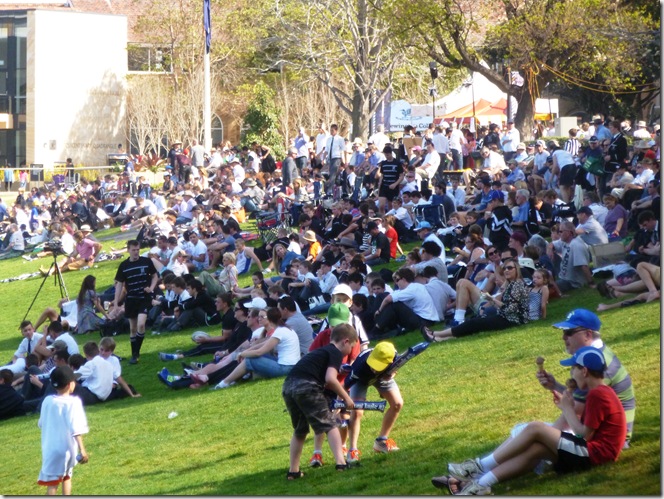
I wandered around in the bright sun eating a sausage and onion roll watching the various games. Eldest had promised to come with me to this last TAS game of the season, but had to pull out at the last moment because she was unwell.
In the first part of the Thirds game, the TA First Fifteen was clearly better than Newington Thirds, although Newington were holding them. The following photo show's TAS's first try. I fear that this round my photos were not as good as usual, but you will get the picture' 

I still had to vote, so I left the gathering. It's been a fun year.
Friday, September 06, 2013
An Australian election overview - with apologies to cricket
It is Friday evening here in Australia. Tomorrow are important events such as TAS playing Newington in the NSW GPS Rugby Thirds. My eldest daughter is coming with me to watch. That's good. Australia is also playing South Africa in the Rugby. We need a win. There is also an election on.
In this post I thought that I would try to explain the mysteries of Australian politics as clearly and as simply as I can for the benefit of international readers. Mind you, you may need a little sporting knowledge to understand.
To start with, we have two main teams. The team that is in is trying to stay in to avoid going out, the team that is out wishes to go in. To achieve this, they have to bowl the batting team out.They are playing on the main oval, the House of Representatives. However, there is a game on another oval as well, the Senate. We will come back to that in a little while.
On the main field, there are three groups. The Liberal Party used to stand on the right of the political fence and talk about the evils of the workers. The Labor Party stood on the left of the fence and talked about the evils of the workers. The Country Party now National Party sat on the fence and talked about the high cost of fencing.
The world changes. Both Liberal and Labor are worried about the working families of Australia, both are worried about the inability of the other to balance the family budget. By contrast, the National Party is worried about the high cost of combine harvesters.
Just outside the fence around the oval are a number of players trying to get into the game. The Greens have one player, although its not quite clear whether or not he is on or off the field. In any event, most of the Greens are up the trees around the oval trying to defend them from the bulldozers; the grounds need to be reshaped say some; the Greens do not agree.
Stretching around the oval on both sides of the Greens is a raggle taggle lot of would be players. One rather big group, the Palmer United Party, surrounds a plump and excitable mining magnate who has fallen in love with cricket, although he is still not very clear on the rules. By borrowing friends and staff, he has been able to put together a full scratch team. His corporate jet is parked nearby. It has brought in the advertising bill boards that ring the oval, as well as the bulldozers Mr Palmer wants to use to redefine the grounds. The Greens look on suspiciously. They know about bulldozers, if not combine harvesters.
Just to the right (or is it to left?) of the PUP crowd, a disconsolate figure wearing a big hat stands among a much smaller crowd of hatted followers. This is Bob Katter and the Katter United Party. It's really not fair, he thinks. Mr Palmer was going to join him at one point, but then decided to form his own team. He consoles himself with the thought that he and Clive have still been able to form an entertaining song and dance act that has attracted crowd attention.
Things are tense out in the oval. The game has been briefly suspended while Liberal captain Abbott argues with the the umpires, It's an arcane dispute over the rules of cricket. Mr Abbott has said he would only play if he could win the main game without bringing in players from other teams. He wouldn't play without a full team. The Umpire has noted that Mr Abbott's team appears to be a combination of two teams and therefore in breach of the rules that Mr Abbott has laid down.
Supported by his ever loyal deputy, National Party leader Warren Truss, Mr Abbott argues that we are all one team, there is no difference between us. This is an Abbott team. Mr Truss nods wisely and murmurs just so. This view does not appear to be shared by all the players. The National Party members have gathered in the gully to talk about soil erosion. Some Liberal members can be heard murmuring that the Nationals don't quite understand the rules of they game, that they don't play by Liberal rules. One Liberal looking at National candidate Barnaby Joyce is heard to remark, who does he think he is? Shane Warne?
At the batter's end, Labor leader Kevin Rudd stirs nervously. He has just come back to the captaincy after a changing room coup. He has come in to bat in the fading light with his team down, and is trying to achieve at least a draw. He pokes the wicket with his bat, and looks at the stands. Many of his team have given up, gone to the showers without waiting the results. Angry, he waves his bat at the crowd and does a little dance, trying to gather crowd support.
Meantime, over at oval two, the Senate, chaos reigns. Under the rules of Australian cricket, players on oval two can reject or amend the results of the games on oval one. The rules of team selection vary too, allowing all sorts of people to become players that would simply not be allowed in the main game. To become a player on oval one, you must win the vote in a single electorate after distribution of preferences. On oval two, each state is a single electorate with multiple members elected by a proportional preferential system.
The crowds gather around the oval fence, waiting for the signal. It's a much more varied crowd. Ex fish and chip shop owners jostle with country singers and ex-Rugby League players. All the smaller teams are there. Greens' leader Christine Milne has her prospective players and supporters out of the trees and ready to charge. Bob Katter and Clive Palmer are there too. The big parties are there, but so too are a myriad of smaller teams from Smokers Rights to Libertarians to Hunters and Fishers. The teams mingle, trying to strike preference deals before the rush for the wicket.
The bell sounds. The unruly crowd charges. The rush is on. Meantime, back on the main oval the game has been called off pending an entire new team selection process. Now we wait.
Postscript
I missed a remarkable number of typos; now corrected! In a comment, JCW drew attention to this poem. She modified it slightly, but looking at the last public opinion polls this morning, I thought that I would repeat the first two verses in unmodified form. I know that it's so very Imperial and old school, but it somehow seems appropriate. It's really about all Labor can do.
Vitai Lampada
THERE'S a breathless hush in the Close to-night -
Ten to make and the match to win -
A bumping pitch and a blinding light,
An hour to play and the last man in.
And it's not for the sake of a ribboned coat,
Or the selfish hope of a season's fame,
But his Captain's hand on his shoulder smote
"Play up! play up! and play the game!"The sand of the desert is sodden red, -
Red with the wreck of a square that broke; -
The Gatling's jammed and the colonel dead,
And the regiment blind with dust and smoke.
The river of death has brimmed his banks,
And England's far, and Honour a name,
But the voice of schoolboy rallies the ranks,
"Play up! play up! and play the game!"
Henry Newbolt
Wednesday, September 04, 2013
What can we expect of a new Coalition Government?
This is the first election in my experience in which, at the end, I don't have a real feel for the policy outcomes from the likely result. I am forced back to guesses and first principles. Still, I thought that I should put some ideas down so that you can judge their accuracy later.
Politically, the most likely outcome is a very large Coalition majority in the House of Representatives, so large that the Liberals may have a majority in their own right. The Nationals have been sidelined to some degree in this election. I don't think that they liked it very much. There has also been sniping against the Nationals on the Liberal side. Again, the Nationals didn't like that very much.
The Coalition will continue, but in my experience the closest working relations come (WA has been an interesting apparent exception) come when the Liberals cannot ignore their National brethren. Expect some tensions that will grow over the life of the next Parliament.
In the Senate, the most likely outcome is a Coalition minority. The exact effect here will depend on the final mix. However, the ability of the new Government to do what it likes will be constrained.
The budget position is reasonably difficult. The Coalition hasn't locked itself into silly surplus promises in the way Mr Swan did, but they are still locked in by their pervading rhetoric. They have very little room to move on either the tax or expenditure side. In the medium term, I expect the Australian economy to improve, with consequent improvements in the fiscal position, but that won't help in the short term.
Their position is further complicated by the myriad of foreshadowed expenditure cuts. We may not know the full details, they still haven't been released, but we know enough to know that there will be a lot. Those cuts involve pain for some, while many will require legislative change. It's also complicated by their commitments to Gonski, to NDIS and paid parental leave.
The Government also face an action/decision backlog, especially in the Commonwealth-State arena where decision making under existing agreements has been stalled for several months.This is apart from any actions required to bring their new initiatives into affect.
If you now look at the Coalition's six key priorities as defined in the little pamphlet we received through the mail or at shopping centres.
First, we have a stronger 5-Pillar economy = manufacturing innovation, advanced services, agriculture, education and research and mining exports. This will come with lower taxes, boosted productivity and more 21st century infrastructure. A Coalition Government could certainly do something about improving productivity. It could do something about improved infrastructure if it was prepared to borrow, but that's difficult. Lower taxes depend on overcoming budget constraints.
Second, the Coalition will deliver stronger borders' aka stop the boats. Leaving aside value issues or our international reputation, this one is mainly potentially costly atmospherics that stand at the left edge of key national priorities. An Abbott Government must move, but there are going to be stumbles; its been useful in campaign terms, but its actually a distraction that may have other costs.
Third, end the waste and debt. This conjoins two very different things. There is always some waste that can be cut, although its not as much as people think. Debt is very different. because that depends on revenue as much as expenditure. The main effect of this pillar will be to constrain other things that the Government might do.
Fourth, the carbon tax will be abolished. This one is a soft underbelly because it actually depends on two legs, the Government's ability to abolish the tax on one side, problems with its direction action alternative on the other. It is far from clear that the Government can abolish the tax. It is far from clear that the direct action program will work. While Mr Abbott is talking about a double dissolution if abolition of the tax is rejected, Senate obstruction may actually be a blessing in disguise for Mr Abbott in allowing him via negotiation to exit from some of the sillier aspects of his current position.
Then in fifth and sixth we have better roads and services and two million new jobs. mmm!
So what might actually happen? Assuming that the Coalition doesn't get sidetracked by its own rhetoric and by the sheer load of coming back to Government, we can expect the following:
- The new Government will focus as best it can on cost cutting, recognising that it needs to buy space for its own programs and that it needs to do that while its election is fresh. It will then move to patch up the sillier results of its actions. Take a bow, Mr Costello.
- Second. it will try to lag expenditure commitments or modify them at the margin. Parental leave will go through because the numbers are there, but beyond that?
- Third, it will focus in those area where it can get results, and that means a focus on productivity improvement.
Let's see how close I am.
Postscript
kvd found this link to an IPA document that gives the line by line Coalition costings. Have a look and see what you think. This tweet from H G Nelson made me laugh.
"
@hg_nelson12m Have I got this right? They can starve but we will get new tunnels and freeways going nowhere that will be clogged by boat people".
Seriously, do have a look at the costings. The way this election has been run, this is what we are voting for.
Meanwhile, Michael Pascoe from the Sydney Morning Herald is not impressed.
Tuesday, September 03, 2013
Australian election - the Coalition will win; the interest lies in the detail
The latest opinion polls show the continuing opposition lead in the Australian Federal election. However, the latest poll also apparently shows the strength of the Palmer United Party in Queensland, around 8%, the same as the Greens. The Queensland results also show the Katter Australian Party on 4%. The PUP campaign has been expensive, very visible and somewhat irreverent. You will get a feel here.
While I''m sure that the overall polls are right, there has been a remarkable diversion of individual voting intentions among people that I know, especially among the Labor voters. Ever heard of the Future Party? I hadn't until a younger family member suggested that I might vote for them since they had a candidate in my electorate!
Many of the Labor voting group still intend to vote Labor number 2, but cannot bring themselves to vote Labor number one. They are disengaged; many among the women were Gillard supporters. I haven't seen this level of disengagement before.
I have no idea how all this will break in the end. The national opinion polls have a very good record at tracking aggregate results in the House of Representatives: they are not so good at individual seat level, worse in the senate. Mr Abbott will win, but its the detail that counts in the longer term.
In WA, I am keeping my fingers crossed for the WA National Party. There the party is not in coalition with the Liberals. In the Northern Territory, will the First Nations Senate candidate get up? If so, it would be the first specifically Aboriginal political party to get a candidate into the national parliament. Now that Tony Windsor has backed independent Rob Taber in New England, will that translate into a stronger independent vote. \
There are all sorts of interesting competitions, if all at the margin. In terms of Government, the only question is the size of the Coalition victory. I am not going anywhere next Saturday night. Yes, I am an election tragic, I accept that!
Sunday, September 01, 2013
A morning at the rugby - TAS v Scots
it's been a gorgeous weekend here in Sydney. Yesterday I went to see TAS play Scots in the NSW GPS (Greater Public Schools) thirds competition. TAS,The Armidale School, has been a GPS member since 1897. The school's smaller size and non-metro location (TAS is the only NSW GPS school outside Sydney) makes participation in Sydney based GPS events difficult. However, this year TAS firsts have been playing in the newly created GPS Thirds, while other TAS teams have been making the trek as well.
It's a big effort. With the exception of Sydney Boys High and Sydney Grammar who come to Armidale on an annual basis, the other Sydney schools play in Armidale every second year. By contrast, the TAS teams play in Sydney on average every second week. There are fifteen players in a Rugby team plus reserves. Twelve TAS teams played against Scots Saturday. That's 180 boys plus reserves, coaches etc. Every Friday when there is a Sydney game, the boys join the buses that pull up at the front of the school for the seven hour trip to Sydney. Every Saturday after the games. they join the buses for the seven hour trip back. It's a huge effort.
Why bother? Well, it's partly tradition. But it's also the only way that the boys can get top level competition. TAS is the Australian Institute of Sport Rugby focus for Northern NSW. It draws a thousand plus boys to its local Rugby carnivals. But while still weak by Sydney standards, it is just too strong for the local competition.

Yesterday TAS won against Scots 31-22, the competition leaders. With results in other other games. TAS moved to second place, Scots to third. This is one shot I took of the game. It shows TAS defending.
I suspect that at my age one could argue against my interest in schoolboy football. But I do enjoy it.
I get depressed, mind you, at just how much better the boys are as compared to my period. I do wonder how I might have gone with today's training skills? I also get depressed at the way that professionalism and sports scholarships have entered the game. It doesn't seem right. In the end, this should be kids enjoying themselves.
Still, it was a nice afternoon. Next week is the last game in this year's comp with TAS playing Newington. Eldest daughter has promise to come with me. That will be fun its own right.
Friday, August 30, 2013
Elections, representative democracy and popular opinion
As the Australian Federal election campaign enters its last week, both sides are attempting to appeal to what they perceive as popular topics with particular slices of the Australian population. Meantime, there appears to be a common view that this has been an uninspiring election. Most people shrug and say that they are voting against or for the least disliked. Of course there are enthusiasts, true believers. Still, they appear to be a smaller group than usual.
Looking back over my writing on previous campaigns, I have railed against what I see as the supermarket approach to politics, the idea that parties put forward a series of specific offerings that voters then chose between; I have criticised the idea of mandate, that Governments must do just what they have promised to do at an election; and I have suggested that the idea that a popular vote at some point in time can somehow bind Parliament or Parliamentarians to either fixed agendas or specific leaders was a fundamental breach of representative parliamentary democracy.
Back in June 2012, Possum Comitatus had a rather interesting piece, What Australians Believe, that looks at certain sets of Australian views as measured by the polls. It may be over twelve years old, but it is still worth a read for the patterns and contradictions revealed actually frame aspects of the current election campaign rather well. For example, the conflict between the popular view that Government should do more and the equally popular view that Government is too large.
Now consider the following table. Even after all these years, the privatisation of icon Government enterprises is seen in negative terms. By contrast, the five following items including the GST are seen in positive terms. They each met with sometimes very strong opposition at the time, but are now seen in positive terms. Further comments follow the table.

The things I criticised in my second paragraph have the effect of locking Government into a straight jacket set by popular view at a particular time. The role of Government is to govern, taking changing circumstances into account. This includes taking unpopular decisions, not implementing blind promises made at a point in time regardless, With time, some of those decisions will prove to be right if still unpopular, others will gain net approval but in fact be questionable.
That's all part of our system. In the end, we give Governments power and expect them to exercise that power if with restraint. We do so, knowing that we can kick them out.
Thursday, August 29, 2013
Biographical wanderings - introducing Archibald Clunes Innes

This is Archibald Clunes Innes, then a Captain in the English 3rd Regiment or Buffs. Study him, for you will be hearing more about him.
I have been sadly remiss in my writing on my main history project. I don't want to give up writing on politics or MOOCs or any of the many things that interest me. Indeed, I have an economics column due that must be written before the Australian election but won't be published until some time after, but must be current. That's kind of a challenge in itself! But I must move forward on my main projects.
I have decided to try an experiment. While still writing on other things, over the next week or so and across my blogs, I am going to focus on one man.
Archibald Innes was, to my mind, a rather nice man, kind and courteous. These are qualities I value. He went bankrupt in 1852. But before he did, he built a business empire. The world of Archibald Innes is a world that few Australians know. It is a world that I find appealing in, at one level, for the same reason that I find Jane Austin appealing. It is about manners and style.
I am not going to say more tonight. I wish to write my Armidale Express column on one element of the life that surrounded that man. You will see that column much later. Now I am just staking the ground. I will use this post as an entry post for all my posts.Think of them as an experiment in biography, the way that a man or women can illumine their world.
Subscribe to:
Posts (Atom)