Saturday, October 25, 2008

Saturday Morning Musings - Confusions over China, labels and ethnicity

HotpotNeil and Ben kindly left some informative and mouth watering comments on my post Personal confusions over Australian food. I did not realise either the variety or long history of steamboat or hotpot. This photo shows the Sichuan Hotpot.

Still on China and food, Yawning Bread had a fascinating post, Cantonese Sydney, that provides a picture of life in one part of Sydney from a visitor perspective. This got me thinking about some of the confusions in my reactions to China including food.

Before going on, one small correction to the history in Yawning Bread's post - the Chinese who came to Australia to mine gold and other miWing Hing Long & Co letterhead, 1927. Photograph by Stephen Thompson.nerals including tin did not go just to Victoria. There were, for example, relatively large Chinese populations in the mineral provinces along the New England Tablelands. The photo shows Wing Hing Long & Co letterhead from Tingha, 1927. The big general stores in Tingha, Inverell and Glen Innes were all Chinese owned.

We all use labels - Chinese, Indian, Indonesian, Australian are examples - to describe things. We then attach meanings to those labels, bundles of attributes. This helps us simplify and understand the world, but it can lead to confusions and misunderstandings.

The first Chinese food I ate was Cantonese modified for Australian tastes from the first Chinese restaurant established in Armidale in the 1950s. The first Chinese I heard was Cantonese. The first Chinese I met were overseas born Chinese largely from Singapore, Hong Kong or Malaysia or, a little later, the Republic of China (Taiwan). I did not meet someone from mainland China for many years.

My first intense exposure to Asia came when I was twenty when brother David and I stayed for a week with an Indian family in Singapore, then for another week with a Chinese family in Taiping (Malayasia), before going onto Bangkok where our father was working for the UN. Upon our arrival in Bangkok the first thing we asked for was a steak!

Living in Canberra gave me a different exposure. I added other Chinese dishes, acquiring a taste for Sichuan food. One of my main friendship groups were Asiaphiles,far more knowledgeable than I about Asian - especially Chinese and Vietnamese cooking. Richard was very friendly with the owners of the Golden Phoenix restaurant at Dickson. We used to go there a lot, coming in through the kitchen, trying special things. This remains some of the best Chinese food I have ever eaten.

Yet again, we have the Cantonese flavour, the Cantonese language. I now ate many types of Chinese food, but the rise and fall of Cantonese - something that I tried to imitate, although I am dreadful at tonal languages as I had found when I tried to learn Thai - was central to my mental label "Chinese".

Track Beijing Street Sceneforward.

Arriving in China, I found Shanghai a Chinese city, Beijing not. This was partly a matter of cityscape - as indicated by the photo, Beijing is recognisably an imperial capital city along lines that Europeans would find familiar. However, it was also true that the mental label "Chinese" that I had in my mind with its Cantonese flavour was more attuned to Shanghai.

My confusion was compounded by the fact that after eating so much Chinese food of different types over such a long period, the label "Chinese cooking" had become an absolute pot pouri in my mind, a mixture of styles that had come together to be Chinese. I expected this to be the reality, and (of course) it was not.

One of the issues that I have explored from time to time on this blog is the way our perceptions of the world, the labels we use, are affected by our personal history. Here I have pointed to what I see as a fact, that current cultures and attitudes are like an archaeological site, combining things from different stages in the past.

The migrants who came to Australia brought with them all the mental mud-maps formed from their experiences. Upon arrival in a new land with its different experiences, those mud-maps became frozen in time. Still there, still important, yet no longer refreshed.

To say that the world changes is an obvious truism. Yet we do not properly relate this to our own experiences and those of others.

I do not think that I am mis-quoting Yawning Bread if I say that he found Cantonese Sydney somewhat alien, almost a time warp as compared to the modern Mandarin China and Chinese.

In Saturday Morning Musings - ethnicity and change in Australia I noted in passing that Sydney's China Town - the area that Yawning Bread comments on in particular - was only one of Sydney's Chinese areas. Now in Australia we have multiple groups of Chinese ancestry. The differences between those groups are as wide as any other part of the Australian community. The simple label "Chinese" is of no help in identifying and understanding these groups.

More broadly, and I will finish on this point, I think that we Australians are not good at understanding the archaeology, the derivation, of the labels that we use. We need different perspectives to draw them out.

Friday, October 24, 2008

Strictly Personal


The Sermon

Photo: Clare (left) with some of her friends at Helen's 21st. The striking girl on the right, one of my favourites, lost most of her family in Cambodia's killing fields.

This is modern Australia. Despite our national problems and sometimes failures, we provide a home to people from more than 140 countries.

Now for the post

Up very early this morning to take Clare (youngest) to the airport for her New Zealand trip. Lots of fussing since this is her first international trip on her own. Her mother who is away must have rung four times!

Then updated references on my last post, Ken Henry, Malcolm Turnbull and the Australian Government's bank deposit guarantee - issues arising. I am still not satisfied, but time to move on.

Going through my posts for this story and trying to pull my ideas together, I wrote Musings in the midst of economic downturn. Again not perfect, but I think that it gets some points across.

Thursday, October 23, 2008

Ken Henry, Malcolm Turnbull and the Australian Government's bank deposit guarantee - issues arising

Ken_Henry

Photo: Dr Ken Henry, Secretary, Australian Treasury

For someone like me, the current flutterings in the Canberra dovecotes over the fall-out from the Australian Government's bank deposit guarantee are fascinating.

I do not want to comment on the detail of the saga - that has been well covered in the mainstream media. However, I thought that I might usefully make some observations on some of the issues raised. I also thought that I might add some context for the benefit of international readers interested in Australian developments. I have added links at the end of the post.

Background

In Australia, the three main sources of official advice to the Government on the macro economy are the Commonwealth Treasury, the Reserve Bank and the Department of Finance.

Treasury and Finance are both Departments of State. Treasury is concerned with the economy as a whole and provides a range of economic advice on both macro and micro issues. Finance focuses especially on budget issues. When I joined Treasury, the two Departments were in fact one - they were split because the then Government saw Treasury as too powerful. As an acting SES officer at the time, I still remember the final drinks put on by Departmental Secretary Fred Wheeler as the unified Department dissolved.

Australia operates under a Westminster system of Government. Under our system, the national Government is formed by the party controlling the lower house of Parliament, the House of Representatives. The Government appoints ministers who control portfolios, areas of responsibility. Within those portfolios, the Departments of State are responsible for the provision of advice to ministers and for the implementation of ministerial and Government decisions.

Traditionally, the public service is seen as politically neutral, serving whatever Government is in power. This ethos is central to the Australian tradition. Advice provided by public servants to their political masters has traditionally been seen as private advice. Governments make decisions on that advice, but also factor in a range of other considerations and sources of advice.

In contrast to Treasury and Finance, the Reserve Bank is an independent authority responsible, among other things, for the stability of the currency and for monetary policy. The decision to create an independent Reserve Bank, something that I support, created a divide between fiscal policy (Treasury) and monetary policy (the Bank). This has created its own tensions and policy difficulties.

There has been concern in Australia about what is seen as the erosion of the Westminster system. One element of that has been a decline in the power of Parliament as compared to the Executive. A second element has been the perceived politicisation of the public service, the transformation of the service from a body serving any Government to one serving the Government in power at the time.

In July of last year, a speech that Dr Ken Henry gave to Treasury staff was leaked to the media. Malcolm Turnbull
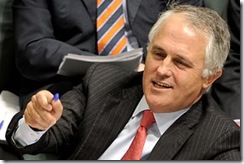
This speech took place against a background of the announcement of a new plan by the Howard Government to save the Murray-Darling River system. Spearheaded by Minister Turnbull, now Opposition Leader (photo), the development of the plan had sidelined Treasury.

Dr Henry's speech re-affirmed Treasury's role as a source of independent advice, advice that needed to take Government views into account,but should be delivered without fear or favour. Minister Turnbull was dismissive of it. He said:

This is not a narrow or arid economic analysis issue, this involves a lot of big questions, it involves dealing with practical people, people who've got a lot of dirt under their fingernails, who work all day in the bush and know how things work. And they're the people I'm spending my time consulting with and listening to.

Dr Henry was punished for this episode. It was only later that press reports recorded the apparent fact that his performance bonus was withheld.

Following this imbroglio, Opposition Leader Rudd announced his intention to restore the Westminster system. Then, in announcing his new ministry, he stated his intention to restore Treasury's role with a special focus on micro-economics reform.

Now track forward. When the Government announced its new guarantee package for bank deposits, the opposition initially supported it. As the problems with the package become clear, the opposition switched its position, focusing on reported differences in advice between the Reserve Bank and Treasury. This led to a seven hour grilling of Dr Henry by the relevant Senate estimates committee.

Returning to institutional matters, the Senate is Australia's upper house. Originally conceived as a states' house, the Senate has evolved into a house of review largely because Governments of all persuasions have not been able to obtain majorities there because of the state based proportional representation system used to elect the senate.

Within the Senate, the estimates committees formed to review Government expenditure have come to play an especially important role because they provide an opportunity to review the detail of Government activity.

The opposition's attack in estimates committee focused on the differences in advice between Treasury and Reserve Bank. The opposition has also focused on the failure to model the effects of the economic stimulus package. Now the opposition has rejected the bank guarantee scheme as a clear failure because of its distorting effects on the money market.

The Government itself is moving to modify the announced scheme to try to compensate for the distorting effects.

The issues

Mr Turnbull is an intelligent man with close links to the merchant banking community. I have no doubt that he quickly understood the adverse effects of the bank deposit guarantee package.

For the benefit of international readers, the decision by the Australian Government to guarantee all deposits of Australian banks, building societies and credit unions was introduced in part because decisions by other countries to provide guarantees had affected the competitive position of Australian banks. However, it then had the effect of of encouraging flows of funds from non-guaranteed bodies such as mortgage funds to guaranteed bodies. It also adversely affected the operations of the inter-company money market since no guarantees were in place here.

Dr Henry states that The Treasury and Reserve Bank supported the initial package.I have no reasons to doubt this, although it still leaves open the issue of nuances in the form of advice. I also have little doubt that the Reserve bank did provide advice as soon as the problems became clear. All this said, there are some things in the current situation that concern me.

The first is the apparent assumption that official advice must be made available. This, to my mind, is a breach of the Westminster tradition. Governments make decisions and can be attacked on those decisions. The issue as to whether or not they accepted advice is quite different. Mr Turnbull and his colleagues seem to be implying that the failure to accept advice, if that advice existed, is a fault. This is not a view Mr Turnbull took as minister.

The second is the apparent rush by the Government to decision. Here I have complained quite consistently about what I see as the tendency of the Rudd Government to try to do much, to come to sudden positions.

Now the Government might argue, and I would accept the argument, that urgent action was required. Here I do not accept the argument put forward in the context of the stimulus package that the outcomes of every set of decisions must be modelled first. This argument misunderstands the purpose and limitations of modelling.

That said, I am concerned that the bank deposit guarantee package now requires significant amendment to fix up its flaws. You do not require detailed modelling and testing to follow through the likely implications of a policy change - in most cases, rough back of envelope stuff will suffice. So this really should have been done.

The third issue, and one that I find quite complicated, is the question of when it is appropriate for the opposition (and the media) to comment.

The stimulus package, the really big dollar item in actual spend terms, seems to have attracted little substantive comment. On the other hand, commentary on the guarantee package seriously worried me in terms of the safety of a little bit of money this family has in a cash management trust. Should we, too, rush to safety?

My point is that I am not sure that the public comments on the guarantee package are very helpful. I would have thought that the best course was to let things ride. There will be time for comment later.

A little later

I ran out of time on this post. Thinking about it and listening to Parliament in the car, I am far from satisfied about my own discussion of the issues.

To begin with, given global responses, I am not convinced that the original decision to provide the guarantee was, of itself, wrong. I can understand the desire for quick action, while we do need to protect the global competitive position of our banks.

My instinctive reaction at the time was that, given the strong position the Australian banks already held, the guarantee was likely to signficantly advantage them in global terms. I stand to be corrected here, but this is still my gut judgement.

I remain concerned that the flow on effects in the Australian financial market were not sufficiently addressed. The imposition of what the opposition calls a tax, the Government an insurance premium, on deposits (I do not have the details available) is not, as Dr Henry suggested, fine tuning details, but a significant change.

My point on media and opposition comments about problems with the guarantee package probably seems obscure. My point is that for a period those comments actually encouraged a run on other financial institutions.

Does this mean that the comments should not have been made? I suspect that, so far as the opposition is concerned, the answer is yes.

Postscript

Even as I was writing my update, the radio was carrying reports that at 4.45pm Perpetual announced that it was freezing withdrawals on a number of its funds.

These are conservative, well managed funds whose mortgages are reported to be around 50 per cent of the value of the properties involved. If my maths is correct, this brings the total of funds frozen in the last few days because of sudden cash outflows to about $A5 billion.

References

A list of posts relevant to this story follows. Like all blog posts, they are somewhat fragmentary and subject to my own biases.

The controversy created by the leak of Ken Henrys' speech to staff was carried in Australia's Treasury and the Formation of Public Policy. For the announcement of Mr Rudd's new ministry and the role of Treasury, see The Head's New Team - Mr Rudd announces his new ministry.

The Hansard record of Dr Henry's grilling is still not up. Check here to find the current status.

For comment and information on Mr Rudd's approach to policy see the following posts. Looking over them, one of my concerns with Mr Rudd has been his tendency to try to do too much, to rush to decision.

22 November 2007, The Rudd Approach - Efficiency Dividends, Axe Wielding and Razor Gangs
27 November 2007, Mr Rudd - the Head or Headmaster
5 April 2008, Saturday Morning Musings - foreign policy, Mr Rudd and the dangers of Australia's middle power status
28 April 2008, Mr Rudd and a dreadful sense of deja vu
29 April 2008, Mr Rudd and a dreadful sense of deja vu - Managerialism and systemic failure
1 May 2008, Alcopops and mixed drinks - The Head strikes
14 May 2008, Australia's 2008 budget - written from a slightly US perspective
30 May 2008, Slow down Mr Rudd, for all our sakes, slow down
22 June 2008, Is Mr Rudd being New South Walesed?
3 September 2008, Mechanistic management and Mr Rudd's education revolution

For economic analysis see the following list.

12 October 2006, Demography, Universities and the Trades in Australia. I have included this post because it includes some material on the structure of the Australian economy.
17 October 2006, Water, Drought and the Environment - working from facts
3 November 2006, Changes in Public Administration - Notes. This post, one of a series on changes in public administration, is included because it points to the importance of the stagflation of the 1970s in changing attitudes to public administration and policy. We are at another such tip point now.
8 November 2006, Impact of Demographic Change in Australia. While this post contains outdated material, I gave included it because it provides a simple introduction to a key longer term issue.
8 November 2006, Drought in South Eastern Australia
23 November 2006, GDP - Australia in its Region
21 December 2006, Australian Economy - Mid Year Economic Report
8 May 2007, The Australian Budget 2007 - an international perspective
5 September 2007, Australia's remarkable economic performance - the need to avoid hubris
19 September 2007, Australia's good economic management
11 December 2007, Bali, Climate Change and the Australian Economy 1
19 December 2007, The Balance of Payments, Australia and the sub-prime crisis
17 March 2008, Deposit bases, credit rationing and the Australian banks
14 August 2008, Inflation's mechanics - and the importance of improving productivity
27 September 2008, Saturday Morning Musings - longer term impact of the US financial crisis
30 September 2008, The fallacy of modern management
1 October 2008, Why the US financial package should be rejected - and why Australia will ride out the storm
2 October 2008, The international curse of the ratings agencies
8 October 2008, The international financial crisis - return of the liquidity trap?
9 October 2008, Australia and the global financial crisis
14 October 2008, Keeping a sense of perspective
14 October 2008, Australian Government's new stimulus package
14 October 2008, The Rudd economic stimulus package -a missed opportunity
15 October 2008, The Australian economic stimulus package - distributional and timing issues
16 October 2008, Paul Frijters observations on the financial data + measures of decline in Australian personal wealth
21 October 2008, Unintended Consequences - Australia's bank guarantee places pressure on the non-bank financial sector

Wednesday, October 22, 2008

Welcome to my Indonesian readers - and blogs as fine wine


At the start of Sunday Essay - Musings on Australian foreign policy (among other things) I said that I was taking a break from posting on this blog. That has proved far harder than I expected. So I am breaking my rule - again!

First welcome to my new if small group of Indonesian readers.

Tikno kindly listed this blog in his post The Essence of Blogging. Tikno is a new blogger and worried about his English. His English is sometimes a bit mangled, but it can be understood. And the best way of improving English is to read, write and talk.

To my Indonesian readers, Tikno wanted more on Indonesia and Australia. My post, listed above, was a small step because it emphasised the importance of cooperation between our two countries. I will do more posts. However, I need help on the Indonesian side. I know Australia. I do not pretend to know Indonesia. So comments and feedback welcome.

The term blogochurn was used on Australian radio the other day to describe the way we bloggers repeat, circulate, material. That's true, it's part of our role, but it also misses the point. The blogosphere is a lot more than that.

The blogosphere has given people like me - reasonably intelligent people interested in events or ideas or simply the idiocies of life - a platform to express our ideas.

The photo shows a scene at a restaurant in Beijing. Denise and I found it by accident. We just walked in.

The table in front (you may have to click on the photo to see it properly) is a group of para-olympians and officials. Behind them is a celebration. The guest was a very attractive pregnant women. Table after table came across to drink toasts and to sing songs. Everybody else watched and, sometimes, joined in. We wondered if she was some form of media star.

How does this link to blogging? Blogging gives us platform for sharing experiences, but also for understanding sometimes subtle differences.

While I have learned to perform in public (speaking I hasten to add, not singing!), like many Australians I am a fairly inhibited person. This makes me very different from the Han Chinese. More precisely, they too are inhibited in their own way, but the expression is different from mine.

My experience at the restaurant was personal. Enjoying the enjoyment of those celebrating.

Blogging gives me the chance to turn this type of experience into a more public form, to articulate and test my reactions, to learn from others.

The relations between blogging and the conventional media are complex and fascinating. Blogging does compete with the conventional media at one level simply because the blog response time to events is so fast. However, the relationship is really a symbiotic one.

Most bloggers depend on the conventional media for input - the blogochurn. However, bloggers also provide an external crtitique, a response factor, that has become increasingly important in maintaining the standards of reporting at a time when reporters are under great pressure to meet deadlines.

Regular bloggers have their own deadlines. This has led to criticism of the standard of reporting and analysis in the blogosphere itself. These criticisms are justified, but miss the point.

Taking Australia as an example, for every reporter writing on a current issue there are likely to be a number of bloggers also writing. Some of this writing may be bad, most ephemeral, but there will also be a number of people who do have expertise, some of whom may invest significant time.

This may not feed directly into reporting, although most media outlets do some blog monitoring. Even some of my writing has been picked up! However, what does happen is that blog writing conditions and corrects over time.

One of the most important advantages that bloggers have is the ability to return to a topic, regardless of whether it is news or not. Conventional reporters do not have this luxury.

I am coming to the view that we bloggers do not take sufficient advantage of this. Too many of us write like reporters, write and move on. This may help us in the blogger stakes measured by things like Technorati, current writing gets the traffic spikes and the most cross-links, but is (I think) a mistake.

To my mind, a good blog should be like fine wine, constantly improving with age. To do this, we need not just to refresh our current thinking, but also constantly remove past impurities, recognising mistakes.

We also need to refresh and re-present good writing from our collective pasts, bringing it back into currency.

Active bloggers write a lot. On this blog alone, I have written 851 posts since my first post 0n 19 March 2006. 851 posts. That's a lot! I struggle to remember all of them.

None of us can maintain a consistent high standard all the time. There is, I think, a real gain in standing back from time to time, looking at what we have said before. This helps us in current writing, but also ensures that we make corrections as required to previous posts or, as an alternative, simply provide a link to new thinking or developments. Some posts we may simply choose to forget.

I think that the point that I am searching for here is that those of us who are active content bloggers need to think more about what we do, why we do it, how we do it.

Postscript

A comment from Neil reminded me of one of his posts, Why I blog — Andrew Sullivan, that was in the back of my mind when I wrote this.

Tikno, Neil has added your blog to his Google Reader list, so you have an added incentive to keep blogging since many of us read Neil's Shared Items An Indonesian flavour!

Monday, October 20, 2008

Where to find the new NSW population projections

The Sydney media today has extensive coverage of the new NSW population projections made by the NSW Department of Planning.

These numbers are quite important for those who live in the state because this is the data the State Government uses for planning purposes. There is no attempt in NSW to use policy to affect population distribution through, for example, economic development action. Rather, the Government simply goes with the projections, making them something of a reinforcing prophesy.

I am completing a full analysis of the numbers for the New England, Australia blog - to say that the projections for Northern NSW are depressing would be an understatement.

In the meantime, those who want access to the original report can find it here.

Postscript

I have now put up my first post on the numbers, New NSW Population Projections 2006-2036 - what do they mean?. Recognising the qualifications I have made, I think that the analysis shows the need to avoid the type of breathless reporting, here for example, that has been so prominent today. It is sensible to look at the assumptions involved before jumping to conclusions.

I found one very odd thing in this first analysis. Assuming that I have not made a silly error, the projections show an actual decline in the population of NSW outside Sydney between 2006 and 2016. I don't believe this. On the surface, it just does not make sense.

Later note: I was right. It did not make sense and there was a silly mathematical error, now corrected!

Sunday, October 19, 2008

Sunday Essay - Musings on Australian foreign policy (among other things)

After this post, I am going to take a break in posting on this blog for a few days because I need to do some other reading and writiForeign language book store 1ng.

I took this photo in Beijing at the Foreign Language book store for youngest daughter because it displays the Australian writer Markus Zusak's The Book Thief in very good company indeed. This was a remarkable store especially in its English language stock selections - all sorts of older titles that I like that have simply vanished from Australian book shops as fashions change.

Why for Clare? Well, she went to a writer's course run by Markus and really likes him. This was her second writer's course - the first was a children's writer's camp run by another popular Australian author, John Marsden. I like Marsden's writing, he tells a ripping yarn, but the popularity of his main series says something about modern Australia.

The series is set in country Australia and begins with an invasion by an unspecified Asian power headed by a dictator. The invasion succeeds in occupying half the country. The Australian kids find themselves on the front line and fight back, wreaking great damage.

One thing to remember about Australia is that there has always been a deep sense on insecurity in the country dating back to our beginnings as a small in population terms European enclave on the edge of a very different continJohn Marsdenent. The fear that we might lose our home - to be dispossessed as we had dispossessed the Aborigines - was very real.

Modern Australia is very different in its ethnic mix, yet the fear remains. You have to remember our history if you are to understand our national reactions to issues. I find it sad but not unremarkable that Marsden's books play to two central themes in Australian life - to fear, plus the nation's sense of nationalism centred on war. As other unifying national symbols have declined, been rejected, our military tradition has come to occupy central stage as the official central unifying element in a way that I for one did not foresee.

In our sister country of Canada, peace keeping has been central in recent years to that country's international military involvements. This is true of Australia too. However, there is a much harder edge in Australia in that we are prepared to use military force to directly defend our strategic objectives. If you look at the official messages, you will see that the need for the country to defend itself, the prowess of our military forces, the value of Australians sacrificing for their country, are central.

I do not want to be misunderstood here. I find it inconceivable that Australia would ever invade another country just to gain territory. But our willingness to use force in defence should never be under-estimated. We are being trained for it. Just as happened in the two previous world wars, Australians of all ethnic groups would rush recruiting stations should full war break out.

One thing that few Australians realise is just how complex and sophisticated Australian foreign policy is. Some Australians would laugh at me for saying this, yet it's true.

In military and economic terms, we are presently a mid power facing inevitable relative decline. We have done much better than many expected to this point - remember, twenty years ago many in Asia saw Australia as the soft and lethargic sick man of Asia, some still do. Still, the facts of economics and demography are working against us.

Fortress Australian has been one option much canvassed in the past. Keep within our walls, make the pain of action against us so great that no-one will try. The problem with this approach, although it remains one element in official thinking, is that we depend on one side upon sea lanes that could be easily cut, on the other on the import of key products and equipment to maintain our defence. To go this route would required us to re-build domestic capabilities at considerable cost, protection in the face of a globalising world.

Having studied elements of the Australian response to the Second World War, at the way in which national policy was slow to respond, I think that we could do more to maintain strategic capabilities. However, I do support the core of the alternative approach.

The first element in this is trade policy. Here Australia is building a network of free trade agreements designed to integrate the Australian economy into our key trading partners of the future. We hope to gain in economic terms. However, we are also aiming to become economically important to those countries as suppliers. More trade. less threat.

One of our problems here is the potential of conflict among trading partners. Here ASEAN is a key. In total, ASEAN is a critical trading partner. More importantly, ASEAN countries form a military buffer, while many of our most vulnerable trade routes run through ASEAN waters.

There have been problems in the Australian relations with ASEAN, including especially the attitudes of Malaysia's Mr Mahartir as well as Indonesia and East Timor. Yet when you look at our foreign and trade policy towards ASEAN, it has been both persistent and consistent. We are working to build relationships.

The longer term advantage that Australia and New Zealand ( I group the two countries together in this context because of the linkages between them) have in ASEAN is that our combined economic size, while declining in relative terms, is still very high. We offer a largish market, we can supply food, commodities and technology.

My personal view is that ANZ and ASEAN will inevitably move towards a more integrated economy. In this, our relations with Indonesia will be of particular importance.

Indonesia are Australia are very close in geographic terms. They are in fact next door neighbours. To put this in perspective, Indonesia is closer to Darwin than Sydney is to Brisbane. However, border myopia creates a problem - most Australians see Indonesia as a bit distant.

It will not be easy to build closer integration with Indonesia. As a simple example, the Indonesian population is now projected at 300 million plus. This dwarfs the equivalent Australian projections. Free movement of people could swamp Australia. Yet closer integration including people movement will come. We have to decide how to manage this.

Again, my personal view is that it is going to come in small incremental bits. Only looking back will we be able to see the changes.

Indonesia must succeed in developing. The implications for Australia as well as the Indonesians themselves are just too dire to contemplate. Yet the more Indonesia succeeds, the more unbalanced the relationship may become. Imagine an Indonesia with two times the population, six times the GDP.

Just at present, Australia's GDP is roughly three times that of Indonesia. We are talking of a world in which the Indonesian economy is twice as large as Australia's with the gap growing. Yes, this is good for Australia, but it does change things.

I am nor sure how things will work out. What I am sure is that we should be aiming to build as many links with Indonesia in particular as we can.

Saturday, October 18, 2008

Saturday Morning Musings - ethnicity and change in Australia

This has been an interesting week, made more so by some of the conversations around me.

On Ninglun's Specials, Neil Whitfield has been carrying his camera around taking photographs of his immediate area within Sydney, including Sydney's China Town. The modern China Town was not the first Chinese area in Sydney, nor is it the only one. However, it is the best known.

Up in New England, Gordon Smith from lookANDsee has taken his camera to the streets of Bingara on New England's Western Slopes. I thought that I would use photos from both to illustrate this morning's musings.

This photo by Neil shows the high rise residential development on the northern edge of China Town. This is part of the development that has seen a dramatic rise in the residential population within central Sydney, attracted by the metro lifestyle.

Wikipedia has quite a useful article on the Chinese in Australia.

At the last census, 669,890 Australian residents identified themselves as of Chinese ethnic origin, or 3.4 per cent of the Australian resident population. These numbers are not spread evenly across Australia, but are especially concentrated in Sydney, where the 292,338 Chinese make up approximately 7 per cent of the population.

Again, the Chinese in Sydney are not spread evenly, with special concentrations not just in China Town, but also places like Hurstville and Ashfield. Sydney's popularity as an entry point for migrants combined with out-migration from the city of locally born means that the Chinese proportion of the population, more broadly the migrant proportion of the population, will continue to grow. Here Sydney is heading towards the position already holding in Auckland, if with a different ethnic mix.

The photo on the right shows the main street of Bingara on a quiet Sunday morning.

Perhaps best known now because of the nearby Myall Creek massacre, Bingara has been fighting to retain population, including the promotion of its own tourist attractions.

Bingara's population is older than Sydney, the locally born proportion of the population is very high, the small overseas born group all comes from Europe.

New England has its own Chinese tradition dating back to the gold rushes. However, if the census data is correct, there was not one person of Chinese ancestry, not one of Asian ancestry, living in Bingara on census night.

The life styles in Bingara and Sydney are very different, not just the ethnic mix.


Neil's photo shows Sydney coffee addicts in China Town. This is a mixed, cosmopolitan world.

People densities on the street may not be as high as say Shanghai, but this is still a crowded world.

China Town is not in fact typical of Chinese Sydney, just as metro Sydney is not typical of Sydney. There are huge differences between metro Sydney and the further out suburbs where the majority of Sydney's population lives.

Now compare this to Gordon's photo of Bingara's Regent Cafe. I have had coffee here. The contrast could hardly be greater. Bingara is a quieter, village world with its own concerns. Sydney seems very remote.

I have used China Town Sydney and Bingara simply as examples, the tip of the iceberg, of diversity in population mix, lifestyle and attitudes across the country. Darwin, as an example, is as far removed from both Bingara and Sydney's China Town as they are from each other.

One of the points I have tried to make in my writing is that Australia has always had greater diversity than is commonly allowed. That said, Australia is presently dealing with waves of change across the country, waves going in different directions, moving at different speeds. I find this fascinating.

Still using Australia's Chinese as an example, the previous dominance of those from Southern China as well as other parts of Asia has been challenged in recent years by a rise in Mandarin speakers. Both may see themselves as Chinese, but the two groups are not the same.

Then there are the differences between the ABCs, the Australian born Chinese, and more recent arrivals, sometimes summarised by the derogatory term banana, yellow on the outside, white within.

Yesterday I was talking to a mother, European, who has enrolled her son in a coaching college to improve his maths. The Chinese concern about education has led to a proliferation of coaching colleges across Sydney preparing people for key examinations, especially those for entry to the selective high schools. While standards may vary, some of the colleges are very rigorous indeed.

In the case in question, to gain entry to this college mother and son were first interviewed, then the son had to sit a test to demonstrate suitability. He was admitted, the only non-Chinese at the college. He is known by other pupils simply as white boy.

I am not suggesting prejudice in this case, although that may be there, simply that the term is used as descriptor.

In all this, at least some Chinese parents worry about cultural acculturation, the way their children are adopting Australian attitudes.

I used to worry about the risk that Australia might fragment into different ethnic groups. This was part of my concern about official policies that seemed to deny the validity of the central Australian culture as a national unifying device. I am less worried about this than I was, say, five years ago.

Part of the reason for this is the diversity in our migrant intake. However, part too is the sheer power of the central culture itself, as well as the ability of Australians to distinguish between attitudes to specific groups (group x is ) and individuals (Fred is alright).

What I find more interesting now are the growing divisions within Australia based on geography. Australia is segmenting.

I am not suggesting that this is of itself a problem, although it does pose some long term risks. So long as these risks can be contained, then I think that the trend will ultimately add to the texture of Australian life. However, that's another story.

Friday, October 17, 2008

Personal confusions over Australian food


Photo: Peking Duck, Beijing.

Back in March in Problems with Peking Duck I vented my anger over what I saw as the diminished quality of Australian Peking Duck. So while in Beijing we obviously had to try Peking Duck.

I must say that I did think it nice, although not the best I had ever had. That was in Canberra.

Our food experiences on the trip (I will talk about this at some point) drew out just how mixed and eclectic my tastes in food had become, with a whole variety of influences merged together in my mind and my cooking.

The real trigger was my attempt in Beijing to get a dip of soy plus one a chopped up fresh chili. I like this as a dip, especially with greens. I made three attempts at different places - it simply could not be done.

This created confusion in my mind because I thought of this as Chinese, and indeed most Chinese restaurants in Australia will provide it. That was not the case when I first started asking for it. Then I realised that the confusion came about because I did have so many influences merged together, distinguished only by very general labels.

A little while ago I ran a short series of posts on the topic of what would you describe as Australian cooking. For the benefit of international readers I have listed the posts at the end.

One of the key issues in the discussion lay in the question: is there such a thing as an Australian cuisine? My answer was yes, simply because our cuisine is what we eat. At the same time, I have to admit that it has become a strange mixture.

Thinking about all this, I thought that it might help me and be of interest to international readers if I looked at some of the influences on my own cooking. You will see that it really is a strange mixture.

Steamboat is one of my favourite meals, although I have done this very little in recent times because steam boat is a sociable meal suited to a group. My family likes to eat in front of the TV on those now few occasions when everybody is home together!

With steamboat you start with a pot in the centre of the table with a bubbling broth - I use chicken stock. In the beginning I used a charcoal burner, but an electric wok is now easier.

You cut up meat and fish and a variety of suitable vegetables, place a mixture in a small long stemmed holder and place them in the bubbling stock. When cooked, you place them in a bowl with rice and use chopsticks to dip them in various sauces. The broth itself is drunk at the end of the meal.

Steamboat itself is, I think, Vietnamese. Certainly I acquired the habit from a group that included a number of Vietnamese girls with Australian boy friends who had fallen in love with Asia. This was a fun group whose members went everywhere, including a later Deputy Governor of the Reserve Bank.

If Steamboat is Vietnamese, the dipping sauces were more varied. In My case they included the required soy with chili, soy plus vinegar (Japanese I think, acquired from Japanese BBQs at the Shogun in Sydney - but that's another story), sambals (South East Asian) as well as things like Hoi Sin.

Steamboats contrast with roasts, a traditional English stream that my family likes. And so do I. I cook a roast at least once a week. Roast chicken on Sunday is one of the few real combined family meals.

Even here other influences come in. I marinate the chicken with lemon steeped with oregano (Italian, I think), the stuff it (English) and rub it with olive olive (Italian), before placing it on a drip tray in the pan.

The use of olive oil has been one of the big changes in Australian cooking. Olive trees were planted soon after the Europeans arrived, but for much of the period since olive oil was seen as medicinal. I now use olive oil all the time, as well as sesame oil (South East Asian, I think). I very rarely use vegetable oils.

Unfortunately my children do not like curries.

The first curries I ate were a mild English variant using curry powder imported from the Indian raj. Cooked by my mother, this was the only time we ate rice apart from sweetened rice deserts (rice with prunes comes to mind) that I thought were dreadful. At University, my friends cooked me real sub-continent curries, hot and very spicy. I turned red, sweated, but gobbled them up.

When I came to Canberra I taught myself to cook a variety of curries, using original ingredients. I have forgotten now how to do this. In addition, I can no longer eat such hot curries without discomfort.

If alone, I love a moist curry (if you are broke, a potato curry gives cheap bulk) with lots of juice, My wife is a better curry cook now, although her curries are drier than mine. Still, lamb with spinach is to die for.

Chili versus curry.

The Europeans brought chilies from the Americas to Asia. There it was incorporated in South East Asian cooking, among others.

I learned about chilies in Canberra, one of the first Vietnamese influences on Australia.

As an aside, I don't think that I have ever seen a proper article on the Vietnamese influence on Australia. To my mind, it was quite important.

My family does not share my love of chilies. Unlike the Americas, and here I express a prejudice, the South East Asian use of chilies is more subtle, far less like that episode of the Simpsons. My youngest will laugh at Homer, but not eat a chili. In fairness, I should add that she blames this on me because I gave her a very hot chili to eat!

A salad in a bowl with a little bit of fish sauce (something else I always have now) and chili makes a great lunch.

Good heavens, look at the time. I have become completely distracted!

Postscript

My thanks to Neil Whitfield for pointing me to this Wikipedia article on steamboat. I do love the way in which our blogging community constantly extends our collective thinking!

The Australian cuisine series

Welcome to visitor 40,000

Welcome to visitor 40,000 who arrived at 5.41am Australian Eastern Day Light savings time. He/she came from Bethany in Connecticut, USA. I had never heard of Bethany, but it is a small town whose slogan is "Rural is beautiful". Now how could I disagree with that?

Visitor 40,000 searched on the importance of Chinese history. This brought them to Another view of China - and the importance of shifting perspectives. This post would not have helped them especially - it has a somewhat different focus. Another post?

Thursday, October 16, 2008

Personal Reflections - Anne of Green Gables, depression about indigenous issues, postives about India and Indonesia


While in China I bought a copy of L M Montgomery's Anne of Green Gables.

Published in 1908 and set in Canada's Prince Edward Island, the book tells the first part of the story of Anne Shirley, an orphan who came to stay with Marilla and Mathew.

The Avonlea series are some of Canada's most loved books and formed the base for a number of popular TV series and films.

The photo is from the Anne of Green Gables series web site and shows Marilla (Colleen Dewhurst) with Anne (Megan Follows).

I have just been re-reading the book as a break from the world around me, an antidote for the depression that comes from too much exposure to serious stuff.

Part of the trigger here came from listening to the detail of and responses to the report into the Northern Territory intervention. After listening to an hour of radio discussion, I wrote Depression about indigenous policy - and a challenge to North Coast Voices. This led to a very tart response from one of the writers on that blog pointing out that I had my facts wrong. I brought the comment up into the main post as a correction, but it added to the sense of depression.

The way I feel at the moment, I don't think that I want to be involved in further discussion on indigenous issues. Things seem to go round and round. I listened to Fred Chaney being interviewed again. As always, he made good points, but he sounded very weary. How could he not be? I really admire the way he has kept on going.

I re-entered the discussion on indigenous issues in part to educate myself. Concerned with constant policy failures, I tried to use my skills as an analyst to suggest the reasons for failure, identify principles that might be used to develop new policy approaches. I also started writing on Aboriginal history again after a break of many years, focused especially on Northern New South Wales.

My knowledge has certainly improved, and that has sometimes been useful in a policy environment and to at least some readers measured by comments. However, I don't think that I have much additional that I can add at least at a policy or analytical level - the position I have developed is too far outside the often polarised main streams to be helpful at this point.

At some point I will try to consolidate all the posts I have written over the last two years into a single document to see if there is in fact anything more that I might usefully say. In the meantime, I will limit myself to continuing to build my understanding of Aboriginal history within New England.

On a more positive note, I seem to have been doing something right on this site measured by the traffic stats, with both page view and visitor numbers running at consistently higher levels.

On a still more positive note, my thanks to Ramana for Blogger From Australia. I have enjoyed the new visitors and my follow backs to their sites. Really a very nice break from a world recently dominated by economics. Ramana seems to have built a real community through, I think, his very positive comment policy.

Tikno, as I think mentioned in my response to your comment, material on Indonesia-Australia is spread in a number of posts. However, you may find the following of interest:

  • GDP - Australia in its Region (23 November 2006) looks at Australia's place in its region, including the impact this has on Australian trade policy. One point in that post was the need for growing integration between Australia and Indonesia.

  • UNE's Overseas Student's Association (October 2008) shows an Indonesian student at the University of New England in 1960. The first Indonesians I met were Colombo Plan students at UNE. The first Indonesian food I ate was cooked by them.

I spent the best part of an hour searching for a full post I thought that I had written on the death of President Suharto. I wanted this one because it had some historical material in it on the Indonesia-Australia relationship. I finally found it unfinished in drafts!

I will try to update and publish this so that there is another post similar to the one I did on India.

In the meantime, back to Anne of Green Gables!

Wednesday, October 15, 2008

The Australian economic stimulus package - distributional and timing issues

This post continues the discussion I began in The Rudd economic stimulus package -a missed opportunity, looking at distributional and timing issues. There is nothing profound in the material that follows. Think of it as brief notes to myself to try to increase my own understanding.

Economic Linkages

The various Government initiatives are meant to fit together in this way:

  • the various elements in the finance guarantee package are meant to ensure domestic liquidity and to provide a measure of insulation for Australia from the previous global financial turmoil.
  • then there are the various longer term measures already announced that are intended to provide a long term growth base. I am not sure that these, and especially the integration between them, have yet been properly analysed.
  • and now there is the fiscal stimulation package intended to provide a short term fillip to domestic demand (the one-off payments) that should in theory then phase into increased housing construction.

The One-off Welfare Payments

The one-off welfare payments are equivalent to around .9 per cent of Australian GDP. However, those to receive the payments are not distributed equally across Australia, with higher concentrations in particular areas. This means that the impact in local terms will vary and in many cases may be far higher than .9 per cent of local GDP.

The one-off pension payments ($A4.8 billion) will be especially important in those areas with above average concentrations of age pensioners. I have not attempted to chart this, although ABS census data could be used to chart distributional impacts using a combination of demographic structures with data on welfare recipients.

As a broad generalisation taking NSW as an example, the greatest relative impacts are likely to be in regional NSW simply because older people make up a higher proportion of the total population. The overall impact could be quite high in individual localities, equivalent to a one-off increase in total weekly incomes in some areas (the income in that area in that week) that could, on some rough back of envelope calculations, be over 50 per cent, in some cases well over 50 per cent.

Conversely, the one-off child support payment ($A3.9 billion) will have its greatest relative impact in areas where there is a substantial proportion of young from lower and middle income families eligible to receive the Family Tax Benefit such as the outer suburban areas. The area impact here is likely to be less simply because the payment is smaller, while the relative proportion of the young is also smaller.

I am not sure that I draw any substantive conclusions from this in terms of its aggregate (average) effects. I just find it interesting.

All these one-off payments will be made from 8 December, sort of a Christmas bonus. However, we should not assume that the total impact will be an increase in aggregate spend hitting at one point.

A reasonably significant proportion of benefit recipients live in social housing and pay income based rents. If the one-off payments are counted as income, and it is unclear as to what extent this might happen, then around 25 per cent will be absorbed by rent increases. To this degree, the overall spending stimulus will be reduced.

We also need to take debt into account. A number of recipients have small debt amounts and will use the money to reduce that debt, thus reducing the aggregate spend effects. Others may borrow against the future benefit payment, this bringing spend forward.

The net result of all this is that the aggregate spend impact may be lower, its timing a little more distributed, than would be suggested by the raw numbers.

In measuring impact, we also need to take into account where the money will be spent.

Based on my limited knowledge, I would expect the majority of the money to be spent on groceries and beverages including alcohol, entertainment including gambling, car repairs (many pensioners are struggling the keep old cars running), some smaller consumer durables, things for the kids, meeting medical and dental backlogs etc.

So the the spend will translate to an immediate increase in consumption for certain types of goods and services. However, the flow-on stimulatory effects, the multiplier effect, depends upon leakages including especially imports. Because we import so much, a significant proportion of the spend is likely to flow though to a one-off increase in imports, reducing the subsequent stimulatory effect.

The First Home Buyer Grant

The time limited funding for first home buyers ($A1.5 billion) applies to existing and new homes, with a deliberate skew to new homes.

Increased payments for existing homes should immediately flow over increased property prices as compared to what would otherwise have been the case.

I find the economics here a little complicated.

The lower the house price, the greater the impact simply because of the ratio between the fixed amount of the grant and the house price. We saw this when the original scheme was introduced - some of the greatest percentage increases in house prices occurred at the low end in regional market places. One outcome was a reduction in the margin between highest and lowest house prices.

So regional house prices should increase at the lower end.

The effect in the outer metro suburbs is a little more complicated. House prices have come down in some of these areas as people struggled with higher repayments. This decline will be reversed to some extent as new buyers come into the marketplace. This will actually have the useful side effect of making it easier for the over-extended to exit.

The effects of the change on the rental marketplace are a little unclear, at least to me. An increased number of new home buyers implies less rental houses. However, by definition, as first home buyers they area already renting. So that frees up the house they were living in for rental. On the surface, the net effect on rental availability is likely to be zero.

I have heard some commentary that the rise in house prices flowing from this move will of itself encourage construction. I cannot see it.

The only thing that I can think of is that the move will encourage transfer of people between areas, soaking up unused and presently over-priced inventory in some areas. This may encourage further construction, especially of flats.

The grant for new homes should encourage new construction, subject to the key constraint that land is available. Again, the ratio between the size of the grant and the development price is important in determining actual outcomes.

Development price combines land costs, all the multifarious state and local government charges, construction costs plus a profit margin. On the surface, the greatest relative impact is likely to be in regional areas and in the construction of flats.

There is an interesting linkage here between new and existing homes, one that was not clear to me when I started writing. New homes compete with existing homes for buyers. In theory, a rise in price for existing homes may make construction of new properties more attractive.

Conclusion.

I have run out of time. As I said, this post is really a note to myself to help me work through the issues.

Afternoon Update

As you might expect, the airwaves have been full of the package.

Just to check on the regional reaction I looked at Tamworth's Northern Daily Leader. One headline in the paper reads Home buyer incentive set to ignite market. Another story suggested that $4 billion of the funds would go to the country. I could not find the story again, but North Coast Voices carries the full press release on which the story was based.

I see that Neil is going to use his money to pay December accounts. He promises not to waste it!

Tuesday, October 14, 2008

The Rudd economic stimulus package -a missed opportunity

I have very mixed views on the Australian Government's stimulus package. In a post this morning, Keeping a sense of perspective, I suggested that the Rudd Government should not rush into an economic stimulus package. There I said:

Managing the real economy is a matter for sensible fiscal and monetary policy. Yet here the rhetoric of at least Australia's leaders is still dominated by the financial crisis - we must avoid global melt-down.

Please, Mr Rudd, take a deep breath. Yes, we need to take action to reduce the effects of economic downturn. But we also need time to think the best ways through.

Later that day the Government announced its economic stimulus package. I have summarised it here.

I have complained before about some elements of Mr Rudd's style. See, for example, Slow down Mr Rudd, for all our sakes, slow down. His tendency to rush, his focus on activity, can combine to create bad results.

I generally supported the Government's approach to bank guarantees because this was a response to an immediate crisis that really required a fast response. The same cannot be said for the latest measure.

Yes, and as I have argued, the economy will need stimulation. However, I also saw the downturn as an opportunity to do new things because downturn makes resources available. It is hard for a Government to do major new things when the economy is pressed hard against capacity constraints.

The wording of the announcement is an example of modern word spin set within an atmosphere of crisis.

This is an "Economic Security Strategy". It is not. It is an immediate stimulus measure.

The package is designed to "strengthen the Australian economy in the face of the worst global financial crisis since the Great Depression." The package will stimulate, not of itself strengthen, the Australian economy. "In the face of the worst global crisis" is a sales pitch.

When we turn to the detail, we find that the word "spend" has been replaced by "invest". We "invest" by providing pensioners with a one-off payment. This may be a good thing, but is hardly an investment.

I could provide further examples, but I think that you will see what I mean.

Turning now to the details of the statement, the measures break into three.

The first is one-off payments to pensioners and other welfare recipients, payments to be made from 8 December. This has been targeted to those most likely to spend. The statement presents this as a down payment on future changes to the pension system.

It is hard for me to argue too strongly against this measure given some of my previous statements on the social welfare system. However, the effect of the measure on domestic demand is a little difficult to gauge because of the spend patterns of those involved. Specifically, I would expect it to add to sales of food, drink and clothing . I am not sure how far beyond this effects will spread.

The second is an increase in first home buyer grants for new and existing homes. I have put the and in bold because therein lies a problem.

The substantial increase in the grant for new homes will translate to an increase in home building, if with a lag. However, the increase for existing homes makes little apparent sense because it is likely to translate to an immediate increase in house prices with no demand effects.

That's fine if the aim is to underpin house prices, although I do not think that this is a good thing. Otherwise its a waste of money.

The last and smallest immediate element of the package is its longer term elements.

The first is an increase in training places. That's good.

The second is a stated intention to bring infrastructure spending forward. That's puff. The Government was trying to do this already.

In all this, there is the question of value for money.

Take, as an example, this post, Business misses in the stimulus package, from the Australian Newsagency Blog. The argument here is that things such as investment incentives would have stimulated business activity. The writer has a point.

My view of the "Economic Security Strategy" is that it's a missed opportunity, that we could have got better long term results for the same spend if we had just taken a little more time to discuss it.

It's very rare that we do get an opportunity to spend a large sum of Government money outside normal parameters. I think that we have just muffed such an opportunity.