Showing posts with label family history. Show all posts

Sunday, January 21, 2018

Reflections inspired by Nick Brodie's family history "Kin: A Real People's History of Our Nation"

I find that my brain has been slow to re-engage after the Christmas break, especially when it comes to serious stuff. To a degree, that's still true. I haven't made any new year resolutions beyond a desire to attempt to work less and to read and relax more.

One of the difficulties with working from home as I am at present lies in achieving real separation between work and leisure. I feel I should be doing something all the time and as a consequence become very inefficient. I  know that I should fix this, but its quite hard. Still, I have picked up my reading.

Looking back over my blogs, I have written a fair bit about family history, my own and family history as a craft or discipline. I mention this now because one of the books I read over Christmas was Nick Brodie's Kin: A Real People's History of Our Nation. This is a really good book, a yarn, and I encourage you to read it.

One of the challenges in family history is to find a way to avoid becoming lost in family trees. Each generation you go back in the tree expands the number of names and possible further connections. This makes some family histories effectively little more than lists with some commentary.

The long running BBC TV series Who Do Think You Are, the start of a global franchise, solved this problem by selecting only what they saw as the most interesting bits, the Australian program even more so. This plus the sometimes breathless imposition of current views and sensibilities on the past became somewhat annoying with time.

Nick has chosen a different route by taking portions of the family tree and telling the story in discrete blocks, effectively making each a stand-alone story. This means that you don't have to remember the entire family tree, although I sometimes found myself a little lost and had to refer back to the main tree at the front of the book. But that's just me. You can read the book as a series of stories without worrying to much about that.

He has also consciously tried to place the stories in the context of the time, trying to avoid or at least minimise the filter created by the present.

I mentioned in an earlier post that I had finished, at least for the present, my Express series on New England's built landscape and architecture. Inspired Nick Brodie, I decided to do the next series of columns on the Belshaw family.

The first column is here. The photo shows walking day, Platt Bridge, Wigan 1900. I promised Cousin Cyril a long time ago that I would write a full history of the Pacific Belshaws and added it to my list of books. As you might expect given my already existing list of books, this has lagged. Still, its a start in sorting out themes. .  


Wednesday, November 02, 2011

Sharing nostalgia in an internet world

We all feel nostalgic from time to time. Often, it is triggered by something small - a smell, a sound, a snippet of song - that re-ignites a larger memory. Australian cowboy & indian outfit 1951is a case in point.

I wrote it because a photo from Cousin Jamie's collection triggered a memory. This led kvd to comment:

Jim don't know if you ever had one but my most treasured possession at that time was a Davey Crockett hat complete with tail. My brother's Labrador stole it then ate it and growled at me when I tried to take it off her. Vivid early childhood memory. Stupid dog. But anyway cowboys and Indians was very big back thereabouts as you say.

Anon responded with a correction and his own memory:

Davy Crockett much later; 1955. Also, who can forget the much desired (didn't have one!) Hoppalong Cassidy tent. We had a much loved and extremely patient ginger cat, who spent some years doubling as a mountain lion/couger/puma. Sat arvo matinees had much to answer for.

kvd responded in turn:

Anon is correct as to dates. "Me hat got et" in either 56 or 57 based on the house we were living in. I had a pair of H C chaps a little after that i think. Proper leather. Cost a fortune these days.

As I read the comments on Davy Crockett, the chorus from the song popularised by the 1955 movie came back into my mind: "Davy, Davy Crockett".

What I had forgotten until reminded of it by kvd's reference to the hat plus the reference to Hopalong Cassidy's tent and chaps was just how important merchandising was.

Today we talk of brands, a franchise, merchandising as though they were relatively recent. The first Hopalong Cassidy book was in fact published in 1904; today the various features are being re-released as DVDs.  

The peak of the HC franchise was directly associated with the rise of television in the immediate post war period. On June 24, 1949, Hopalong Cassidy became the first network Western television series, igniting mass interest.

Children have vivid imaginations. The role played by anon's much loved and patient ginger cat is an example. This shot shows brother David and I with our grandfather's dog Ben. Toys, animals and immediate surrounds are all incorporated into mental and physical games. Nostalgia is often associated with childhood memories simple because those memories are so vivid and often, not always, uncomplicated.

By it's nature, nostalgia is individual. It is our individual memories that come back to us. Usually, there are few if any people to share them with. However, this is where the internet has worked a most remarkable change.

When I look at my overall traffic figures over the last six years, the posts that attracted the highest visitor volumes all deal in one way or another with popular, often serious or current issues. A different picture emerges when I look at comments or email traffic. The posts or newspaper columns that attract the strongest individual reactions are nearly all connected with personal experiences, histories or memories. The internet allows us to share. Nostalgia becomes a shared experience.

Increasingly, I find myself writing consciously writing to this individualised audience.

I write about the need for change in management, public policy or public administration because I believe this to be important. The old Belshaw change agent, the reformer, is still there, still trying to contribute. However, the posts that give me the most intense personal satisfaction are those that strike a personal response in one or more readers.

One of the most important features of sharing nostalgia in an internet world lies in the way it has begun to record, reshape and rewrite what we might call social history, history seen through the experiences of individuals, families and groups that once lay below the surface created by formal history because the evidence was not there, or not easily accessible.

One personal challenge for me as an historian is to bring this alive.

The other day I was trying to work out just how I might manage, let alone use, the thousands of comments and emails I have received over the last few years.

One of the traditional challenges for the historian lies in identifying and collecting evidence. In my case, a large slab of evidence actually collects itself. My problem is to how to use the accumulating evidence that constantly passes my screen!

Perhaps I shouldn't worry to much. I have actually written more history in the last few years than the rest of my life combined. Perhaps I should just go with the flow, enjoying what I have now. After all, I really am privileged to share so much with so many people!     

Postscript

I have added a short post on my history blog - Use of the internet in social history: an example

Tuesday, September 20, 2011

Random musings on family & New Zealand

Somewhat tired yesterday and still today. Not surprising, really. We got up to go to the airport yesterday at 4am NZ time, 2am Australian. Then for booking reasons we came via Melbourne, only to be caught in the security scare at Sydney airport, forcing the plane to sit on the tarmac at Sydney airport for an hour and a half. In the end, we didn't get back to home until around 4pm Australian time, making for a fourteen hour trip.

While in New Zealand I read Frank Walker's The Tiger Man of Vietnam. It's a good yarn, although I have some reservations about some of the analysis from an historical perspective.ghost platoon

Upon return, an excited youngest daughter showed me her autographed copy of Frank's new book, Ghost Platoon. Why excited?

It's not just the autograph, but there in the book is a map that Frank got Clare to draw as an illustration. There, too, in small print is an acknowledgement of Clare as the artist!

Frank was a senior journalist at the Sun-Herald in Sydney who took retrenchment and then decided to become a full time writer. He is now working on his first novel.

I was thinking this morning as I was writing this week's Armidale Express column, this one on the Rugby, that I really must get Clare to do some illustrations for me. I can't afford to pay her at the moment, so will have to rely on charm!

I was thinking the other day that my three girls, while all very different, are frighteningly competent modern women.

Apart from her other activities, Dee has just facilitated her first course for the Australian Institute of Company Directors, was interviewed as one of the talking heads on insolvency for the George Negus Show and is the official speaker this year at one of the Sydney University graduation ceremonies.

Helen took me to New Zealand for the Rugby, displaying her practical organisation skills. I really didn't have to do a thing. Helen is very like her Aunt Kay with a high degree of emotional intelligence, a calm demeanour in a crisis and a very, very, practical approach. I do stand a bit in awe of her and her gift for friendship.

Clare is different again, far more mercurial and over the place. Still firming up in some ways, she has quite high artistic talent, can be all over the place, but also has very high level organisational skills when she wishes to apply them. Like Helen, she is a natural leader.

All this may sound a bit like boasting, and perhaps it is. But I was also thinking of broader aspects.

One element is the need for me to change as my family changes, and that is not always easy. It's part of the challenge today when relationships are based less on traditional roles, more on individual negotiation.

A second element that has always interested me is the way in which varying personalities are formed through the combination of genetics, experience and personal interaction. This includes the way that gender works itself out, for boys and girls remain very different.

I listen to the sometimes very funny interaction between Helen and Clare and continue to be amazed at their memories for dialogue, for situation and for mimicry. Boys can do this too, but I think that the way that the girls do it is very much a girl thing.

In New Zealand we stayed with cousin Richard. Looking at Richard and his two boys, I was again struck by the variations in personality as well as the commonalities.
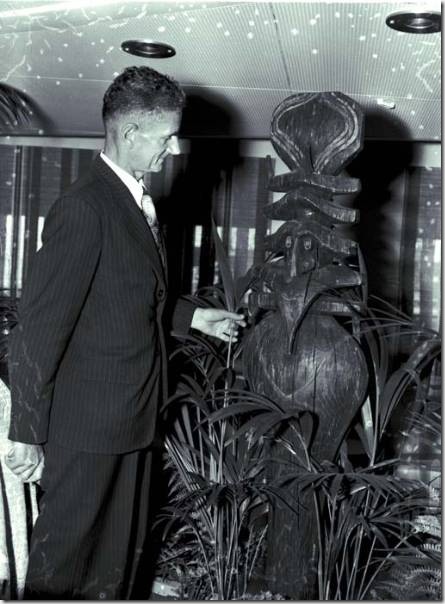
Vic Fisher Monteray In Auckland, we visited the Auckland museum because I wanted to show Helen and Dylan, Richard's youngest, the big Maori war canoe that brother David and I sat in when we were kids. You can't do this now, but Uncle Vic Fisher was curator of ethnography at the museum and took us there one day when the museum was closed.

The photo from the Museum collection shows Uncle Vic on the Monteray. 

I have written before of the way that attitudes, interests and approaches flow down through the generations. This is partly due to family contacts and traditions, but it also seems to occur independent of that.

On the Belshaw side, the interest in history, economics and anthropology is certainly due to proximity and family connection. But the way that this played out across countries and time also seems to reflect a little more, perhaps something in the blood, for people with common interests tend to marry.

My girls are generally patient with me when I get into didactic, introspective mode. I guess that they need to be, for they live in the present whereas I want to show them something about the depth and complexity of the Belshaw and Drummond past.

Introspection is crowding in as I write, as memories of the past come back.

As a child, Vic was simply someone married to my aunt, not an historical figure. He was someone whom I met many times on my visits to New Zealand, less often in Australia. A gentle somewhat gaunt man, he taught brother David and I to play chess. I remember on that museum visit how he showed us how the Maori lit fires, We experimented on the floor of his office at the museum.

Over the years that followed, I listened to his stories. On my last trips to New Zealand before his death he was fascinated by the similarities between the Maori and Elizabethan England. Travelling through the South Island, he yarned about the way that both societies as wood using societies had similar phrases. Tough as old oak had a direct Maori equivalent.

Walking through the Auckland Museum, I remembered those conversations and other family connections. It wasn't just that Vic helped build the Maori and Pacific Island collections. The collections also referred to trade in the pre-historic Pacific, to the ceremonial exchange cycle, something that cousin Cyril Belshaw had written on. Many years later I drew from Cyril's work in my own honours thesis.

Then there was the broader material on the Maori. Here Uncle Horace Belshaw played an early role in Maori advancement. As part of this, Horace organised a Maori Young Leaders Conference in 1939. More than seventy years later and in my own limited way, I campaign for Aboriginal advancement. In the meantime, cousin Cyril created a museum display at the University of British Columbia on the Canadian Indians.

As I write, my train reading is Cyril's book Choosing our Destiny: creating the utopian world in the 21st century, an attempt to apply the lessons from his studies of anthropology to create a better society. This type of approach has carried through several generations.

 BarPopuP026 I will write about Cyril's book later. For the moment, I just wanted to note that the views common among the Belshaws  means that as a family we have generally had a left of centre focus relative to the societies that we have lived in. This photo from Rachel Barrowman's A popular vision: the arts and the left in New Zealand 1930-1950 shows a gathering at Piha. Horace Belshaw is second on the left.

Looking across the family as a whole, we are not left wing in the conventional sense. However, we do have a social concern that carries through to today that does mark us a left of centre in conventional terms. However, formalised ideology has always played a secondary role to the simple objective of human improvement. 

As so often happens, this muse has taken me away from my original starting point. Here I want to finish with a comment I made to Helen as we drove into Auckland from the airport.

In the 1920s, Helen's great grandfather David Drummond visited New Zealand. He was then a backbencher in the NSW parliament. Coming from Northern NSW, New England, he was struck by the number of bigger urban centres with their own universities and other facilities. He contrasted this with New England. Why, he asked, is this so? Why can't New England do likewise?

As we drove into Auckland,I remarked that a country with a total population about the same as Sydney had five airports with international flights, more universities than NSW, sporting venues that took the Rugby World Cup across the country in a way unachievable in Australia.

I think that David Drummond's question remains valid. Still that's another post.

Friday, June 04, 2010

Hide and seek

Cecily, David Jim Mann Street

This photo from cousin Jamie's collection shows Cecily (family friend), brother David and I at Mann Street, our grandparents' house. 

As a child, the world is a big place. We roamed and roamed widely.

Mann Street, a block and a half from our place, had a big garden. The equivalent today of four standard quarter acre blocks.

There were pine trees at the back and front. The back ones were too scraggy to be of much use, but we spent a lot of time up the front ones, playing games and watching the world go by.

At the front on each side of the block were two small garages about two hundred yards apart. Nearby trees made it easy to get onto the roofs. This was magnificent for hide and seek.

The front of the house (this was actually at the back overlooking the town) had a big sweep of stairs with pillars at the bottom. This was home. We would count and then call coming ready or not.

Sneaky kids would hide nearby so that they could rush in behind you to pat the pillar and say one, two three home. One quickly learned to stay near the pillar and look around. Then rush quickly towards each corner of the house and back to try to flush out any nearby kids. After that, things became more difficult because you move further and further away from home.

The advantage of the two garages lay in the fact that you could lie on the roof and watch. Then, if things were right, jump to tree and ground and charge for home. 

Friday, May 14, 2010

Do you know of any photos of the Jimmy Sharman boxing troupe?

I am running this story on a number of my blogs just to get the best coverage I can.

Back in July 2009, I ran something of a nostalgia story on this blog, Memories of Jimmy Sharman's Boxing Stadium. In response, kellso100 has just written:

Hi am looking for photos of sharmans troup in the late 40's and early 50's as my dad fought for him he fought under the name curly ryan before sparing for dave sands until daves unfortunate death.

When I got the comment, I did something of a web search on Jimmy Sharman photos and on Curly Ryan, but found very little.

Can you help kellso100? There must be some photos around. 

Sunday, January 03, 2010

The Drummond Story 1 - early days

Today is one of those blank screen days. I have a newspaper column to write, the first of the new year, but seem to be doing everything I can to avoid it.

I am absolutely awash in family and personal history at the present time. I followed yesterday's post on this blog, Saturday Morning Musings - past, present and future, with another New England Story, New England Story - new states, archives and the preservation of our past

I blame part of my current preoccupations on cousin Jamie. He keeps on putting up family photos and scanned memorabilia in what has now become quite a major collection. Then brother David has to share some of the blame: giving me two disks of family material including photos and biographical material is like giving kerosene to an arsonist!

Family snaps can be very boring indeed for those with no interest in the family. But take photos that cover the activities of a number of connected families over more than 120 years and you start building what is in fact a social history. Weddings, funerals, children, places, activities, events all flow across time.

I thought that I might try to illustrate this by taking some of the photos to tell a story.Catherine & Morris c 1882

The first photo shows Morris and Catherine Drummond around the time of their marriage in 1882.

Morris was born in Scotland in 1852 at Forteviot in Perthshire, the third or fourth child of Henrietta and William Drummond. He completed his apprenticeship as a stone mason in July 1875 and then followed his trade in the rapidly expanding city of Glasgow. There he met Catherine McMillan, described later as 'a real little highland lady.' Born in Refrewshire on 9 June 1854, Catherine had been brought up by two maiden aunts before entering domestic service in Glasgow.

Catherine and Morris decided that he should emigrate to Australia and then send for her. On 30 January 1879 Morris sailed for Australia as a steerage passenger on the John Elder. Catherine followed him on the Cuzio in February 1882; the couple were married in Leichhardt (Sydney) on 21 April 1882.

If you look again at the photo, you can see that it is pretty typical of the posed photos of the time, with the wife standing behind the husband. The heavy clothes are also pretty typical. Waistcoats in the Sydney climate strike me as over-kill!    

Sydney was booming when Morris arrived, with plenty of work for a master mason. Initially the newly weds lived at Benbow's Cottages in Manly where Morris was foreman in charge of the building of St Patrick's College Manly. Morris was able to buy first a house at Leichhardt and then a little later a small farm at Liverpool.

Their first child, Henry, was born in 1883 but appears to have died soon after birth. Then came William in 1884, Morris in 1886 and Catherine 1888. Catherine too died, but then was followed by David (my grandfather) on 11 February 1890.

William Drummond 15 months The photo on the left shows William Drummond at 15 months. To modern eyes, the clothing is striking because he appears to be dressed like a girl! There is something here that I have to research, but my recollection is that dress for males and females was not dissimilar as young children; boys' passage to pants marked a life stage.

The happy and prosperous period for the Drummond's proved short. By the time David was born in 1890, the great Sydney building boom had collapsed. Work was hard to come by. In 1892 another child, Henrietta, was born. Sadly, neither mother nor child survived; Catherine died of puerperal fever in May, aged just thirty seven.

Morris struggled to keep the family together. In 1895 he remarried. By then, he had probably lost the Leichhardt house, moving the family to the small Liverpool farm.

In September 1896 Morris died suddenly, leaving his new wife, Martha, in a very difficult position. The family's financial position was poor, she was pregnant, and she had suddenly to assume full responsibility for three young step-sons. To earn an income she became a dress-maker, using the ten year old Morris junior to make deliveries since he could still get a concession fare on trains. Will, still only twelve, left home to take a live-in job at a general store in Richmond. By 1898, the family had lost the farm and was forced back to Sydney.

The relationship between the young David Drummond and his step-mother was a difficult one. Finally, in despair after a series of mistakes, the boy tried to poison himself. His step-mother arrived home in time to save him, but this was the final straw. David Drummond was handed over to the Child Welfare Department as an uncontrollable child. In his words:

She gave me a letter to the head of the Child Welfare Department and bade me farewell. In October 1902 I called on Inspector White, a kindly bearded gentleman, presented my credentials, and without further ado became ... a 'Ward of the State'.

Drummond's arrival at Buckingham Palace, 10 Jul 52 Jumping forward in time, the photo shows David and Pearl Drummond arriving at Buckingham Palace in July 1952 while on an overseas trip.

There is an enormous gap between this photo and the uncontrollable child of 1902.

The story that follows is not unique, but is still inspirational because it shows the way in which personal determination, faith and family support can overcome obstacles.

I think that the lessons here are relevant today when considering social attitudes.

In 1965 Drummond wrote:

One of the most cruel things is the repeated axiom 'The Boy is the father of the man', for this means that if a young adolescent is guilty of theft or untruth he is predestined to be a thief and a liar through life.

He went on to ask:

how many bright lads have taken their own lives in despair as a result of similar axioms?

If you look at some of my writing, you can see how my grandfather's experiences have shaped my own views, including my emphasis on the importance of compassion and my distaste for what I see as the increasingly censorial and punitive tone of current politics.

In the next post in this series I will look at Drummond's experiences as a Ward of the State and the role that his family - his brothers - played in helping a troubled child.

Monday, July 13, 2009

The importance of family history - revisited

Back in December 2006 I wrote The Importance of Family History. That's less than three years ago, but re-reading the post I felt as though this was another world. So much has happened since that December 2006 feels quite remote, ancient in fact.

The comments on Saturday Morning Musings - more on the Belshaws were very helpful from my perspective. I agree with Kanani that it is better to write fully and then modify if necessary for publication. That way the full story is accessible to future family members at least. Neil also provided a story giving another example of generational span.

I lot of my historical research and writing is connected in some way with my own family.

My current project on the history of Australia's New England deals with a part of the world that has been important to my most immediate family. My next project is to complete the biography of my maternal grandfather that began with my PhD thesis. This is actually about 70 per cent done. The main gap is the period from 1942 to 1967. Now the third project is a history of the Belshaws.

I spoke of my PhD thesis in The changing meaning of words and the historian's craft and then again in a follow up post, Selection, perception and bias in the historian's craft. The problems that I experienced mean that that thesis is in some ways still un-finished business that drives my writing today.

When I began to write, I intended to write on my grandfather's public career. However, as I researched I concluded that Drummond was first and foremost a regional New England politician, that you could not understand his life without understanding the interaction between his troubled childhood, his adoption of and love for New England and his political and public career. These were three corners of a triangle. This insight then influenced the direction of my research and writing.

The reaction of one examiner and then the adjudicator appointed to resolve the dispute among examiners made it inevitable that at some point I would try to write a history of New England. Simply put, I now had a point to prove. I also felt that this would improve the biography of my grandfather by providing a better context, and indeed this has proved to be the case. I know now that some of my PhD was incorrect. The broad sweep of the story remains the same, but individual lines of argument have changed.

Whether I should have allowed the examiners' responses to my thesis to affect me in the way it did is open to question. Family and friends have argued that I should have simply rolled with the punches, been a good boy and did what was asked, then got on with life. Had I done so I would have had a PhD (the feeling was that the matter had become so embarrassing that even nominal compliance would have got me through) and indeed could have got on with life.

I am sure that they were right, but I am not built that way. I finally walked away; now I try to use the experience as a driver.

I use family histories extensively in writing about New England. This is partly a matter of illustration. History is about people, so using people's stories can help bring history alive. Saturday Morning Musings - New England's Ogilvie dynasty provides a good example here. However, individual family histories also provide new insights.

As happened with me in writing about David Drummond, when you write about an individual or family the evidence you are concerned with is driven by your subject(s). Broader history necessarily involves generalisations. Family history - the same applies to local histories - is valuable because it challenges those generalisations.

Many family histories, while interesting to family members, are quite dull to the broader reader. Family trees, dates etc. Yet these histories are still of value to the historian.

On the other side of the ledger, some of the best family histories are quite wonderful reads.

Friday, September 14, 2007

The Poetry of Mary Gilmore - The Saturday Tub

Each Friday Neil (Ninglun) writes about an Australian poem or poems. I have fallen into the habit of writing a companion piece where I know something about the poet.

This Friday Neil featured two poems by Dame Mary Gilmore (1865-1962), a writer I know a little about. As always, please read Neil's post first.

As Neil noted, Mary Gilmore occupies a special post in Australian history, general as well as literary. You can find out more about her life from the short Australian Dictionary of Biography entry.

Neil notes that she was a Utopian then a Communist just about all her life, but paradoxically became a Dame of the British Empire (1937) and has her face on our currency. As part of the paradox, her friendships extended well beyond the notional left. One was my grandfather, David Drummond.

I do not know when they met. I do know that Mary Gilmore was an inveterate letter writer who was always looking for support for her causes and who, understandably, wanted to promote her writing. I think that they first met when David Drummond became NSW Minister for Public Instruction (Education), a role he was to hold throughout most of the 1930s.

They wrote often. I remember one of my Aunts talking about a visit to see Mary Gilmore in the little flat she had in Kings Cross.

In 1948 Angus & Robertson published Mary Gilmore's Selected Verses. Drummond wrote to her to say how much one poem, The Saturday Tub, had 'hit him'.

The poem is a nostalgic look at childhood. The writer, dreaming back by the fire, is thrown

... back where I used to be,

in eighteen hundred and something three,

Still in my place for the old bath tub,

Flannel and soap, a rub-a-dub-dub!

Standing in a line by the fire, the children take their turn

To stand in tub the size of a churn,

It was, 'where's the flannel?" and, "Mind the soap!"

Slither and slide, and scuffle and grope

Then, bath finished,

When each little shirt went over each head,

"Gentle Jesus" and "Our Father" said

It was "quick with a kiss!" and "Now they run!

And off into bed with you, everyone!"

The warmth, happiness and security in the poem is unmistakable.

For Mary Gilmore, the poem probably related to her early childhood on the farm. For David Drummond whose later childhood was neither happy nor secure, I think that the poem 'hit him' because it reminded him of the early days on the little farm at Liverpool outside Sydney.

In September 1895 (Drummond was then five), his mother's aunt wrote to his father:

.. we were so delighted to hear that you and your darling boys are well ... and oh we were so pleased to get a letter each from them ... and to hear that they help their father on the farm - and little David will have to look over you all ... tell David that he is to let us know what is the name of his kitten in your next letter.

So, to return to Neil's theme, here we have a woman who in many ways encapsulated what was called the old left position in Australian thought, but whose friendships could reach across the divides to a Country Party politician from the New England populist tradition, the tradition from I still write.

If I had to chose a single word to summarise the common element that united them, that word would be the word I used in the title of my post on David Drummond's early life, David Henry Drummond and the Importance of Compassion.

A sense of compassion was central to both.

Tuesday, December 26, 2006

The Importance of Family History

As I was writing the last post with its detailed family tree material on the Belshaws of Wigan/ Platt Bridge I wondered just how eye glazing it might be to the external reader.

In a sense that does not matter because I am recording the material for my own benefit. However, the conversation I had with Doug Belshaw on my first notes post on the Belshaws of Wigan/Platt Bridge got me thinking about the importance of family history.

Many thing may have contributed to the rise in interest in family history over the last fifty years, and it has been rising for that period. The spread of more and and higher levels of education, greater wealth, longer lives and freedom from major war have all probably played a part.

It may sound odd to say the last at a time when our news is dominated by war, when there are so many conflicts across the globe. But you only have to look at the numbers killed in the two world wars, set out in my post of 11 November, to see what I mean. At least in western countries, the last fifty years have been a golden age as compared to the previous fifty years with its two world wars separated by the great depression.

But beyond all this, I think that the interest in family history is a response to greater complexity in life, to the speed of change. Over the last fifty years the great institutions that previously provided a sense of continuity in western countries - the churches, the state institutions, the universities are examples - have themselves become victims of change. At a time of complexity and change the domestic, the family, becomes more important in explaining who we are, where we fit.

This may help explain the growing interest but it does not, of itself, explain why I think that family history is important beyond the immediate individuals and families involved. Here my focus is on the importance of family history to interest in historiography, the study and writing of history itself as a discipline.

Because historiography focuses on the human experience, it too has been affected by the change process. This has not been all bad.

When I first studied ancient history at school, the core focus was on institutions, politics and war. Material on ordinary life was included, but it was limited. Now we know far more about daily life, about the experiences and human condition of the mass of the population. I think that's a very good thing.

But there have been downsides. From my perspective the greatest downside of the change process has been the fragmentation of history, the loss of the narrative sweep that used to hold the whole thing together. This is not a comment on the history wars that have been been a feature of discussion in a number of countries, simply a personal observation.

I feel this especially strongly because I have been affected by it in a personal sense at two levels.

I am personally interested in the sweep of narrative history, in the changing human experience over time and space. So I find the fragmentation in historiography annoying.

Equally importantly, I find that entire slabs of history and the associated human experience that I am personally interested in have largely vanished, lost in changing fashions. The building blocks, the previous work, that I want to draw on as a narrative historian, are no longer there.

All this explains the importance of good family history and indeed of good local histories.

Interest in family history often starts with genealogy, the family tree, and sometimes stops there. But to really write a good family history extending over several generations, you have to look at the relationships between the family and the changing external world.

Just taking last century, what was the impact of the wars, the depression? Where did they go to school, indeed how much schooling did they have, where? What did they work at? How did this change?

To answer these questions, to understand the how and why behind the identified family facts, the family historian has no choice but to look at the family against the broader sweep of relevant human experience. Here it makes no sense to fragment by topic, subject or slice. The family becomes a prism through which the changing external world is viewed.

The quality of family histories varies. Even limited ones can provide useful information on otherwise ignored topics, while some of the best are very good indeed. In all cases, long may the interest continue.