Monday, June 06, 2022
Can globalisation survive current shocks?
Friday, March 26, 2021
Australia's continuing trade surpluses conceals weaknesses
One of the things I have been monitoring is the impact of covid on international trade with a particular focus on Australia. This also links to the relationship between Australia and China.
On 4 March 2021, the ABS released the latest trade data showing that Australia was maintaining a trade surplus in terms of goods and services. This is set out in the following graph from the ABS.
As Greg Jericho pointed out in an interesting Guardian article, Australia's economy is more reliant on iron ore than ever, the pandemic reduced both exports and imports, leaving a trade still making a positive contribution to GDP.
The following graph by Greg refers to merchandise trade, but service exports and imports both declined dramatically, leaving the position broadly unaltered.
China gives and it takes away. Iron ore exports have grown because China presently still needs Australian iron ore. This growth has been sufficient to offset an average 40% decline in most other Australian exports to China, with some exports blocked entirely.
Greg suggests that the growing dependence on iron ore reveals and conceals a narrowing of and potential fragility in Australia's export base. I agree with him.
Tuesday, December 01, 2020
China and Australia; China's economic power is less than we think
My post, China's apparently expanding Great Wall against Australia (18 November 2020), was an attempt to sort out my own views in the face of deteriorating relations between China and Australia. The position has continued to deteriorate since I wrote:
- Temporary "anti-dumping security deposits" have been imposed on Australian wine deposits, equivalent to tariffs ranging from 107 to more than 200 per cent. The effect is to block Australian wine from the Chinese market
- Some seventy bulk coal carriers are still held up waiting to dock in China, entry blocked by Chinese "environmental" concerns. Coal is now being diverted to other markets
- An image, depicting a grinning Australian soldier holding a blood-stained knife to the throat of an Afghan child, was posted yesterday on the verified account of China’s Foreign Ministry spokesman Zhao Lijian. An angry Australian Prime Minister demanded an apology, leading to the Chinese Foreign Ministry apparently doubling down on the issue.
The Chinese Embassy has responded to the uproar from federal government ministers and media over a fake social media post from Chinese Spokesperson Zhao Lijian, claiming Australia was misreading and overreacting to the image.The embassy claimed the "the rage and roar" of some Australian politicians and media was designed to "deflect public attention from the horrible atrocities by certain Australian soldiers" and to "blame China for the worsening of bilateral ties"."These may be another attempt to stoke domestic nationalism," the embassy said."All of this is obviously not helpful to the resetting of the bilateral relationship. It's our advice the Australian side faces up to crimes committed by the Australian soldiers in Afghanistan, hold those perpetrators accountable, and bring justice to the victims."We also urge the Australian side to face up to the crux of the current setback of the bilateral relationship and take constructive, practical steps to help bring it back on track."
QUESTION: Thank you Jennifer. Good evening Prime Minister, and thank you again. My question is also about a topic that not be so concise and what’s your views on our relationship with China and the various trade bans and export bans that some sectors face and importantly your comments on what we can do as business to manage business to business relationship and trading partnerships from a business point of view?PRIME MINISTER: Well, it is a very difficult issue and I won't pretend it's not. There are clearly tensions there and have been played out again over the last couple of days but I think what we've seen over the last couple of days is you know what is more at the source of these tensions. Australia has always been keen for a productive, open, respectful, mutually beneficial partnership with China and we've put a lot of effort into that over a long period of time as have, as have the members of the BCA who sit around this table and so many outside. Australia has not changed, our view is the same. Our view about our national interests, our view about securing those interests, whether it's on foreign investment or technology or communications or wherever it happened to be, our Ag sector, how our polity runs, how our freedom of our press, our parliaments, our views on all of these things haven't changed they're exactly the same but I, I had not seen before say, 10 or 20 years ago, and I often have these conversations with former Prime Minister Howard. It was a very different China back then. You wouldn't have seen a list of alleged grievances come out of the Chinese Embassy that we've seen in the last 24 hours. You wouldn't have seen that list 15 years ago. That was not the outlook that was there about Australia but Australia is no different to back then. Australia's democracy, what we stand for how we stand up for those things when we speak out, what we believe is important, the integrity of our systems. These are things that we won't compromise and I understand that others understand this as well. It struck me, as I said on the media this morning, that the tension is based on Australia just being Australia. Now, some suggest that this all could be fixed by a phone call. I think that doesn't really appreciate what's really at stake here. Australia has never, at any stage, not been willing to have a meeting or pick up the phone but I'll tell you what I'm not prepared to do. I'm not prepared to agree to a meeting on the condition that Australia compromise and trade away any of those things that were frankly listed in that, in that unofficial list of grievances. Some of them were misconstrued. The other thing that we struggle with and I've mentioned this in some of my national international speeches this year, is it's important that people understand, those who are dealing with Australia, that we set our own agenda, that we have our own interests and we make our own decisions. We don't make decisions at the behest of other countries. Never have, never will. We make our own decisions. If people or countries are unhappy with decisions Australia has made, that's not because someone else told us to do it. It's because we've decided to do it. So we're the ones who can talk about it and we can sit down and help to build understanding about the decisions we’ve taken. I think that's very important. Australia's relationship with both the US and China can't be seen through the prism of China's relationship with the United States or the US's relationship with China. That's their relationship. Where they've got issues in that relationship, that's up to them. We have relationships with both of them, just as Japan does where I was just yesterday and the day before and so it would be, I think, unfair to look at Australia's decisions and Australia's policies as somehow a function of our relationships with other countries and so I would hope that we can make this point, that we remain always very keen to continue to pursue a mutually beneficial relationship but if Australia just being itself, is the cause for tensions, then that's not something that we can change and so we need to be able to push through that and continue to hold to those perspectives in a polite and respectful way as we can but it's, being Australia is something we should never apologise for. Now, it's important that we work through the technical issues that are raised in relation to trade. Now, the Chinese government rejects any notion that, I assume, that the issues that have been raised as the source of the tension is is is the product is being worked out through these trade, these trade issues. That's a matter for them. But we just have to practically work through those through the channels we've got and we will and if others are introduced into that for whatever reason, then we'll just have to practically and patiently work through that as well. But you know, the Indo-Pacific will benefit from trading relationships like the RCEP we agreed to last weekend, where partners can deal openly and confidently with each other and in a transparent way, and where there are tensions and I said this at the RCEP meeting on the weekend that where there are issues that arise, then leaders and ministers have to be prepared to talk to each other. Now, I'm very prepared to do that but all it takes is for that to be arranged.
Wednesday, May 06, 2020
Are current productivity measurements still meaningful in services dominated economies? - a note
I am very out of touch now with productivity discussions, but felt that the rise of services created difficulties for productivity measurement and indeed for the measurement of real income growth. I saw three problems.
The first lay in the definition of capital investment itself where measurement based on physical capital underestimated real capital investment in services where investment in things such as improved processes had a high labour component, a low physical component. A second problem lay in valuing outputs especially in non-market areas. A third and related problem lay in the assessment of quality in outputs.
My feeling was that, in combination, these problems meant that the level of capital investment in services was underestimated, output was underestimated, leading to misleading conclusions about the nature and level of productivity growth in services. Overall, I thought that productivity growth in services had been considerably underestimated.
I still think that was right, but now I suspect that productivity growth in services has declined, in part because the previous gains from process improvement have been largely exhausted while the longer term costs from process improvement have become more apparent. Services have also suffered from a growing regulatory burden, especially but not just where Government funding is involved. I wonder, too, about the quality of services. Has this actually declined as I suspect.
These are not insignificant issues now that services constitute such a significant portion of the economies in developed countries, some 64%. I wonder how much meaning conventional productivity measurements now have.
Friday, May 01, 2020
A note on the economic aspects of covid-19 and the associated shutdowns
In China, CBNC reported (16 April 2020) that in March quarter Chinese GDP contracted by 6.8% in 2020 from a year ago. Domestic downturns flow to other nationals through trade effects. As an example, Xinhua reported (30 April 2020) that international brands had cancelled textile orders with Bangladesh suppliers worth 3.18 billion U.S. dollars, a major hit to the country's economy.
In Australia, the Grattan Institute has developed a useful economic tracker that aids measurement of the economic effects of covid-19 and associated measures. This chart, for example, shows the proportion of jobs lost/gained by industry.
In considering the economic impact of covid-19 we need to recognise that we are dealing with a multi-stage process. There is the first impact of the covid-19 shutdowns, cushioned to some degree by stimulus measures. Then comes the progressive re-opening of economies, followed by longer term adjustments. Jobs lost are not so easily regained. Many businesses will be forced to close. Others including financial institutions will be left in a weakened position. The ability of Governments to provide further support will be increasingly constrained by debt burdens.
In countries like Australia, one critical point will be the ending of current support measures. What will the economy look like one stimulus is withdrawn?
Monday, April 27, 2020
Covid-19, globalisation and Australia's vulnerability
Just at the moment, I feel like that top, spinning around in response to events. It makes we wonder what the longer term effects of covid-19 might be. Will there be basic change, or will the top having spun simply fall over a little distance from where it began its journey?
I think that a few things are reasonably clear.
At global level, the epidemic has continued the process of US withdrawal from world leadership. Like most countries, US politics is inward looking, focused on domestic issues and responses. The sheer size of the US has made this focus particularly strong, although you only have to look at the Australian media response on particular issues to know that it applies here too.
I have to be very careful in my comments on the US for, like most of us, my views are coloured by my reactions to President Trump. The US decision to withdraw at least temporarily from the WHO at a time of crisis forms part of a pattern of retreat. Whatever the WHO's weaknesses may be, it is the only global body capable of providing a degree of global coordination at a time when many countries are turning inwards, focused on domestic threats.
I would like to think that the US withdrawal will force other countries collectively to step up, but I think that's naive, at least in the short term. A fair bit of the discussion has centered on a US v China trope, including suggestions that China will use the opportunity to try to extend its international reach. Maybe, but I suspect that this is a second order issue. The real issue is the overall impact of the virus including government responses.
At this point we simply don't know how far the virus will spread globally with countries at different stages in the outbreak. We don't know what the final human and economic impact will beyond the fact that it is and will continue to be enormous. We have never had a shutdown like this before.
Comparisons have been made with the Great Depression. That's fair enough in providing a rough measuring block in terms of unemployment and resultant social misery. It's fair, too, in that policies adopted for national purposes fed on each other to create a downward spiral, replacing a previously globalised trading system with national autarky. There is also an uncomfortable similarity in that US actions based on something very similar to the Make America Great Again rhetoric played a major role in worsening the Depression. All this said, there is one key difference.
The Great Depression was a result of economic forces whose impact was accentuated by conflicting national trade and economic policies. This economic shutdown results from conscious decisions made on health grounds. The immediate economic effects may be somewhat similar, but the causes are different, as are the economic responses, with governments seeking as best they can to cushion at domestic level some of the more dire economic and social impacts.
While this domestic focus is understandable, I think that the most important issue is the decline and potential collapse of the global economic order that has underpinned growth since the Second World War, in so doing lifting hundreds of millions of people out of poverty.
There has been considerable debate about the virtues of globalisation and freer trade and investment. Globalisation has been in retreat for some time, attacked from left and right. Now covid-19 has turned retreat into at least short term rout.
We can see the impact if we take the Australian trade data as an entry point. The data comes from a DFAT (Department of Foreign Affairs and Trade) publication Trade and Investment at a Glance, 2019.
Starting with services exports, our top two exports are:
- education-related travel services: $32,434 million, third ranking in total exports at 8% of total exports
- Personal travel (excl education services): $21,580 million, fifth ranking in total exports at 5.4% of total exports.
Australians are great travellers. This is reflected in the import figures with personal travel (excl education services) totalling $42,496 million, Australia's largest import category at 10.7% of total imports.
In terms of very crude arithmetic, we spend $42.496 billion on international travel including accommodation etc, get back $32.434 billion. In the short to medium term, some of the spend on international travel will go to the domestic market as distancing rules are relaxed, although from two years out international travel is likely to expand again. In the meantime, the tourist destinations especially reliant on Australian tourists will be hurting.
While personal travel spend will re-balance to some degree, the damage to our education exports is likely to be much longer lasting. We are not alone here. In the UK, 2020 education exports are expected to be down between 80 and 100%. Our ability to rebuild our education exports are not being helped by Mr Morrison's domestic focus which effectively treat international students as collateral damage.
Turning now to merchandise exports, our top merchandise exports are:
- iron ores & concentrates: $61,357 million, first ranking in total exports at 15.2% of total exports
- coal: $60,356 million, second ranking in total exports at 15% of total exports
- natural gas: $30,907 million, fourth ranking at 7.7% of total exports
- gold: $19,393 million, sixth ranking at 4.8% of total exports
- aluminium ore & concentrates (incl alumina): $9,448 million, seventh ranking at 2.3% of total exports
- beef: $7,963 million, eight ranking at 2.0% of total exports.
We can get a further feel for this if we look at the graphic which shows the broad sectoral composition of Australian exports in 2017-2018.
You can see the dominance of minerals and fuels. The services exports which form the second largest component are heavily influenced by education and tourism Without having analysed the remainder in detail, I think that they depend in large part on travel and the movement of people to service international market places are have therefore also been heavily affected by covid-19 restrictions.
Australia has benefited greatly from globalisation including the rise first of Japan and then the Asian tigers followed by China. Now with globalisation in reverse we are exposed. If you take coal out, we are very badly exposed. Those sectors of the economy that depend upon taking in each other's washing, the consumption expenditure that forms such an important part of GDP calculations, are all vulnerable.
I think that it pays us all to think about how we actually preserve global trade, investment flows and indeed the movement of people as we come though this to the mutual benefit of all.
Tuesday, May 01, 2018
Monday now Tuesday Forum - inherent conflicts in modern management
This is a very thoughtful piece Jim - my thanks.
Some of the problems recognised in your comments are, I submit more associated with country Australia than city. There is more sense of community in country, and less transient population, making for a marketplace based on a relatively static consumer base - in my innocent opinion. There are other problems of country/rural which also don't readily translate/apply to city folk - and I'm going to move to another of those that I have been following, somewhat wistfully: dairy co-ops.
Here's the latest post from a blog I follow quite closely: A Mexican standoff as the sun sets on MG
- and to tie it back to your comments on newspapers, this is a blog I have come to trust more completely than the reportage to be found on the same subject in either metro or even rural press outlets. I think this is partly due to the "interests" represented by Marian compared to the "interests" of the media outlets. Agree?
But carry Marian's concerns one step further, and you can get back to a wider subject of direct and current concern: AMP Society and how it appears to have "lost its way" as revealed by the Banking Royal Commission.
Here's Marian's linked piece on co-operatives generally:The heart of the co-op which, I believe could as well be used as a base descriptor of our "mutuals" of the finance and banking world, because it raises the very same problem at the heart of it: the rise of a "managerial class" with objectives not completely connected to the business of its prime customers/owners.
I'd be interested to see if you can see the same connections that I can observe in the above?I will pick up some of kvd's comments via the New England media post. However, I thought that they might also provide an entry point for a Monday now Tuesday forum topic.
I agree with kvd that milkmaidmarion's blog provides excellent reporting and, like kvd, I have been following the fall of Murray Goulburn with sadness. I suspect I agree with the idea that the country and rural media no longer provides the reflective reporting that we might once have expected. In fairness, though, that type of reflection has generally appeared outside a press concerned with the day to day or week to week. Where I think a change has occurred is that the press can no longer pick up, report on, the more reflective stuff or follow the longer stories in a coherent way.
kvd suggests that the loss of way shown by the Murray-Goulburn disaster or the AMP fiasco, something I referred to in The fish rots from the head - the Financial Services Royal Commission, is due to the rise of a managerial class. I wonder if that's true, although I accept that it's part of the problem. Rather, I wonder if we have completed a system that is fundamentally conflicted.
I do not know how to express this clearly. It's a feeling that I would like to explore in discussion. Perhaps I might clarify a little by posing a few questions:
- have we lost sight of the fact that organisations are formed for different purposes and need to be judged differently in terms of those purposes? For example, a cooperative might chose to earn a lower rate of return on its accumulated capital if that maximises the benefits to its members?
- have we created a system where narrow performance measures dominate to the exclusion of other considerations?
- have we created a system where universals such as effective governance become a distraction from, an impediment to, performance, substituting rules for a focus on ethics and purpose?
- have we created a system where targets, performance measures and associated remuneration dominate at organisation level even though the aggregate targets are mathematically across sectors or the economy are mathematically unachievable? .
Wednesday, April 18, 2018
The fish rots from the head - the Financial Services Royal Commission
I believed that there had been irregularities and injustices over a considerable period, I had experienced some myself, but felt that changes were finally being made and that a Royal Commission was too blunt an instrument to address the problem. Boy, was I wrong. Before going on, here are a few of the stories from the last few days:
- ABC News: News Banking royal commissioner warns CBA for failing to answer questions about bogus financial advice fees
- The Guardian: Banking royal commission: CBA agrees it is the 'gold medallist' at fees for no service
- The Guardian: Banking royal commission: AMP executive says company put profits before the law
- The Guardian: Banking royal commission told 90% of financial advisers ignored clients' best interests
- Financial Review: Banking royal commission exposes AMP's burning platforms
- Financial Review: CBA's systems 'so hopeless', banking royal commission hears
- ABC News: Treasurer Scott Morrison 'deeply distressed' by AMP's evidence to banking royal commission
We have talked here before about problems in the banking and financial services sector. Just based on the evidence to this point, those problems would appear to be far deeper and more systemic than I had realised. kvd might say told you so!
I said systemic because there are clearly inter-related problems including:
- problems with IT platforms
- lags in recognising problems and then in responding especially where there are response costs or reduced income or a combination of the two
- incentive scales and performance measures that, in combination with cross-selling arrangements, encourage behaviour that disadvantages customers
- ethical problems at individual and organisation levels where the pursuit of the sale becomes dominant to the exclusion of everything else. I couldn't help thinking here of the old saying that a fish rots from the head. .
I think that one of the problems in all this is going to be the avoidance or at least minimisation of new layers that simply increase costs and reduce choice, especially for the smaller investor.
Sunday, March 04, 2018
Playing with the Pew Research numbers on global migration
To illustrate with New Zealand:
- in 1990, there were 520,00 overseas born people in New Zealand. The three top source countries were the UK, 230,000, Australia 50,000 followed by Samoa on 40,000. In that year, there were 390,000 Kiwis living abroad. The top three destination countries were Australia 300,000, the UK 40,000 and the US 20,000.
- In 2017, the number of overseas born people in New Zealand had increased to 1,070,000 people. The top three source countries were the UK, 270,000, China 100,000 and India/Australia each on 70,000. In that year, the number of Kiwis living abroad had increased to 830,000. The top three destination countries were Australia, 670,000, the UK 60,000 and the US 30,000.
Some of the types of questions that arise include:
- Are Canada, New Zealand and Australia in fact exceptional when it comes to the relative size of immigration? How do the three compare?
- What do the stats tell us about relative migration patterns in Europe and the UK?
- Which countries have the lowest immigration patterns measured by the number of foreign born?
Saturday, January 13, 2018
January round-up of my other writing - Historic changes in climate and sea levels, more on hominin history, architecture and the built environment, Airbnb
Historic Changes in Climate and Sea Levels
I am still seeking to increase my understanding of the enormous variations in climate and sea level over the last 100,000 years, something that affected all human species. If Aboriginal people arrived on Sahul 65,000 years ago, they would have been affected by multiple changes including especially the onset of the Last Glacial Maximum and the subsequent arrival of the Holocene. The last two saw sea levels fall by 120 metres below current levels then rise to perhaps 3 metres above current levels before stabilising. The climate fluctuated from relatively benign to very cold, windy and dry to hot and moist to today's climate.
These are huge changes. Generally, they would not have been noticeable within any generation, but sometimes sea level changes were so fast that entire hunting ranges could be lost in a single generation. That's a very fast change, one that appears to have been recorded in Aboriginal oral traditions.
We can think of these patterns at various levels. At the highest level, there are widespread changes that affected the varying distribution and indeed evolution of various hominin groups. Then there is the likely pattern at the time the peoples who would become the Aborigines were making their way to Sahul. We then have the changes that occurred after arrival affected the distribution of people across the continent and might well have threatened the very survival of the Aboriginal peoples.
One of the analytical challenges is to move from the broader picture to the local. The exact pattern of climate and sea level change and its effects varied between areas far more than I had originally realised .There was also more variation over time. You simply cannot take a broader macro picture and just apply it locally.
No doubt you will hear more of all this! For the present, my most recent posts have been:
- Understanding the impact of sea level change in Aboriginal New England - a note
- Understanding the impact of sea level change in Aboriginal New England - a second note
- The work of Dr Caitlin Green - the importance of the local effects of sea level changes on the detail of human history
I have continued monitoring as best I can research results on early human history, the most recent post being Beringia and the settlement of North America - DNA results from Alaska.
Of all the academic fields I am interested in, I think that history is the one that has changed most over the years. While the basic canons of the discipline remain, I'm not sure that can be said of other fields such as economics, the tool kit available to historians has exploded. In many ways, history has become a truly multi-disciplinary subject.
This poses a major challenge for historians. How do you absorb all this stuff, especially in areas outside your areas of expertise?
Architecture and the Built Environment
Architecture and the built environment has continued as one of my major interests. A sad note first. Dreams of self-sufficiency - the Lammas Ecovillage has been one of the most popular posts on this blog in the last twelve months. Sadly, the hobbit house that featured burned down on New year's Day.
At the end of December my Armidale Express series on New England's built landscape and architecture came to an end after some sixteen columns. There was much more to say, but I thought that it was time for a break. I will bring up a post on the New England history blog providing an entry to all the columns in order and then post a link. For the present, I have created an entry point for the last four columns, The story of builder and philanthropist George F Nott, making it easier to access information on this remarkable man.
As an aside, one of the features I have noticed on the UK Grand Designs program is the importance placed on airtight houses to reduce heating costs and hence energy consumption. This included mandated rules and physical testing to ensure the house is airtight. Watching Grand Designs at a time I was writing on New England's architecture and built landscape, I was struck by the differences in perspective, between keeping heat in and Australia's desire to keep heat out. In pre-air conditioning days.this made things like breezeways, eaves and verandahs critical.
I was therefore struck by a recent story suggesting that modern Australian air tight homes designed to be energy efficient were in fact having the opposite effect. The ABC headline captures the message: Modern homes trapping heat 'like a plastic bag".
Airbnb and similar platforms
My first post on the New England Australia blog this year, How new platforms such as Airbnb and Stayz might support New England development part 1, went in a different direction.
I have always been interested in the impact of new technologies. Most recently, the new communications and computing technologies seemed to hold out the promise of increased individual freedom, diversity and choice. To a degree they have gone in the opposite direction, encouraging centralisation, control, conformity and standardisation.
A particular effect that I have been concerned about is the impact on local activities. The vision was that the the new technologies would provide choice in location and lifestyle. You could work from wherever you wanted, access services from wherever you wanted, breaking the tyranny imposed by distance and travel costs. To a degree that has happened, but for every local job created dozens have been lost through service centralisation facilitated by the new technologies.
In a way, platforms such as Airbnb or Stayz are no different in that the markets they play to are driven by existing patterns. For everybody who knows Bingara, 100,000 plus know Byron Bay. Traffic and service supply are drawn to the existing bigger markets, reinforcing the status quo. .
All that said, I have recently spent time browsing round Airbnb listings for various New England centres. It started looking for specific places to stay but ended with a much extended and quite enjoyable browse. I was left with though that Airbnb or Stayz might actually be used as platforms to support tourist development outside the main tourist centres which automatically attract Airbnb or Stayz visitors. I want to tease this out in my second post in this series.
Update 17 January 2018
Map of Australia by Sean Ulm showing sea-level change and archaeological sites for selected periods between 35,000 and 8,000 years ago. PMSL=Present Mean Sea Level.Regular commenter on my history blog JohnB pointed me to this recently published paper on the historic pattern of climate change in Australia:Alan N. Williamsa, Sean Ulm, Tom Sapienzab, Stephen Lewis and Chris S.M. Turneya, Sea-level change and demography during the last glacial termination and early Holocene across the Australian continent, Quaternary Science Reviews Volume 182, 15 February 2018, Pages 144–154, published on line 12 January 2018.
The authors provided a summary of the paper in The Conversation, "Australia’s coastal living is at risk from sea level rise, but it’s happened before", January 16 2018. The map is from this paper.
While the authors' analysis of the past appears broadly consistent with my own analysis, there are a couple of elements that make me cautious I need to think this through and will write an analysis on my history blog when I have done so with a cross-link here. Meantime, I thought you might find the results interesting.
Monday, October 23, 2017
Updating China's Belt and Road project
One Belt, One Road: Australian 'strategic' concerns over Beijing's bid for global trade dominance (23 October 2017), about earlier Cabinet discussions on Australian participation in China's "One Belt, One Road" project. Apparently, the heads of Immigration and Defence strongly advised that Australia should not participate because of strategic risks, while the Department of Foreign Affairs and Trade was split with Trade officials in favour of participation, Foreign Affairs officials against.
"The economic case for Australia formally joining simply wasn't made," a senior government figure has told the ABC.
"We saw very little in additional economic benefit for signing up, but a lot of negative strategic consequences if we accepted Beijing's offer."The project, a signature project of Chinese President Xi Jinping, was first announced in 2013. So far, 68 countries including New Zealand have signed up.This 14 May 2017 ABC story, China wants 'new Silk Road' One Belt One Road project to help it dominate world trade, provides additional information, while this earlier piece from the Commonwealth Parliamentary Library provides a useful overall summary.
Considerable doubts have been raised about the geopolitical problems facing the Chinese initiative. I think that these miss a key point. We are talking relatively long time periods, several decades. As the roads and railway lines spread, so will trade. In a way, I also think that the Chinese are hedging their bets here. If the recreation of the southern Silk Road with all its various projects lags, they still have fast routes to Europe via Russia.
No where so far as I have seen, I may well have missed something, will you see references to the rise of Eurasia as a continent.We are used to thinking of Europe and Asia as separate continents. They are not. They are a single land mass that has never been fully integrated because of distance. This is changing quite quickly.
I think that this is important. In Australia. we like to talk of this as the Asian or Asian Pacific century.What happens if this is actually the Eurasian century? What does Australia do then?In August 2015, I recorded Great Silk Road - first eastbound Polish train leaves Lodz for Chengdu.In January of this year an English service was announced. In April, the first train left England for China.
These trips are hardly fast. I quote from Forbes. "The journey is as much an engineering challenge as a logistical problem. Freight must swap trains along the way, as railway gauges vary between the connecting countries. In its 18-day journey, freight will span 7,456 miles of railways, crossing Kazakhstan, Russia, Belarus, Poland, Germany, Belgium, France and the UK."
It will be some time before the trains provide effective competition to either sea or airfreight, but the process has begun.
Since I wrote that first story in 2015, I have noticed references to Belt and Road everywhere from travels through the Stans to African stories to stories about ports and investments. I am not talking here about specific Belt and Road pieces, rather stories in which the Belt and Road connection is incidental. I haven't attempted to track them, although perhaps I should. The sheer scale and diversity is a little mind blowing. Herein lies a problem.
Belt and Road combines economic and political considerations. Just considering economic issues in particular, I am left with a feeling of incoherence, of fragmentation, of failure to prioritise. The project may or may not deliver on China's political objectives, but I have a feeling that it's going to leave a lot of economic white elephants in its wake.
Thursday, October 19, 2017
Round the blogging tracks - China Financial Markets, Club Troppo, Darcy Moore's blog with a dash of Milk Maid Marion
On China Financial markets, Michael Pettis asks the questions Does Cutting Taxes on the Wealthy Lead to Greater Growth?.His conclusion:
Policies that increase income inequality can in some cases lead to higher savings, higher investment, and greater long-term growth. But, in other cases, such policies either reduce growth and increase unemployment or force up the debt burden. What determines which of these outcomes takes place is whether or not savings are scarce and have constrained investment.I have to say that this strikes me intuitively as very sensible. I wonder what Winton might think? Mind you, to get an answer we might have to drag him a way from his current consideration of Aristotle and happiness!
On Club Troppo, Nicholas Gruen has begun a new series on the use of wellbeing frameworks in policy development, starting with What have wellbeing frameworks ever done for us: Part One. I must say that I was puzzled when the Australian Treasury adopted, or seemed to adopt, this approach, something that Nicholas discusses in his first post. I just couldn't see what it might mean in any practical way.
On his blog, Darcy Moore's MyData: Personalising the Curriculum addresses the question of the use of personal data in teaching or of teaching about personal data. I actually found the post a little confusing. Its quite an interesting post, but seems to me to mix quite different things together: one was the need for students to be aware of and educated about their personal data and the way in which it might be used; a second thread was the use of that data and the issues surrounding it as a broader teaching tool.
The post left me a little depressed. There are some important issues here, but it reminded me just how complex life has become in general andfor young people in particular.
Changing directions, over at The Milk Maid Marion, Marion complains Don’t call me a “female farmer”, I am just a farmer. She wonders about the prevalence of women only agriculture groups.
What am I missing? Why do women flock to special female-only groups and why do so few of us turn up to broader industry events?
What do you think? Are female-only ag forums important to make women feel comfortable expressing ourselves or do they simply reinforce a perception that we’re somehow not able to perform in mixed company? .I actually think she has a point, although the comments picked up the other side. One of the things Marian expressed reservations about was the Museum of Victoria exhibition, Women of the Land that displays "objects and audio-visual stories that collectively make up the first official documentation of women's contribution to Australian agriculture." The exhibition is an outcome of the Invisible Farmer project subtitled "The invisible farmer: the forgotten history of Australian country women". The ABC story on this project begins:
Australian farming women have been on the land as long as men, but they’ve been largely ignored by the history books. This is despite their significant contribution to the rural economyI bristled a little at all this. Before going on, this is the photo used to illustrate the ABC story. Comments follow the story.
This 1944 photo of a woman riding is used to illustrate women in agriculture. But if you look at it closely you will see that it does nothing of the kind. It's actually a very gendered posed shot. Look at the sandals and the tie.Now consider her riding the mower in that outfit.
This shot of Aunt Kay picked almost at random was probably taken a little later but certainly in the 1940s. It's a more realistic shot
Roles in agriculture were gendered as were inheritance patterns. However, the idea that farming women were in some ways invisible strikes me as a bit of a travesty. They certainly weren't invisible to me growing up. In fact, they struck me as fiendishly practical and competent.
Nor were their roles limited to "domestic duties". They did whatever was required to support what were in most cases family businesses. Far more women managed properties than their equivalents in other sectors of the economy.
There is a balance issue in all this, of course. In agriculture as in other parts of Australian life, there have been shifts in roles and attitudes. However, I do wonder if the particular focus in this exhibition and the preceding Invisible Farmer project is partly a reflection of how much has been forgotten in an increasingly urbanised city focused Australia, as well as current preoccupations.
Its not possible to research and write in the areas that I do without being very conscious of the role of women in agriculture.The material is all there.
This last sidetrack has exhausted my time. I will have to finish here.
Monday, September 25, 2017
The Greek economy revisited
Given the passage of time and the current economic strengthening in the Eurozone, I wondered how the Greek economy was performing now. The answer appears to be that the patient is still on a degree of life support, but its condition is improving.
The scale of the Greek economic collapse was quite dramatic. Figures from Focus Economics provide a picture of that collapse. Greek GDP declined from 191 billion Euros in 2012 to 176 Euros in 2015. Partially reflecting that decline, Government debt increased from 160% of GDP in 2012 to 180% in 2014. Retail sales dropped and dropped. The unemployment rate peaked at 26.5% in 2014.
After these dramatic changes, the economy began to stabilise. In June, the OECD reported:
After a prolonged depression, the economy stabilised in 2016 and GDP is projected to grow by 1.1% in 2017 and 2.5% in 2018. The labour market is improving, supporting private consumption, and higher demand from abroad is boosting exports. Investment has started to recover from very low levels and should gather pace. The consumption tax increase in early 2017 and recent energy price increases will raise consumer price inflation, even though core inflation will remain moderate, as ample spare capacity persists.
In 2016, the primary budget surplus was 3.8% of GDP, exceeding expectations and the 0.5% target. Further progress in combatting tax evasion, broadening the personal income tax base and controlling pension spending are key to cementing the significant fiscal achievements of recent years, while freeing up resources for much needed social assistance programmes. Public debt has stabilised but remains very high, aggravating economic vulnerabilities and calling for additional debt relief to ensure medium to long-term fiscal sustainability.In July, Greece was able to return to the Government bond market for the first time since 2014. In August, the Greek Prime Minister presented a positive view on the economic outlook, suggesting that Greece had turned the corner. Despite these signs of improvement, there is also a stream of negative reporting in the left of centre press and especially The Guardian. As in 2015, Greece's problems rouse an intensely ideological response.
One can argue about the nature of the response to Greece's problems, my personal view is that the official responses accentuated economic decline, but looking just at the present numbers Greece does appear to have turned something of a corner. Growth in the Eurozone economy remains the key. If the Eurozone continues to expand then so will Greece.As it does, the financial crisis will continue to ease, laying the basis for future growth.
Previous Posts
- Tuesday, June 30, 2015 The Greek crisis - a high stakes game marked by blindness, inexperience and rigidity
- Thursday, July 09, 2015 Greece and the future of the Euro
- Monday, July 13, 2015 Fissures and divides in politics - Europe and Australia: a comparison
- Tuesday, July 14, 2015, Greece and the Eurozone's Federal Moment
Sunday, April 30, 2017
Brexit outcomes: a stronger EU, a diminished UK?
The BBC has some of the best coverage. The links within this story will carry you through to related stories.
The EU focus on a united front was on display and reinforced by the European Council endorsement.
These negotiations were never going to be easy. The UK Government wanted parallel negotiations including trade, whereas the EU is insisting on sequential negotiations with the first key issues guaranteeing the rights of the 4.5 million EU/UK citizens who live in the UK or the EU; the future of the Northern Island border; and resolution of outstanding budget issues. This can be followed by discussions on trade matters.
Completed in 1992, the EU single market allows the free movement of goods, services, money and people within the European Union as if it was a single country. The UK has ruled out full participation, while the EU says it will not allow cherry picking. The trade negotiations are therefore likely to be complicated.
It is quite easy to think of worst case scenarios. In the worst of all absolute cases, the UK suffers major economic setbacks and shrinks to the United Kingdom of England and Wales, while the EU itself largely disintegrates, leaving a gaggle of inward looking nationalist protectionist states from the UK to the Balkans.This combination is unlikely.
I have previously argued that the institutional and economic factors linking the European federation are now so deeply entrenched that they provide a great deal of internal cohesion. My feeling is that the Brexit process is likely to reinforce EU unity and cohesion. This gives rise to the next worst case, one in which UK suffers major economic setbacks and shrinks to the United Kingdom of England and Wales with the EU surviving, if damaged at some levels. I think that the greatest risk to the EU from Bexit is not economic, but a narrowing of view linked not just to the withdrawal process, but to the withdrawal of the leavening effect of UK membership on EU culture and institutions.
Perhaps the absolute best case, the one that some of the Brexiteers hope for (not all: some devoutly look to the nationalist, protectionist alternative), is a reinvigorated UK with the EU remaining a strong economic partner and friend. This, the Brexiteers would say, is a plus-plus solution.
The end result will probably fall somewhere between the two polar points of the spectrum. My best guess is a strengthened EU with a somewhat diminished UK. .
Monday, March 20, 2017
Sunday Snippets + Monday Forum
It's been quite wet in parts of Northern NSW. The road between Armidale and the coast is called Waterfall Way. This ABC shot of the road down the Dorrigo mountain suggests why. The road was closed soon after this photo was taken.
For entertainment. This YouTube video attempts to explain some of the intricacies of Brexit - and the UK..
Staying in the UK, both Helen Dale and kvd pointed me to story in the Guardian: 'London Bridge is down': the secret plan for the days after the Queen’s death. It's a long but very interesting piece, drawing out some of the logistic and political complexities involved in responding to the death of such a long serving and respected monarch. Queen Elizabeth the Second became Queen on 6 February 1952.
The first annual meeting of the G20 since the election of President Trump has been held in the German spa town of Baden-Baden. The consensus communique released following the meeting deleted previous references to climate change and free trade. The BBC report states that after the meeting ended, US Treasury Secretary Steve Mnuchin said he would not read too much into his country's desire to change the language behind the communique, as "what was as in the past" releases was "not relevant".
Mr Mnuchin added he had been "very clear that we do believe in free trade but we believe in balanced trade". .
The Australian Financial Review provides this comparison of the wording between 2016 and 2017.
In the same story, the paper reports claims by the Australian Treasurer that he and his Canadian counterpart worked hard to get some trade reference that was acceptable to both sides, at least keeping a trade reference in. Australia has pushed global freer trade because it is in the country's interests as a smaller relatively open economy.
There has actually been a lot of economic news recently that I am still trying to absorb. However, one point that is worth noting now is the way that first the NAB and then Westpac immediately raised their Australian domestic home loan interest rates in response to the official interest rate increase by the US Federal Reserve.
The reason given was the impact on bank funding costs. The Australian banking system raises around 40% of its funds on the international market. I expect further increases independent of any Australian Reserve Bank action as the slow process of unwinding the responses to the Global Financial Crisis continues.
The interest rate rises have obvious implications for the apartment building splurge that has been reshaping Australia's biggest cities. There are a number of interconnected issues here that are current hot topics.
One is the supply of affordable housing, especially in the bigger metro cities. I hope to write something on this. My central concern is that there is no such thing as a free lunch or, alternatively, silver bullets. Some of the proposed solutions will introduce their own distortions and inequities
A second issue interconnected with the apartment boom are the planning failures now being revealed in the supply of services including especially education. Forecasting errors are central to those failures, a topic in its own right, as are the nature of decision lags and processes.
Another related issue is the use and abuse of quantitative measures. Here I record for later use (hat tip Legal Eagle) Every attempt to manage academia makes it worse.
The running Australian soap opera called energy policy is another example of planning failures accentuated by the application of ideological models independent of evidence. The problems Australia now has go back
in part to decisions made in the 1990s, compounded by the subsequent inability to bridge ideological and political divides despite all the evidence of emerging problems.
Finally and for something different, for lovers of dark chocolate, the Huffington Post has provided nine reasons why you should it some every day.
I'm not saying the paper is right, but I do like dark chocolate.
Wednesday, October 26, 2016
Un and underemployment in Australia. How do we fix the problem?
The attached graph shows the unemployment rate (those who are looking for work but can't find a job) and the underemployment rate (those with some part time work but who want to work more) over the last ten years.
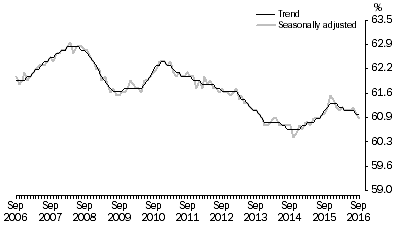
Two points to note. While movements in the two curves generally mirror each other, you can see how the gap has widened over the least two years. I think that reflects in part the continued rise in part time work. The second point is that the combined total of those out of work or who are underemployed is now well over 14% of the workforce.
The next graph shows the workforce as a percentage of the total population. This is not the same as the participation rate which is the proportion of the working age population actually in the workforce. Consequently, it is affected by the number of children and the number of those who have retired.
So what we appear to have is a steady increase in the combined un/under employment rate at the same time that the work force is declining as a percentage of the overall population.
Just at the moment, the country needs to maintain workers as a proportion of population and increase the utilisation of those who want to work. I don't think that we are doing an especially good job of either.
Friday, October 21, 2016
Parramatta and the dynamics of the apartment glut
Each day I travel through the heart of Sydney apartment centrals, finishing at Parramatta. According to Greater Sydney Commission chief Lucy Turnbull, Sydney must be "re imagined" as three great cities for its growth to be successful.
The former Sydney lord mayor said the three cities of the future would be the Eastern Harbour City, the Central Parramatta River City, and the Western City in and around the new airport at Badgerys Creek.
I can see the changes in Parramatta. Its quite interesting and in a way exciting to watch the transformation of the city gathering pace. The level of new investment is enormous, billions of dollars. As a consequence, Parramatta has (I think) reached a tipping point. Developments already begun will certainly give the city a metro feel. I am less convinced about the Western City. Actually, I can't see it at this point. Parramatta's growth has been underpinned by the shifting of government jobs. It's a government city. Now that it has achieved something approaching critical mass, other things are following. Indeed, Ms Turnbull has suggested that the NSW parliament could be moved to Parramatta by the middle of the next decade. This was, she suggested, appropriate because the areas' west of Parramatta would increasingly be Sydney’s population, commercial and government centres. “What could be more logical than having our government right in the heart of the city where most of the population is based?” Ms Turnbull reportedly told an audience of the city’s business and political elite.
I shuddered a bit for reasons that you might understand.
At the moment, I can't see this type of dynamic happening in the "Western City". There is no natural focus, although those round Liverpool may challenge me on that, while there is no sign of Government job shifts.
Finishing with two brief points. The first is, and this has been widely reported, is that the level of apartment building in the three largest Eastern capitals has got to the point that a crash is almost inevitable, The second is that we have not looked properly at the dynamics of this in terms of what it means not just for the operation of Australia's largest cities, but for the Australian polity more broadly defined.
Wednesday, October 19, 2016
Coal Returns - at least for now
During that period my twitter and Facebook feeds were full of posts especially from New England with the constant theme that coal was dead. As I pointed out at the time, there was always a difference between thermal coal used in power generation and coking coal used in steel production; you just couldn't talk about coal. Now coal prices are up, with rises most heavily concentrated in coking coal, so some of those small coal plays are in the money.
Timing is critical. It does seem likely that thermal coal is in long term decline, but in that process there will be fluctuations around the long term trend that provide investment opportunities and profits.
BHP's Andrew Mackenzie is cautious about the recovery in the prices for iron ore and coking coal, suggesting that expansion in supply would continue, reducing prices. Meantime, as Greg Jericho noted in this Guardian piece, Australian Treasurer Scott Morrison just got lucky, at least for the short term.
Tuesday, September 20, 2016
Problems in Australian profit patterns
Accounting skulduggery hides $26b in losses,
The graph suggests (I am just working from the visuals) that reported revenues have gone up by around 50 per cent. During that same eight year period, statutory profit before tax (the profit of the business after write-downs and charges) after rising sharply have trended down and are now lower in money terms than eight years' ago. Underlying profits have been trending down, but at a much slower rate and are still higher than they were eight years ago, leading to a growing gap between underlying earnings and statutory earnings.
Some measure of asset write-down is perfectly normal. Businesses make investment decisions. Some go wrong, some go right for a period and then go wrong. The most recent impairments reflect, at least in part, the end of the mining boom and consequent write-downs. However, the growing gap between underlying earnings and statutory earnings is a worry as is the poor performance of statutory earnings.
Both sets of measurement are subject to manipulation. New CEOs, for example, often seem to write of as much as they can in their first year to boost later performance in statutory earnings. Both businesses and investors focus on underlying earnings because they are meant to provide the best measure of the core strength of the business. We have had to make this financial write-off, but the underlying business is doing well. This creates an incentive to manipulate underlying earnings.
Accepting that both measures are subject to a degree of manipulation, the decline in both profitability measures relative to revenue is reasonably striking. Statutory earnings this financial year are likely to pick up because impairments will be less, narrowing the gap between the two measures, but I don't think that that will affect the overall trend unless underlying earnings increase.