Showing posts with label Greece. Show all posts

Thursday, March 22, 2018

Niko Ghika, John Craxton, and Sir Patrick Leigh Fermor and the allure of Greece - British Museum exhibition

John Craxton, Still life with three sailors 1980-1985 (detail) Tempera on canvass
I am still bogged down with other writing. Hopefully that is easing.

Interesting piece in Artdaily 21 March 2018, Exhibition explores the influence of Greece on the lives and work of three artists on a new exhibition at the British Museum this European spring. ,
Charmed lives in Greece: Ghika, Craxton, Leigh Fermor explores the influence of modern Greece on the lives and work of three influential artists, the Greek painter Niko Ghika, British painter John Craxton, and British writer Sir Patrick Leigh Fermor. The three met at the end of the Second World War and became enduring friends who all made their homes in Greece. The show brings together their artworks, photographs, letters and personal possessions in the UK for the first time.

It sounds like an interesting show about interesting subjects. I have given you the links to the Artdaily piece above and then the Wikipedia links to each of the three. If you are interested, I suggest you start with Artdaily and then go to the Wikipedia entries. From there, you can easily sidetrack into multiple directions!

 I have wondered before about the enduring love for Greece and the Greek Islands especially for writers and artists. In popular fiction, for example, Mary Stewart's thrillers The Moon-Spinners and My Brother Michael. The last includes a description of a hostel at Delphi occupied by archaeologists, artists and writers. The Australian writers George Johnson and Charmian Clift lived on the Greek island of Hydra for several years attracted by the low prices and other writers and artists. Johnson's Clean Straw for Nothing tells the story of a journalist (David Meredith) who relocates to a Greek island, but fails to find the answers he seeks after even 13 years.  

From my own trip, cheap wine, cheap cigarettes, cheap food, cheap rent, nice views and weather all provide  a possible answer. It's more than that, of course, for the romantic ideal of Greece is deeply entrenched in Western thinking.

Monday, September 25, 2017

The Greek economy revisited

It is now just over two years since the Greek political and financial crisis, I have listed some of the then posts at the end of this post.

Given the passage of time and the current economic strengthening in the Eurozone, I wondered how the Greek economy was performing now. The answer appears to be that the patient is still on a degree of life support, but its condition is improving.

The scale of the Greek economic collapse was quite dramatic. Figures from Focus Economics provide a picture of that collapse. Greek GDP declined from 191 billion Euros in 2012 to 176 Euros in 2015. Partially reflecting that decline, Government debt increased from 160% of GDP in 2012 to 180% in 2014. Retail sales dropped and dropped. The unemployment rate peaked at 26.5% in 2014.

After these dramatic changes, the economy began to stabilise. In June, the OECD reported:
After a prolonged depression, the economy stabilised in 2016 and GDP is projected to grow by 1.1% in 2017 and 2.5% in 2018. The labour market is improving, supporting private consumption, and higher demand from abroad is boosting exports. Investment has started to recover from very low levels and should gather pace. The consumption tax increase in early 2017 and recent energy price increases will raise consumer price inflation, even though core inflation will remain moderate, as ample spare capacity persists. 
In 2016, the primary budget surplus was 3.8% of GDP, exceeding expectations and the 0.5% target. Further progress in combatting tax evasion, broadening the personal income tax base and controlling pension spending are key to cementing the significant fiscal achievements of recent years, while freeing up resources for much needed social assistance programmes. Public debt has stabilised but remains very high, aggravating economic vulnerabilities and calling for additional debt relief to ensure medium to long-term fiscal sustainability.
In July, Greece was able to return to the Government bond market for the first time since 2014. In August, the Greek Prime Minister presented a positive view on the economic outlook, suggesting that Greece had turned the corner. Despite these signs of improvement, there is also a stream of negative reporting in the left of centre press and especially The Guardian. As in 2015, Greece's problems rouse an intensely ideological response.  

One can argue about the nature of the response to Greece's problems, my personal view is that the official responses accentuated economic decline, but looking just at the present numbers Greece does appear to have turned something of a corner. Growth in the Eurozone economy remains the key. If the Eurozone continues to expand then so will Greece.As it does, the financial crisis will continue to ease, laying the basis for future growth.

Previous Posts

Tuesday, August 30, 2016

Painting the colours of Greek statues

As late as my 2010 visit to the Greek Isles, I thought that while marble Greek statues were just that, white marble. I always thought that they were a bit cold, but they had become a sort of taste thing, an exemplar of Greek taste. Then I found that they were painted.

The Wikipedia article on Ancient Greek Sculpture tells a little of the story. Paint flakes had often been found on the statues but had been ignored, even denied. It wasn't until modern technology and the work of Vinzenz Brinkmann and Ulrike Koch-Brinkmann that the light (and colour) dawned upon the scene.

This 2014 piece tells a little of the story. This 2016 piece on a current exhibition a little more.

I have to say that the colours are a little garish by current tastes. This one makes the lion look a little like a stuffed toy sitting on a child's bed!

Still, it is nice to know that there was colour around. Some of those Greek homes and temples would actually have been very drab without it.

Another reminder too about the difficulty of actually knowing the real texture of the past. As an example, it wasn't until my visit to the Greek Isles that I realised just how important water was to settlement. I did know how important trade was, but it didn't form a real pattern in my mind until the visit.

The same sort of thing applies to Australian history. When I first studied Australian history, the near starvation of the early settlement at Port Jackson was attributed to poor farming techniques. That may have been a factor, but we also now know that there was an El Nino induced drought.

I should leave the last word on Greek statues to a comment from JCW at another place:
Funny, innit; whole literary/dramatic theories have been written about the differences between Apollonian (cool/white/ classical/contained) and Dionysian (unrestrained/colourful/extreme), based on modern(ish) observation of classical statues, wot were never white in the first place. I bet Apollo and Dionysus are laughing their silly heads off after getting pissed on nectar, and agreeing that humans are pretty stupid for getting it SOOOOO wrong.

Tuesday, July 14, 2015

Greece and the Eurozone's Federal Moment

I am defering my follow up post to Fissures and divides in politics - Europe and Australia: a comparison until Thursday. I found events over Greece to fascinating to leave alone, leaving me with too little thought time given other things I had to do. I really hadn't expected to become so involved in the Greek crisis, but the European media coverage and especially that from the BBC was just so good, giving me a crash up-date in European politics and economics.

In my first post on the crisis, The Greek crisis - a high stakes game marked by blindness, inexperience and rigidity, I wondered
I hadn't expected the Tsipras Government to adopt such a high stakes approach. Looking at the IMF/ECB/EC document from a purely professional perspective and accepting that it has come about after a series of discussions, I don't think that the Tsipras Government really had clear strategic objectives, nor defined negotiating tactics. It finally devolved down to tinkering with detail. We will all suffer as a consequence. 
Maybe in the few days before the referendum, Prime Minister Tsipras may set out more than what, in the end, comes down to we were robbed. I wouldn't count on it, however.
In a very interesting interview in the NewStatesman, former Greek Finance Minister Yanis Varoufakis suggested that Greece was "set up." It is clear that his early attempts to start discussions on changes to the Greek bail-out deal met opposition. It is interesting that he was apparently effectively sidelined quite early in the discussions, more interesting that he wished to implement what one might describe as a modified Grexit to assert Greek control, issuing Euro denominated IOUs and seizing control of the Greek Reserve Bank. Creditors would have been given some form of compulsory haircut. This move was rejected by Cabinet.

Based on what I have read, it appears that Professor Varoufakis met with what might be termed objective reality. There were several things that I had not properly realised about the European scene. A Greek bail-out required contributions from other Eurozone states. Here the debate was framed in terms of lack of trust. Greece could not not be trusted. Trust must be rebuilt. Beyond that, and this was captured by the Estonian PM, Eurozone taxpayers in other countries were very reluctant to put more of their money on the table. We have invested considerable political capital in this agreement despite fierce opposition from some of our citizens was his message.

Given this climate, Greek attempts to renegotiate were always going to be difficult. Here there was another problem, one not unique to Greece. The fierce domestic views developed the Greek campaign that elected the Tsipras Government did not provide a sound negotiating base in circumstances where key levers were beyond Greek control. This need not stop renegotiation, but renegotiation requires a very strategic and calculated even low key approach that reassures the other side.

I know that this is easy to say. In strategic terms, the aim is to gain concessions that will ease the Greek position. In tactical terms, you have to ease creditor and partner fears while also satisfying a domestic political constituency whose views have been inflamed by your own political campaign. This is actually not complicated. You focus domestically first. You say Greece must stand on its own feet. There are things that we must do now to give us the best base for the future, including re-negotiating bail-out terms. The harder you go at domestic level, the better base you have. This does not mean that you should not take steps to ease particular austerity measures, but that easing needs to be part of a package.

In retrospect, the fundamental miscalculation of the Greek Government was its failure to recognise that, in the end, the Eurozone countries would simply let Greece go. Greece just did not have the negotiating power. A Grexit came very close. If it had not been for former Polish Prime Minister Donald Tusk it would have happened. Now many might argue that this would not have been a bad thing. They miss the point. It should not have come to this in the way it did.

A Grexit might have been fine if the Greek Government had had an optional exit strategy in place for some time as a fall-back option. However, the Greek people did not want to exit the Euro. The Government itself including Professor Varoufakis wanted to stay in Europe and the Euro. In the end, it was apparently the German Finance Minister who belled the cat by floating the idea that a modified Grexit might be best for the Eurozone as a whole. With Greece in economic collapse, the potential cost was just too high from a Greek perspective.

What would have happened if Cabinet had approved the Varoufakis partial exit strategy? Further chaos, I suspect. By then, it was just too late.

 In Greece, Jack Lang and the Great Depression: are there lessons? I concluded:
Obviously we have to be careful about the use of historical analogies. However, there are interesting similarities. Like Australia at the time, the EU is really an evolving Federation. The economic challenges are not dissimilar including the differential impact of Federation on diverse local economies.Without over-stating the analogy, and recognising the differences, my feeling is that the most likely outcome with or perhaps less likely without Greece will be the strengthening of central control at least within the Eurozone area. It's part of an evolutionary process. 
The discussion round the post tended to focus on economic comparisons. My focus was an institutional one based on the dynamics of federations. At this point, the outcome appears to be just as I predicted, greater strength to to the Eurozone institutions, a reduction in the freedom of constituent parts.

Is that a good thing or a bad thing? I leave that to you to judge, but certainly some of the commentary that I have seen is simply very silly because it ignores institutional issues. The third Greek bail-out may or may not stick. My feeling is that it will, but it's still line ball. Whichever way it goes, it's an historic moment.

EU Structure

I response to a comment from kvd, I tried to provide a brief overview of the EU structure:
As I understand it, the 1992 Maastricht Treaty effectively sets the EU's broad constitutional framework. All EU Member States form part of the EMU (Economic and Monetary Union) described as an advanced stage of economic integration based on a single market. It "involves close co-ordination of economic and fiscal policies and, for those countries fulfilling certain conditions, a single monetary policy and a single currency – the euro." 
19 of 28 member states have adopted the euro. Two states, Denmark and the UK, have euro opt out provisions and are exempt. The other seven are meant to adopt the euro when gateway conditions have been met. However, and as demonstrated by Sweden where euro membership was defeated in a referendum, there are ways round this. 
The nineteen member states form the Eurozone. The European Central Bank (ECB) and national central banks in the euro countries form the Euro System. The 'Eurogroup' coordinates policies of common interest for the euro-area Member States. 
The EMU applies to all member states. However, additional provisions apply within the Eurozone. The EU itself is a somewhat complicated federation with certain powers delegated to the centre. Within the EU, the Eurozone forms a more tightly integrated entity because of the rules and requirements imposed by the common currency. In a way, its a federation within a federation! This requires decision processes within the Eurozone coordinated by the Eurogroup. 
We saw this in operation during the crisis when the planned EU summit, a meeting of all members, was cancelled and it was left to Eurogroup members to come up with a solution. Sources : Wikipedia, EU
There are all sorts of complexities in this that I don't properly understand.For example, the UK is a member of the EMU and as an EU member contributes to the EU budget. However, the UK as a non-Euro member is strongly opposed to the possible use of the EU budget to provide any form of support to Greece.

I think that a key point in institutional terms is that the EU is a political federation with both inherent conflicts and poorly developed central mechanisms that are still evolving.

In an interesting piece on the Lowy Institute Interpreter blog, The big lesson from the Greece fiasco: Don't let the IMF meddle, Stephen Grenville makes a couple of interesting point. The first is that Greece in combination with its partners have effectively plucked at least a degree of defeat from the jaws of victory. The basis was there early on for what might have been an effective compromise. That was lost.

The second is worth repeating in full.
Some see this as the beginning of the end for the euro experiment. With Greece staring at departure, will others follow and the euro disintegrate into national currencies? This outcome would be some kind of wish-fulfillment for the euro-sceptics who dominate the UK press. But for all its challenges (past and future), the core countries of the euro have built up massive synergies and benefited enormously, both economically and politically. The degree of integration now accomplished will not be abandoned lightly. Greece was always an outlier, a misfit in economic structure and maturity. The parting would be painful, but will not unravel the euro.
The third is that the IMF should not have become involved. This was a matter for the Eurosystem to work out. To extend the argument a little, if the IMF was to become involved it should have been an arrangement with the Eurosystem itself, not between the IMF and Greece. Why? Well, Greece is a member of a Federation. It has national sovereignty in certain areas, but not in the areas that are normally the province of the IMF. Greece is to the Eurosystem as NSW is to Australia.

We are not used to thinking in these terms. It may be that Greece should leave the Euro and indeed the EU. However, so long as Greece and the Greek people want the benefits of Federation, there will be a price to be paid.    

Sunday, July 05, 2015

Sunday Essay - Greece: the importance of family. In a failed state world, it's family that counts.

Later today Greece votes in the bail-out referendum, something I spoke of in last Tuesday's post: The Greek crisis - a high stakes game marked by blindness, inexperience and rigidity. Later kvd pointed to Greek Finance Minister Yanis Varoufakis' blog. I knew he had one, but hadn't seen it.

I live in what was Sydney's Greek Central. The surrounding suburbs, Mascot, Rosebery, Eastlakes and Kingsford were all areas of heavy Greek settlement in tha mass migration period after the Second World War.

St Spyridon's Greek Orthodox Church is nearby. Next to it is St Spyrdon's primary school. The senior school campus is in Maroubra. Just up my street is the Acropolis Funeral Service with its Greek and Cypriot flags. The Greek population that came during the mass migration period is rapidly aging. Acropolis does a very good business. I often see its cars on my walks past the Church.    

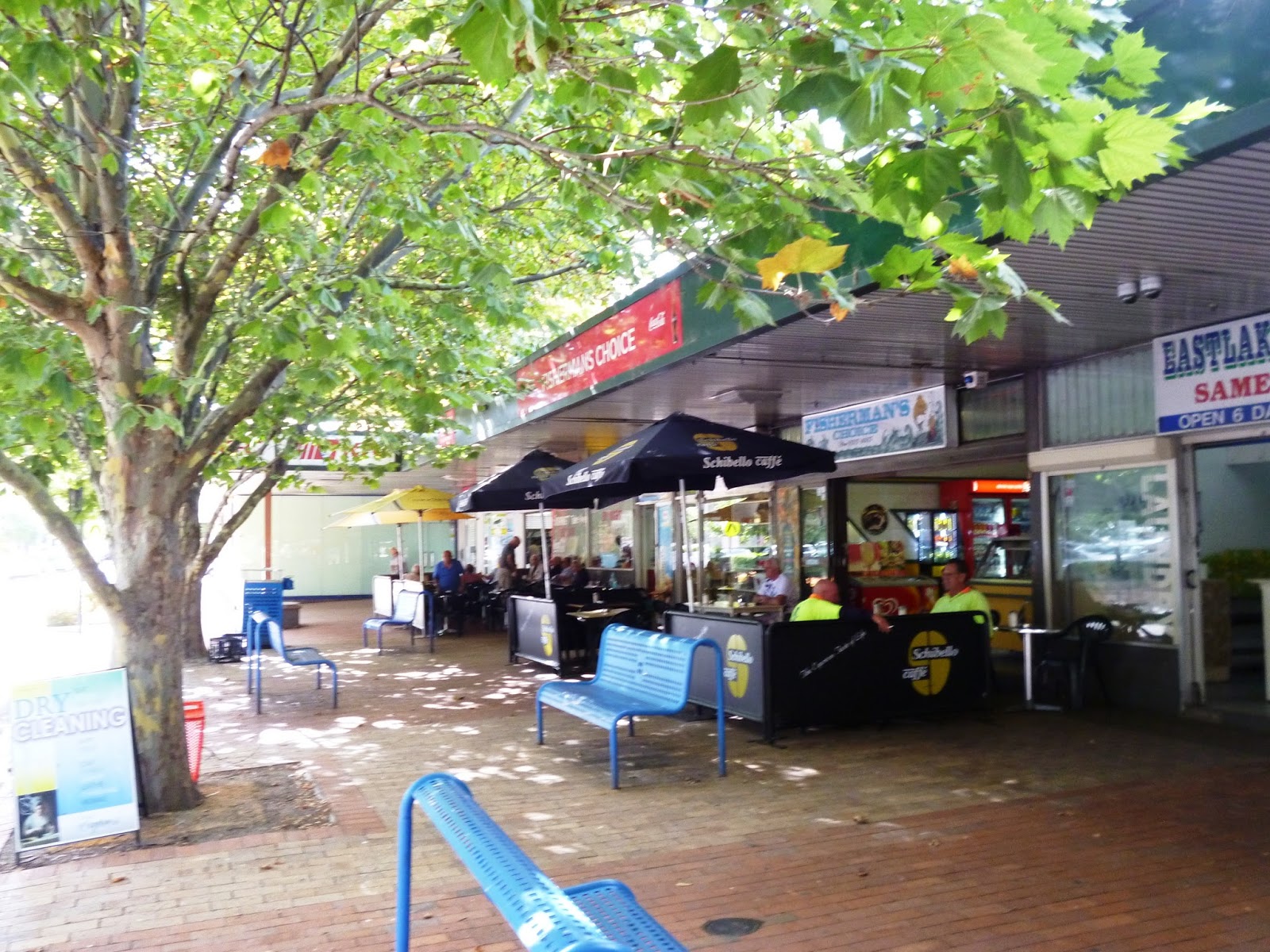
This is the Eastlakes' shopping centre. The Centre is now very mixed. Greek, Chinese, Russian and Halal shops wrestle with Woolworths and IGA. The photo is not a good one, but shows the strip where the older Greek men, most now retired, gather for their coffee. It's almost totally a male audience, the Australian equivalent of scenes that you would see in many parts of Greece. They smoke, they argue, constantly changing seats.Sometimes it's only a few, more often it's twenty or thirty.

I wonder what they are going to do about the anti-smoking regulations now about to come into place that will stop them sitting outside to have their coffee and cigarettes, to play cards and chat? Our current, mandated, health obsessions can be very cruel and insensitive sometimes.

To these people, the Greek problems are not an abstraction, they are personal. I don't actually know many Greek people in this area. My Greek connections are elsewhere. I do know that that the locals still have family in Greece, that some local residents have gone back to Greece, that the turmoil affects them personally.

It's hard. One can argue about the causes of the crisis, about the validity of different solutions, but in the end it comes back to people. In purely local terms, it's about dads and mums, daughters or sons, about parents and grandparents. It's about what happens to us.When the state fails, and that is what has happened in this case,  you come back to the most personal bedrock, family. Then, you just do what you can. In the end, it's family that counts.

Tuesday, June 30, 2015

The Greek crisis - a high stakes game marked by blindness, inexperience and rigidity

Last night, I had ABC (Australian Broadcasting Corporation) News 24 on when the press conference with European Commission President Jean-Claude Juncker came on. It wasn't appearing in my twitter feed, that was full of tweets relating to the ABC Q&A program, so I started live tweeting the conference. When the ABC suddenly dropped coverage, I managed to follow along on the BBC.

Mr Junker was obviously an annoyed man. This was a pitch to the Greek people.

The BBC coverage is quite good on this one. Before going on, this EC press release will take you to the proposals as they were at the time that the Greek Government walked out having called the referendum.  I think that these are the proposals that Mr Juncker was referring too. They are difficult to interpret properly without more knowledge than I have of the current Greek system. They seem a little clunky, a  little over-prescriptive, to me.

Based on the public presentations from the two sides, it appears that the Greek Prime Minister's position is this. The EU can't afford to let Greece exit the Euro. The costs are too high. I need a no vote (no to accepting the proposals) to strengthen my negotiating hand. On the other side, a no vote means Greece's effective exit from the Euro.

Listening to the continuing feeds last night, I was reminded of two things. The first was the nearest Australian historical equivalent, the fight between the Federal and NSW State Governments during the depression over the Lang Plan. The second was the onset of the GFC where I stayed stuck to the TV in our Shanghai hotel room watching the crisis unfold..

In parallel to the evolving Greek crisis, the Chinese Government has announced measures to try to kick-start the slowing Chinese economy, while on the other side of the world, Puerto Rico is on the point of default on its $US72 billion in public debt. Meantime, stock markets are diving.

Greece has become a very high stakes game. I am not close enough to the political dynamics to understand all the possible permutations. On the surface, the lock-in effects on each side are now such that Greece will continue in economic lock-down mode until the referendum. If the vote is yes, the Tsipras Government has indicated that it will resign. Unless an alternative Government can be formed, that means new elections and further delays. If the vote is no, then everybody is going to be looking at exit strategies.

In Australian commentary, commentators have argued that China is far more important to this country. That's true at one level. But these things are interconnected. A telling sign here is the concerns expressed by the Russian Federation about the crisis. President Putin needs a weakened EU, not an EU in economic and political crisis whose flow-on economic effects affect other economies including Russia.

From a purely domestic Australian perspective, I don't have a clear idea as to what all this might mean. Clearly, it's a matter of concern to Australia's large Greek, Greek descended community. They have a very personal stake in the problem. Money is going back to Greece to support families and prayer vigils have been held. Beyond that, I have been trying to think through the flow-on effects depending on outcomes.

I hadn't expected the Tsipras Government to adopt such a high stakes approach. Looking at the IMF/ECB/EC document from a purely professional perspective and accepting that it has come about after a series of discussions, I don't think that the Tsipras Government really had clear strategic objectives, nor defined negotiating tactics. It finally devolved down to tinkering with detail. We will all suffer as a consequence.

Maybe in the few days before the referendum, Prime Minister Tsipras may set out more than what, in the end, comes down to we were robbed. I wouldn't count on it, however.

Postscript

This graphic from the BBC sets out the current composition of Greek debt.

Monday, August 19, 2013

The Mediterranean's 300 year drought

This piece by Kosta Pandos and Sunanda Creagh in The Conversation, Climate change hastened ancient civilisations' collapse: study, interested me. It reports on a new study that concluded that climate change sparked the political and economic turmoil that hastened the collapse of formerly prosperous civilisations in regions such as Greece and Syria towards the end of the 13th century BC. You can find the full study here.

The Conversation writers put it in the context of current discussions on global warming, although the study does no more than illustrate the importance of climatic shifts in a particular place and time in which I have an interest.

I commented once before that one of the things that I did not properly understand when I first did history and prehistory at University was the extent of climatic variation. If you look at just how dry the Greek Islands are today, you can see how a long drought might affect life. In similar vein, we now know that the troubles afflicting new settlement at Sydney were in part climate induced, while during the long Aboriginal occupation of this country there were multiple climatic variations.

The expansion in our knowledge of past variations in climate and their affects is really quite remarkable. 

Tuesday, October 18, 2011

Last days on Rhodes

Greek Trip, Day 16, Sunday 3 October 2010, Rhodes continued

Continuing the story of our Greek trip from Lindos & its acropolis, we drove out of Lindos in the late afternoon to return to Rhodes. As I said at the end of my last post, I am annoyed that I did not visit the acropolis myself. Looking at Clare's photos reminded me of just what I missed in terms of overlapping history.

This shot shows the classical influence:

P1110562

This shot shows the much heavier Frankish remains. I don't know whether or not its prejudice, but I think that the gradation in fineness from the more delicate Greek or Hellenic through the Roman to the Franks (the generic name given to those from the west) reflects character!

 P1110572

The run back to Rhodes took us through country we had already see.n I was againP1020014 struck by the barren nature of the countryside, as well as the hints of historical remains. 

Back in Rhodes, we dropped the car off and walked back though the walls into the old city. After cleaning up and a drink, we walked down to a local restaurant for dinner.

I haven't spoken a lot about food on this trip, largely because I am not really enamoured of Greek food.

That night we had decided to go to a place that we had seen before and had got chatting to the owner. I was the one who pushed us into it, for the owner had been quite helpful. Talk about a disappointment! The food was poor and overpriced.

Greek Trip, Day 17, Monday 4 October 2010, Rhodes

The next morning dawned bright and hot. After breakfast, we walked downtown. The girls decided to get a drink, while I went off to try to find an internet cafe.

One of the things that you notice about old Rhodes as compared to the other Greek Island towns is that it's bigger and just so much more spread out. P1110243You don't have quite the same concentration of shops or cafes or indeed sometimes people. You need to know where you are going and have to walk longer distances.

I chose this photo to illustrate the point simply because it shows somewhat lost and confused tourists!

I walked and walked in search of my internet cafe. It was bright sunlight, very hot. Finally I found a cafe that advertised internet connections. When I asked the price, they said that it was free if I ordered something. It was hot, I was going to be there for a while, so I asked for a large beer. Silly me!

The beer arrived in due course in a very large glass boot. As best I could work out, it contained at least three full bottles of beer. Talking to the girl beside me who was drinking from a very large glass, I asked her what she had ordered. A medium beer she said!

My new friend was not a happy chappie! Apart from the beer, she had also asked about printer connections to be told that they had them. They did, but no one thought to mention that the printer was out of paper!

I drank some beer, checked Facebook and emails, then wrote a short post. By then I had drunk half the beer, but could not manage more without getting far to tipsy for a hot Monday in the middle of the day. I asked for the bill, eighteen euros!! This was a bit of a disaster for someone whose already tight budget was badly  overstretched.

I walked outside feeling very silly. It really was a con, but my own fault for not doing the proper checks first. Outside I paused to take a photo, creating some concern among the proprietors. Don't visit!  P1020028 

After this experience I walked back to the hotel and had a rest. After writing up some notes rejoined the group for dinner. We had been going to go to a French restaurantP1020032 for a food break, but found that it had closed two years earlier following the death of the owner. Instead we chose to go to Taverna Mama Sofia's for our last evening meal on Rhodes.

Mama Sofia's was just up  the road from our hotel. We sat in the roof garden overlooking the street and had a very pleasant meal.

I was still cranky about the morning's internet experience. However, under the influence of food, wine and conversation I gradually relaxed and ended up thoroughly enjoying the evening.

Tomorrow Athens and a new phase in my exploration of Greece's past and present, the classical world, the Peloponnesian Wars and current economic troubles.        

Wednesday, October 05, 2011

Lindos & its acropolis

Greek Trip, Day 16, Sunday 3 October 2010, Rhodes

After Lunch at Lindos, we walked back to the car and drove up into Lindos itself. I have said a little about the town before. Now I need to say a little more.

The following photo taken from the Acropolis looks down on the harbour where we were swimming. You can see how protected the harbour is. That protected harbour made Lindos a natural place of settlement, while its location made it a valuable trading point between Greece and the Phoenicians. By the 8th century BC the original Dorian settlement had become a major trading centre. The town's importance declined after it joined with other cities to found the new city of Rhodes, but it remained an important religious centre. 

    P1110556

The "modern" town of Lindos nestles below its acropolis. I say modern, because most buildings apparently date from the 17th century. It's a pretty place with its white houses and narrow streets. The guide book says that many of the houses were once the homes of wealthy admirals, but have since been purchased and restored by "foreign celebrities."  I have no idea about the admirals nor indeed the celebrities! However, I can see why the the place attracts so many tourists now. 

P1110524

Our main aim in visiting the town itself was actually to visit the acropolis. I had no especial desire to climb up yet more steps after Moni Tsambikas: a very steep hill!, so we decided to go up by donkey.P1110540

Now here there was a problem, for we had just missed the last donkey train!

Wife and youngest daughter strode off ahead to walk up. I was going to follow, but got sidetracked. When I looked up Dee and Clare had vanished! I thought of catching up, but the extra effort proved just too much!

I wandered around for a while, and then ended up in the square chatting with a Spanish bloke who bludged a cigarette from me. He had come across from Spain to work on resort developments, but found that work had vanished with the Greek economic collapse. There was no work at home - Spain too has very high unemployment - so he was just eking out a living doing whatever odd jobs he could get.

While we were still picking up details of Greece's economic troubles and the associated demonstrations from the press, as tourists you don't get a real feel of the problems lurking just below the surface.

Listening to wife and daughter on their return, I really should have made the effort to to go up to the acropolis. It's huge and historically variegated.

As you can see from the following photograph, it has a Frankish feel from the outside, and indeed it was occupied and extended by the Knights of Rhodes and then the Ottomans, but the original building is much older than that.     P1110543    

Wikipedia records that in classical times the acropolis of Lindos was dominated by the massive temple of Athena Lindia, which attained its final form in around 300 BC. In Hellenistic and Roman times the temple precinct grew as more buildings were added. Lindos' role as a religious centre attracted pilgrims from round the Mediterranean including the ubiquitous St Paul who reportedly called on his way to Rome. 

In early medieval times these buildings fell into disuse, and in the 14th century they were partly overlaid by the massive fortress built on the acropolis by the Knights of St John (Rhodes) to defend the island against the Ottomans.

Despite the overlays, enough remains of the earlier structures to give a feel for what once was. Here the Italians with their desire to reclaim the Roman past both helped and hindered through their reconstruction efforts during their occupation of the Dodecanese.  P1110561 

I do wish that I had visited. I have an added degree of frustration because I found the on-line material on the site quite patchy. 

With the party all back together again, we repacked the car to return to Rhodes.

Tuesday, September 27, 2011

Lunch at Lindos

Greek Trip, Day 16, Sunday 3 October 2010, RhodesP1110503

Continuing the story of our Greek trip from Moni Tsambikas: a very steep hill!, after a drink we headed south to our final destination, Lindos.

Attracting 500,000 visitors annually, Lindos is one of the most popular tourist places on Rhodes.

This photo will give you a feeling why.

On the left is the harbour with its pretty beach, forming one tourist mecca. In the centre is the pretty white painted village with it seventeenth century houses, a second tourist mecca. Then on the top of the hill the acropolis looms over the town, adding a particular historical perspective for those with strong enough legs.

I fear that our party had not come for the history but the beach! We parked the car and walked down the steep road to the hP1110520arbour.

It was very pretty.

Clare and Denise went off for a swim, while I wandered off along the beach to try to find a place where I could find some stuff for a picnic lunch. There were lots of places to eat, but we didn't want to spend a lot of money.

It actually took me some time, but finally I came back carrying cheese, salami, some fruit and a bottle of cheap red wine.

By then, the two girls had had their swim, if with one adventure.

Clare went swimming with her sun-glasses on, I suppose that one must do this in Greece, and lost them in two metres of water. So her mother went back in and actually managed to find them in the very clear water!   P1010989

We had positioned ourselves at the top of the beach in the shade. While Clare and Dee went for another swim, I jotted down a description to try to capture the scene.

"The beach stretches round in a small semi-circle, then there is a small headline and the main Lindos town beach.

From on high, each beach is marked by rows of sun umbrellas beneath which perch sun lounges. The tourists cluster round their lounges; some are stretched out sun-baking; others have towels draped over their heads, exposing the rest of their bodies.

Just to the left of me is the official control desk: a sun-shade, a water container, a book of tickets. There are two controllers.

From time to time, one collects his tickets and goes out on patrol in case someone is occupying a sun lounge without paying. The first controller leaves, then a mobile rings. The second controller springs to his feet. Perhaps there is a breach, a tourist has not paid.

We are picnicking in the shade, attracting strange glances. In the cafe behind us, the sound system seems stuck on a Caribean version of the Sound of Music. Repetition six of Get Me to the Church on Time has just started. Initially attractive, the beat version has now become unbearable.

It must be the end of the official day. The remaining beach controller has just picked up his water, his tickets and strolled away. We leave too."

Sunday, September 25, 2011

Moni Tsambikas: a very steep hill!

Greek Trip, Day 16, Sunday 3 October 2010, RhodesP1110438

  Continuing the story of our Greek trip from Kalithea Thermi, we finally gathered our group together and sat for a while in part of the shaded garden. Youngest continued her fascination with Greek cats. She took photos throughout Greece. The were a lot of cats to photograph!

We now left the world of Mussolini and the Italian Dodecanese behind, driving south in the mid-morning sun.  Next stop Moni Tsambikas and another part of Greek history and culture.

Just south of Kalithea Thermi, the road passes through Faliraki. This is a big resort area, sort of the Gold Coast of Rhodes. I am not sure why I was surprised to find it, but I was. It all seemed somehow a bit raw. As on Crete, I suspect that part of it was a symptom of the Greek bubble. Curious, I wanted to drive and walk around to have a look, but we were on a schP1010950edule.

  We had been told that we should visit Moni Tsambikas for the views. However, we were also warned that it was a pretty steep climb. That warning was correct!

There is a parking spot half way up, but from there you proceed by steps. We climbed and climbed.

Part of the story about the monastery is that it is a place of pilgrimage for childless women. Apparently on 18 September each year, the monastery's festival day, women climb the steps on their knees and then pray to conceive.

Mmm!

Most of the climb is shaded, but it was still very hot. I began to think longingly of a drink once we reached the monastery. Here I was grievously misled by the word monastery. To my mind, monastery conjures pictures of a substantial building with monks. That's not so here.

Moni Tsambikas is in fact a smallish Greek Orthodox shrine perched right on top of the mountain, with sheer drops on all sides. No drinks there! I was quite surprised, in fact.

As you can see from the following photo, the building is of conventional Greek style with the inevitable add-ons of power line etc.P1010960

We wandered around inside and then clambered around outside. The views were indeed spectacular.P1110490

Fine views are good, but I wish that I knew or could find more of the history on Moni Tsambikas  itself. I know that I am a history nut, but I do like to know just what I am seeing!

We decided to go back to the cafe at the car park half way up the mountain for a drink before moving on. This was an Austrian style place, what else in Greece?, but the beer was nice. There Clare was fascinated by the goats!

    P1110494

Drinks had, goats seen, we drove south through the mid day sun. Next stop Lindos. 

Monday, September 12, 2011

Kalithea Thermi

Greek Trip, Day 16, Sunday 3 October 2010, Rhodes

Continuing the story from Rhodes and the sad failure of the Dodecanese campaign, our hire car was P1010860 delivered to the hotel. All we had to do was to find our way out of the old town and then to the main road down the East Coast. Sounds simple? Well, consider this photo.

We bumped around on the narrow streets for a while and then, with a bit of help, found our way out. Lost again, we drove around in the new town for a little until we got our bearings.

Finally, we got onto the main road and headed south. First stop, Kalithea Thermi.

Our hosts at the hotel had told us a little bit about this place and recommended that we visit.

Attracted by the sea and the then hot springs, the Italians built a spa there for the particular use of King Victor Emmanuel III and Mussolini.

I had to refresh my memory of King Victor Emmanuel III for he is quite overshadowed in my mind by Mussolini. Born on 11 November 1869, he ascended to the Italian throne on  29 July 1900 following the assassination of his father King Umberto. He was then thirty, not all that much older than the country itself; Italy had only come into existence in 1861.  

220px-Victor_Emmanuel_III This illustration from 1902 presents Victor Emmanuel as a small peacock. Peacock he may have been, small he certainly was, a little over five feet.  He inherited a country that was still poorly developed. At the time the Kingdom was established the great bulk of the population was illiterate lacking a common language. What we now know as Italian was really spoken only in Tuscany.

Victor Emmanuel's Italy was a constitutional monarchy, although the King retained residual powers including the right to appoint the Prime Minister. Politics was unstable. Between 1900 and 1922 the King was forced to intervene ten times to resolve parliamentary crises, something that he found personally difficult because he was apparently shy and somewhat withdrawn and hated the day to day stresses of politics.

As in many new states, there was a strongly nationalist thread to politics covering three main threads: a desire to extend the country's boundaries to include all Italians; a desire the build Italy into a modern industrial state; and a desire to re-create an Italian Empire. As with Greece and the Byzantine Empire, the ideal of the Roman Empire exercised a powerful allure.

Benito Mussolini was one of the nationalist figures. Initially a member of the Socialist Party, he came to the view that socialism had failed. Placing weight upon nationalism, he built a new political movement, the Fascists.

Fascist violence had been growing in intensity throughout the summer and autumn of 1922, climaxing with the rumours of a possible coup. In October 1922, Mussolini led a force of his Fascist supporters on a March on Rome. Prime Minister Luigi Facta and his cabinet drafted a decree of martial law.

After some hesitation the King refused to sign it, citing doubts about the ability of the Army to contain the uprising. The King had really lost his nerve. The monarchy was generally popular and the Army loyal, but I think the King was simply unwilling to risk civil war. Instead, he appointed Mussolini as Prime Minister. Mussolini then used this position to cement his power.P1110391

    Kalithea Thermi was opened in July 1929, just under seven years after Mussolini became PM. It was, I think, one of a number of building projects intended to put an Italian stamp on the Dodecanese.

I had no idea what to expect as we came up to the gates, and indeed it took me a little while to work out the layout. It's not until you get right inside that and walk around that you start to get a feel.

The complex is located on a small peninsular, with small bays/beaches on each side. It's a pretty location, although like many parts of the Greek Islands the surrounds are rocky and treeless.

The main building is built in a series of concentric circles and is designed to be light and airy to counterbalance the summer heat.

Even though many of the Mussolini period constructions were monumental imperial, the complex displays a lighter Italian design touch. You can take the Italian out of Italy, but not the Italian out of design!

In a way, the fate of Kalithea Thermi mirrored that of King Victor Emmanuel. In supping with the devil, the King doomed his own mP1110406onarchy. As Italian ambitions expanded, the King became Emperor of Abyssinia (1936) and then King of the Albanians (1939). The King retained his own popularity long after that of Mussolini had fallen. You can actually see this in the somewhat ironic popular ditty quoted in Wikipedia:

 
"When our Vittorio was plain King,
Coffee was a common thing.
When an Emperor he was made,
Coffee to a smell did fade.
Since he got Albania's throne,
Coffee's very smell has flown.
And if we have another victory
We're also going to lose our chicory.

On 24 July 1943, the King dismissed Mussolini. Then, on 8 September 1943, he announced an armistice with the Allies without first notifying the armed forces. Confusion reigned, allowing  the Germans, who had been expecting this move for some time to quickly disarm and intern many Italian forces.

New military forces loyal to the King and Government were formed who fought on the allied side. To try to preserve the monarchy, the King first transferred increasing power to his son, and then, on  9 May 1946, abdicated. P1010921

It was too late. Less than a month later, Italy voted to establish a republic. However, the country split down the middle. A clear majority in the north voted no, in the south yes.

Kalithea Thermi was damaged in the fighting during the last stages of the war. Even so, enough remained to make it a popular movie site. However, the Greek Government with limited funds and its own problems had little interest in maintaining or restoring a site of Italian power.

Deterioration was progressive and cumulative. Finally, the site became a ruin.

As with so many things connected with Greek history, it was the EU that funded the restoration of Kalithea Thermi. Today, you can once again see Kalithea Thermi as it was when the Italians strutted the Dodecanese stage.

Not, mind you, that you will get a full picture.  A bit like current Australian history, the past has to fit present perceptions. In some ways, the Italian period is brushed out in current descriptions.

Next stop, south to another part of Greek history and culture.          


Saturday, September 10, 2011

Rhodes and the sad failure of the Dodecanese campaign

Greek Trip, Day 16, Sunday 3 October 2010, Rhodes

P1010910 Continuing our trip story from A visit to the Archaeological Museum of Rhodes, Sunday 3 October dawned bright and warm. We gathered on the roof garden breakfast area to plan our day.

According to the hotel, San Nikolis', the main hotel buildings date from 1300AD. There is a minor date problem here that I haven't had time to resolve, because this is a little before the final surrender of the Island to the Knights. 

The hotel buildings were constructed on part of the remains of the 2,000 year old agora of Ancient Rhodes. You will find agora in all the older Greek settlements. They were centres for public gatherings that also became markets. Apparently, the Greek words for I shop and I speak in public are both derived from agora, as is the English word agoraphobia. The Roman equivalent is forum.

We liked this hotel because it was comfortable if a bit kitsch, combining in a strangely satisfying way the  combination that is modP1110269ern Greece.

The hotel bills itself as honeymoon/wedding location. The decorations were an eclectic mix of modern, mediaeval and classical.

From the roof garden, you looked over the preserved excavated remains of the agora to the wall built by the Knights. In another direction, the view was of the harbour with it's cruise ships. P1110270

"We don't like the cruise ships", our hostess explained. "Their passengers crowd the streets but don't spend any money. They interfere with our visitors."

Our host had played roles in many films made in Rhodes. The Island's varied history and built infrastructure provides filmic base from the early period to the Second World War.

One of the best know films filmed largely on Rhodes was the 1961 military epic, The Guns of Navarone. I enjoyed both the original book and the film. 

220px-GunsofNavarone The events in the film are based around the events of the 1943  Dodecanese campaign.

With the defeat of the Germans in Africa in the spring of 1943, Winston Churchill turned his attention to the Dodecanese Islands, then Italian Territory. To his mind, their occupation would place pressure on neutral Turkey to join the Allies while opening up a new supply route to Russia.

British planning for what was called "Operation Accolade" began on 27 January 1943.  The Americans, who wanted to concentrate on a landing on Sicily and who where suspicious of British post war plans, told Churchill that they would not support the plan.

One of the things that I find interesting and that is little covered in the teaching of Australian history is the nature of the continuing conflict over a very long period between the US and Empire and Commonwealth strategic interests. I think that it's hard to cover simply because the perceptual models underlying research and teaching of Australian history reject the validity of the very idea of an Imperial and Commonwealth interest in the desire to pursue and present the ideal of the growth of Australian nationhood.

As the possibility of an Italian surrender became stronger, the British began planning for a more limited version of Operation Accolade. Again, the US said that it would not support it. Barely a week before the Italian surrender on 8 September 1943, the military resources intended to support the scaled down version of Operation Accolade were dispersed.

With the Italian surrender, Italian forces in the Dodecanese wanted to surrender or join the Allies. There was a scrabble to try to help them. The far better organised Germans had not been blind to Allied plans. The result was the last great German victory of World War II, a humiliating defeat for the mainly British forces attempting to take the Dodecanese. The Islands remained under German control to the end of the war.

The biggest losers were the Jews of Rhodes. In my first post on Rhodes, Breakfast in Rhodes, I mentioned the Jewish Quarter in Rhodes old town. The ancient Jewish community had survived through multiple changes and by the 1920s represented a significant proportion of the population of the City of Rhodes. This seems then to have dropped, but there were still some 2,000 Jews in Rhodes in in 1943.   

The Italians had never fully shared the Nazi's preoccupation with the Jews. Now that the Germans had full control, German policy applied. On 19 July 1944, the Gestapo rounded up the island's Jewish inhabitants to send them to extermination camps. Few survived.    

Today, the guests of the San Nikolis' include a strong German contingent. The European ethnic wars of the twentieth century have been put aside, at least so far as major groups are concerned. German tourism is critical to Greece, German money to the preservation of Greece's past. I think that that's rather good, even if I do not like German breakfasts!

Well, breakfast is over. Now we have to get our car and head out. First stop one of Mussolini's pleasure palaces.          

Tuesday, September 06, 2011

A visit to the Archaeological Museum of Rhodes

Greek Trip, Day 15, Saturday 2 October 2010, Rhodes End

Continuing our trip story from Popes, Knights, Mussolini & Rhodes, the Archaeological Museum of Rhodes is housed in the medieval building of the Hospital of the Knights. The building was begun in 1440 by Grand Master de Lastic with money bequeathed by his predecessor, Fluvian, and completedP1010890 in 1489 by Grand Master d'Aubusson.

We simply didn't allow time at the Museum. It sprawls with a series of exhibitions or galleries tracking the Island's complicated history.

I ended up making a beeline to the newly opened Minoan gallery.

In earlier posts (The remarkable story of Arthur Evans, Knossos and the Minoans, Akrotiri, Greece and the passage of time) I explained a little of my fascination with the Minoans. I hadn't actually realised prior to the trip just how widely distributed the Minoan influence was. Now I was looking at the same thing in another place.

Sadly, I wasn't allowed to take photos, but I found it fascinating.

I know that many of my readers do not share my somewhat obsessive love of history. It's an addiction, a fascination with the discovery of patterns. I made the point in an earlier post that part of the story of the Greek Islands can be seen in terms of access to water (this was necessary for life) and the sea (trade allowed growth in wealth.) However, you also have to understand location.

Over the centuries, the sea facilitated the spread of Minoan influence and the growth in Minoan wealth. Location affected the Minoans because they had access to the advanced civilisations in what is now the Middle East. To the north on what is now the Greek mainland, another civilisation grew called the Mycenaean that supplanted the Minoans. Then this collapsed, creating a dark age.

For those who want to know more about the history of this long period, I have found a very useful resource, The Prehistoric Archaeology of the Aegean, prepared by Dartmouth College.

P1010904 I spent far too much time with the Minoans, so that it was getting dark when I emerged and had to scoot to see things. This wasn't helped by poor lighting in many places (the photo will give you a feel), nor by the extended history covered by the museum.

According to Wikipedia, in the 8th century BC, the island's settlements started to form, with the coming of the Dorians, who built the three important cities of Lindos, Ialyssos and Kameiros, which together with Kos, Cnidus and Halicarnassus (on the mainland) made up the so-called Dorian Hexapolis (Greek for six cities). I have left the Wikipedia links so that you can explore if you want.

The Persians invaded and overran the island, but were in turn defeated by forces from Athens in 478 BC. The cities joined the Athenian League. When the Peloponnesian War broke out in 431 BC, Rhodes remained largely neutral, although it remained a member of the League. The war lasted until 404 BC, but by this time Rhodes had withdrawn entirely from the conflict and decided to go her own way.

In 408 BC, the cities on Rhodes united to form one territory. They built the city of Rhodes, a new capital on the northern end of the island. From then until Alexander the Great's conquest of Rhodes in 332 BC, life seems to have been turbulent. However, Alexander marked the start of of a long period of great prosperity for Rhodes. P1110329

Under the successor empires that followed Alexander's death, Rhodes became an ally of the Ptolemies who established a new Egyptian dynasty that ruled there until the death of Cleopatra in 30 BC. Rhodes then became a part of the Roman Empire and subsequently the Byzantine Empire.

All this and subsequent history is mirrored in the Museum. You can see why one can get museumed  out!

Just thinking about it in terms of my own interests in using history to help promote tourism in New England, there is a very real skill in the way history needs to be presented to provide context.

The complexity of Rhodes' history is far greater than that of Australia. Yet the challenge is the same. Without history, the museum artifacts lack context. Yet with too much history, it is easy to become even more confused!

After finally gathering all our party, we wandered back to our hotel for a wash, a pre-dinner drink and then out to dinner.

I have no recollection as to where we went, nor did I take any notes! It clearly didn't stand out in my mind as to food.

Tomorrow we drive to Lindos, passing through three very different worlds in one day.

Saturday, September 03, 2011

Popes, Knights, Mussolini & Rhodes

Greek Trip, Day 15, Saturday 2 October 2010, Rhodes continued

P1010852 Continuing the story of our Greek trip from Walking the walls of Rhodes, climbing down from the walls, we founds ourselves back in the mediaeval world of Rhodes.

Our challenge now was to find our hotel in the narrow mediaeval streets!

My wife had checked the map, and knew where we were going, so I followed along behind. We followed the wall back, and finally found the hotel.

This proved to be a nice place with an internal courtyard. Taking one look at the courtyard, the group sent me out to buy things for our usual picnic lunch.

Do you know, I couldn't find a supermarket or small store?

I followed the street we had come back, and then went in the opposite direction. While old Rhodes is still small, it was far larger than the Greek Island towns that I was used too. There were, in fact, far fewer eating places of all types relative to geography. Finally, I came back and admitted defeat. Then, with my wife's assistance (!), we finally found a supermarket.

We settled down in the courtyard with our bread, cheese, wine and a variety of nibbles to plan the rest of the day. We wanted to see the Palace of the Grand Master of the Knights of Rhodes and the archaeological museum.

In introduced the Knights and mediaeval Rhodes in my last post because the physical architecture of Rhodes is dominated by the mediaeval period. It seemed easiest to come in this way. However, like other parts of the Greek Islands, history is not straight forward, but overlaps, leaving an overlapping pattern on the human and physical landscape.

The Eastern Roman Empire, what we now generally call the Byzantine Empire, may have become Greek in cultural terms, but did not forget that it was the Roman Empire. As the Western Empire declined, the East made continuing attempts to preserve the west, to recreate the Empire. The Pope in Rome continued to assert a claim to primacy, but also had to manage the shifting balances of political and military power in the west, including the continuing Byzantine presence in Italy as well as Norman incursions into Byzantine territory in Italy and beyond. 

During the long centuries, the eastern and western wings of the Catholic Church drifted apart beset by politics as well as theological differences. In 1054 AD a great schism occurred leading to real separation.

When in 1095 the Byzantine Emperor sought help from Pope Urban II to defend his Empire against the invading Turks, one of the things motivating Pope Urban to offer support was his desire to reunite the Church. This was to fall foul of politics, theology and dynastic ambitions. 

The modern dividing lines between the distribution of Roman Catholic and Orthodox Catholic adherents as well as Christian and Muslim adherents all reflect the shifting balances of power in these previous periods.     

P1010887 The Knights of Rhodes were today what would be called a multinational organisation. They owed formal allegiance to the Pope and combined people from many language groups. To manage this, they were organised into tongues whose masters reported to the order's grand master.

The newly constructed Palace of the Grand Masters allowed for this division into tongues. However, it appears that the Palace today is not the same as the original Palace. Oh no, that would be far to easy!

The Palace was built on the site of the previous Byzantine citadel. Then, when Rhodes fell to the Ottomans in 1522, it became an Ottoman fortress.

In 1856, a huge ammunition explosion destroyed part of the palace. When the Kingdom of Italy seized Rhodes in 1912 from the Ottoman Empire, the Italians rebuilt the palace in a grandiose pseudo-medieval style as a holiday residence for Victor Emmanuel III of Italy, and later for Benito Mussolini. Rhodes would be formally part of Italy until 1947 when it was transferred to Greece for the first time. 

Now all these mind glazing dates are quite significant. I will talk about the Italian period in more detail later when we come to visit the Mussolini built resort of Kalithera Themi. For the moment, I just want to note that the history of Rhodes and the broader Dodecanese Islands has its own unique features.

P1010864 I keep saying that history and individual visions of history exercise a deep influence on Greek history. To many Greek nationalists, the Byzantine influence, the dream of recreating the great Greek empire, has had powerful appeal. Mussolini, too, suffered from the same disease with his dream of recreating the (Western) Roman Empire.

In 1919, war broke out between Greece and Turkey. The end result was was what would be called today ethnic cleansing. More than a million Greek speakers, half a million Turkish speakers, were relocated.

Rhodes under Italian control was spared this bloodshed and forced dispossession. As a consequence, the Island retained a significant Muslim minority population.

The photo shows the Mosque of Suleiman which is currently being restored. The mosque of Suleiman was built soon after the Turks occupied the city of Rhodes in 1522 on the site of the destroyed Christian Church of the Apostles.

As we walked up the hill from our hotel towards the museum, we passed the site of the huge explosion of 1856 and then walked down the street to the museum.

Now here I want to introduce a practical hint, one that I have referred to before. When travelling in a group in which different people have different interests and go at different paces, do set reunion points and times. Otherwise, you will end up with some waiting for very long periods!

In my next post I want to go back much further into the past, to Rhodes well before the period of the Knights. But that will have to wait until tomorrow. 

Wednesday, August 31, 2011

Walking the walls of Rhodes

Greek Trip, Day 15, Saturday 2 October 2010, Rhodes continued

Continuing from Breakfast in Rhodes, after breakfast we moved off to find the entry to the walls, asking P1110161 as we went. We still had no idea just what we were doing, although we could see signs of fortifications everywhere.

Now at this stage, I need to introduce a little bit of history.

In 1095 AD (or CE depending upon your preference), the Byzantine emperor Alexios I Komnenos sent envoys to Pope Urban II seeking aid against continuing invasion of the Seljuqs (Turks) who had penetrated not far from Constantinople (now Istanbul). The result was the First Crusade, whose primary aim came to be to free the Holy Lands from Muslim (Fatimid) rule.

The North African based Fatimids were in fact divided from and in opposition to the Seljugs on political, dynastic and religious grounds. During uneasy periods of peace and war, the Fatimids had progressively extended their territory at the expense of the Byzantines.  

In July 1099, Jerusalem fell to the Crusaders who instead of returning the territory to Byzantine rule established a series of independent principalities, most importantly the Kingdom of Jerusalem. Now I need to introduce a new player. Australians will know them as the Knights of St John, Maltese as the Knights of Malta.

From 600 there had been a hospital in Jerusalem to care for Christian pilgrims. in 1005 Caliph Al Hakim destroyed the hospital and three thousand other buildings in the city. However, the hospital was given approval to re-open in 1023. After the Crusaders took the city, those involved with the care of pilgrims evolved into religious military orders, the Knights Hospitaller.

P1110172 When the Kingdom of Jerusalem finally fell in 1291, the Knights took refuge in the Kingdom of Cyprus. from there, they decided to seek their own temporal domain, selecting Rhodes, then part of the Byzantine Empire. Still with me? I know that it's complicated, but that's the reality of Greek history.

After over two years of campaigning, the Island fell to the Knights 15 August 1309. Now named the Knights of Rhodes, they rebuilt the city into a model of the medieval ideal. The end result is that the world heritage listed old Rhodes is the largest still inhabited mediaeval centre in Europe.

I said earlier that Rhodes had a very different feel from the other Greek island centres that we had been too. This history is the reason why. If you look up this street, you will see the cobble stones, the medieval buildings.

This was a much tougher world. To hold their new territory, the Knights needed walls to hold of attack in an uncertain world. These were the walls we were going to walk along. Their size is simply unbelievable.  P1010833 

I tried to find a photo that would give you a feel. This one gives at least a feel for scale. 

I said that the world was an uncertain place.

In 1444 and then again in 1480, the Knights withstood attack. However, in December 1522 Rhodes fell to the huge invading  army of Suleiman the Magnificent. The Knights had ruled Rhodes for 213 years, not much less than the time since Governor Phillip first arrived at Botany Bay in 1788. Rhodes would now be part of the Ottoman Empire for nearly 400 hundred years.

The few remaining nights moved first to the Kingdom of Sicily and then to Malta where they set up a new base. The Knights, now known as the Knights of Malta, would rule in Malta until 1798 when Napoleon occupied the Island.  Today the Knights remain with several orders and internationally recognised vestigial powers as a quasi national entity. 

As we walked along the wall in the bright sun, we looked down into the old city on the left, the new city on the right.  Looking now for photos that might best encapsulate the feel, I chose this one from Clare looking down on the old city. It's not the best shot, but it captures some things I want to talk about. Comments follow the photo. P1110202

In terms of the modern, you have the jet trails in the sky, the solar hot water systems. Because of the climate, solar hot water systems are quite noticeable. They are everywhere. Then you have the Greek Orthodox dome and behind it to the right, the mosque. Rhodes is an interesting mix of history and cultures.

The following is another shot. Again, you can see the huddle of buildings and the solar hot water systems. In this case you can also see part of one of the internal gardens that are a feature of Rhodes.P1010849

We walked on through the sun to the end of the wall. Now to find our hotel, But that's for the next post!