Showing posts with label aborigines. Show all posts

Monday, January 17, 2022

Personal reflections on the tent embassy


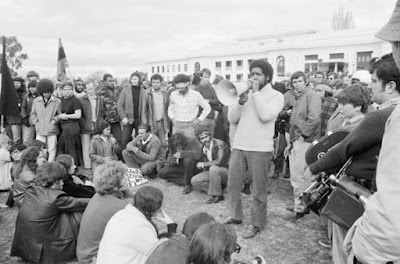
Activist and actor Bob Maza addresses a protest at the Aboriginal Tent Embassy in front of Parliament House on July 30, 1972. Wikimedia Commons, CC BY-SA

A piece by Bronwyn Carlson and Lynda-June Coe in the Conversation, A short history of the Aboriginal Tent Embassy – an indelible reminder of unceded sovereignty, took my mind back.

The Tent Embassy began on 26 January 1972. I was working in Treasury at the time, just across from the Embassy. I frequently walked past it on my walks or when visiting Parliament House. The thing that stands out in my memory now is that I had no idea of its significance. There was a total void between me and the Embassy, a void of ignorance. 

Growing up in Armidale, there were very few Aboriginal people. The big influx began about 1956 with in-migration, leading to the creation of an Aboriginal camp on the town dump. I remember that, I remember the creation of the reserve, the last created by the old Aboriginal Welfare Board. I remember the construction of new galvanised homes leading to the application of the name Silver City. I remember some of the activities carried out through Chirch and University groups to try to improve conditions. I knew some of the older families by name. I even knew some Aboriginal history up to the European invasion and had read anthropological and historical studies. I had heard a young Charles Perkins speak to UNE students at a crowded UNE Union meeting. And yet I knew nothing about certain key aspects of Aboriginal history post 1788.

At the time, discussion on Aboriginal issues tended to be dominated on one side by Northern Australia, on the other by the emerging interest in massacres and frontier violence. I already knew a little about the second, but there was nothing on post frontier warfare Aboriginal history in NSW and especially in Northern NSW where my particular interests lay. 

In 1966 when I read Malcolm Calley's thesis on the Bandjalung I was interested and surprised by the continued existence of Aboriginal culture including language, but I had no context to set that into. 

It would be a number of years before my own research started to paint a picture, more years before I actually met a large number of Aboriginal people through my work with the NSW Aboriginal Housing Office. And yet, even now, I don't think that we have a basic foundation text on Aboriginal history at least so far as NSW is concerned. I think that's a problem.  

Friday, July 09, 2021

NAIDOC Week 2021 - reflections on the meaning of Country


My Country. Gordon Smith, Stormy Morning

The theme of this year's NAIDOC Week is Heal Country. The NAIDOC web site describes is in this way:

The NAIDOC 2021 theme – Heal Country! – calls for all of us to continue to seek greater protections for our lands, our waters, our sacred sites and our cultural heritage from exploitation, desecration, and destruction.

Country that is more than a place and inherent to our identity.

Country that we speak about like a person, sustaining our lives in every aspect - spiritually, physically, emotionally, socially, and culturally.

NAIDOC 2021 invites the nation to embrace First Nations’ cultural knowledge and understanding of Country as part of Australia's national heritage and equally respect the culture and values of Aboriginal peoples and Torres Strait Islanders as they do the cultures and values of all Australians.

For generations we have been calling for stronger measures to recognise, protect, and maintain all aspects of our culture and heritage.

We are still waiting for those robust protections.

This year’s theme also seeks substantive institutional, structural, and collaborative reform – something generations of our Elders and communities have been advocating, marching and fighting for.

Healing Country means finally resolving many of the outstanding injustices which impact on the lives of our people.

It is about hearing and actioning the aspirations of Aboriginal and Torres Strait Islander peoples which are the culmination of generations of consultation and discussions among our nations on a range of issues and grievances.    

In a way, this description is confusing because it mixes together a number of different things. In this post, I want to concentrate one thing, the sense of Country. 


                                My Country. Julia Griffin Rain on the Uralla Road

I once tried to explain the difference between the Aboriginal perspective and that of the new European settlers in this way: to the Aboriginal peoples, the present was an extension of a living past, to the Europeans, a point towards a still to be defined but hoped for future. The Aboriginal perspective was carried through in various kinship systems that effectively integrated the natural and human environment by placing plant, animal and physical features within kinship systems. 

The modern Aboriginal idea of Country and connection to Country draws from this traditional base although it carries connotations that reflect the  Aboriginal historical experience, including the desire to re-establish and re-assert links to past connections and experiences destroyed by European colonisation. In a way, the idea of Country and healing Country is part of a set of beliefs linked to but independent of the original history, a set of beliefs that has now gained a living presence, creating its own history.

The Celtic Revival provides an example of a similar process in a European environment. This drew in part from historical grievances, in part from a sense of loss, in part from a romanticized version of the past.  In doing so it aimed to recover elements of that past, including language revival. It also incorporated mystical elements drawing from Celtic folklore that have had a huge impact in, among other things, fiction including in fantasy world. The ABC TV series Cleverman (a series I greatly enjoyed) provides an Aboriginal example.


                                    My Country. Gordon Smith Winter Morn 

When I first came across the Aboriginal sense of Country, my instinctive reaction was Yes! because it so exactly mirrored my reactions to the area in which I grew up, which remains my Country today.  Later, when I worked with Aboriginal people, I came to understand why Country was so important to people whose pasts had been so disrupted. Without that contact they were adrift in a way I sometimes felt faced with the destruction of the immediate past and present, with distance from my home, with my inability to do things that might protect, preserve and create. 

Some may argue, and especially those deracinated Australians who have lost connection with place, that the comparisons are not comparable. How can I as an older white male from a middle class background who has gained from the benefits of settler society, from the benefits of dispossession, possibly understand, share? In response, I would argue several things. 

From my experience, there is a thirst among many Australians to establish their own place in their family histories, to link back to the places they and their families have come from, to establish connection with the places they now live. Many, and especially older Australians from regional backgrounds who have moved on but now hark back to their past, share and re-share stories and images from places that were, in their thinking, their own Country. I know all this from my experience as a regional historian, from my participation in groups such as Armidale Families Past and Present. 

In my own case, my mind is filled with experiences, stories and images that now incorporate the deep history of Aboriginal New England however imperfectly. I am a story teller who has ended in the role as preserver of memories. My mind is full of stories. Those stories are all linked in some way to land, to Country.  
 
To my mind, the Aboriginal concept of Country holds out important possibilities for healing the gap between between Indigenous and non-Indigenous society. In understanding the Aboriginal concept of Country we learn about Aboriginal society and history. We can better support action to heal the past. But we also learn more about our own concepts of Country, about the things that are important to us. 

Sunday, July 04, 2021

NAIDOC Week - reflections on the teaching of Aboriginal history

Aboriginal languages, NSW at the time of European Occupation. In 1788 there were at least 250 Aboriginal languages on the Australian continent incorporating multiple dialects. 

I see that Neil Whitfield has put up his annual post(s) on NAIDOC Week.  The Week celebrations are held across Australia each July to celebrate the history, culture and achievements of Aboriginal and Torres Strait Islander peoples. NAIDOC is celebrated not only in Indigenous communities, but by Australians from all walks of life. This year the Week begins today, 4 July.

I am less familiar with NAIDOC Week than I was when working as a contractor for the Aboriginal Housing Office, NAIDOC Week was a major celebration, Now many years later and miles away, my current activities have caused me to reflect on the teaching of Aboriginal history. 

As regular readers will know, I have been teaching a full semester (six month) course on the history of the broader New England. As shown by the map, the study area covers the  New England Tablelands and the surrounding river valleys to the north, south, east and west. This is a large area, larger than many European counties including England, incorporating many sub regions. 

The first part of the course traces the history of Aboriginal New England from out of Africa perhaps 72,000 years ago though to 1788. I deal with the impact pf European occupation including the Aboriginal response in two lectures and then try to incorporate subsequent Aboriginal history as elements in the course.

The course has been more demanding than expected. Last year's course was stopped in its tracks by covid requiring it to be spread over the full year. Then I structured first semester 2021 into two groups with with two discussion groups, a structure based in part on the risk that covid might limit the numbers that could be accommodated in the available space. One result was that I ended up with two full lectures a week plus a discussion session. Now I am planning the the third session restructured again to take covid into account. This will start in a bit under two weeks, 

The numbers involved are not large, This is an adult education course, not a fully credentialed course targeting larger student numbers delivered within the University system. I did trial external delivery via  Facebook group but found that the combination of technical difficulties with my limited time and  skills prevented proper action. Still, by the end of 2021 I expect to have some 80 people completing the introductory course with a core group of perhaps 20 who want to go onto further discussion.

The participant reaction to the Aboriginal segments has been interesting. Almost universally, people have liked the story from out of Africa to 1788 because I am telling a story that they have never heard, one informed by new scientific discoveries that throw sudden light on a deep past, Nearly everybody wants this section to be much longer as we try to explore some of the changing detail of Aboriginal history and life. 

The Serpentine stone arrangements east of Armidale are one of the major Aboriginal ceremonial sites 

Having completed the story of Aboriginal New England I turn to European settlement sketching the penal and pastoral periods ignoring the impacts on Aboriginal peoples. I chose this route because it seemed to me that you needed to understand the pattern of European occupation before you could understand how it affected the Aborigines. When I do address the impact of European occupation people have some knowledge of the long Aboriginal history as well as the patterns and drivers of the settler arrival, 

 I also try to focus on the Aboriginal response.  To my mind, this makes it easier to understand just what happened. In teaching. I try to avoid the current focus on massacres. I do so a number of reasons. 

To begin with, a massacre focus is both contested and also largely ignores the multiple factors involved including disease and destruction of habitat.  It also treats the Aborigines as passive victims rather than people with agency responding to events that they could not directly control but did respond to as best they could. Presented objectively, it leads people to a sense of shock. It also lies the base for the later treatment of Aboriginal history. Herein lies a problem if we think of Aboriginal history after colonisation as uneasy co-existence, resistance and then survival and now, hopefully, recovery. 

The key problem from  my viewpoint lies in the absence of current writing that I can draw from.  As a general historian writing on a particular area, I necessarily have to rely on secondary sources, I can only do so much original research. There is enough material to allow me to sketch some of the history including key events, but not enough to present a proper synthesis.

This deserves a separate post at some point.

While useful, most national histories suffer because they are based on generalisations, focused on particular key events, The problem here is that Aboriginal history is local, family, regional and jurisdiction based. Only when you have looked at this level can you generate a proper national perspective. And here we have too few regional or jurisdiction studies. 

I try to teach history in an objective way, based on the evidence that I have. Of course, I have my own biases. 

When I look at Aboriginal history post British settlement including especially the attitudes of the best intentioned members of European society, I find myself myself shaking my head and saying "how could you believe that?!"  Too a substantial degree, the worst damage has been done not by the usual suspects but by those who really wanted to make a difference. I suspect that this may be true today. 

When I present post frontier events including the role of prejudice I find my class shaking their heads in shock. When I present evidence showing how far the Aboriginal peoples have come from disaster I have found the same reaction. This leads me to my final point. 

As a non-Aboriginal person teaching elements of Aboriginal history, I constantly strike trouble. Many, non-Aboriginal as well as Aboriginal, believe that Aboriginal history  can only be taught by Aboriginal people. 

I do not accept that view. As I reflect on NAIDOC week, I would like to think that my history teaching makes a difference, one that will contribute to our share future.    

Thursday, June 18, 2020

Statues, monuments and the need for real action

I met a traveller from an antique land
Who said: "Two vast and trunkless legs of stone
Stand in the desert . . . Near them, on the sand,
Half sunk, a shattered visage lies, whose frown,
And wrinkled lip, and sneer of cold command,
Tell that its sculptor well those passions read
Which yet survive, stamped on these lifeless things,
The hand that mocked them, and the heart that fed:
And on the pedestal these words appear:
'My name is Ozymandias, king of kings:
Look on my works, ye Mighty, and despair!'
Nothing beside remains. Round the decay
Of that colossal wreck, boundless and bare
The lone and level sands stretch far away."
Ozymandias, Percy Bysshe Shelley

The destruction of the statue of Edward Colston (1636-1721) in Bristol as part of  Black Lives Matter protests is part of a continuing process of destruction or removal of historical monuments that interfere with current sensibilities. By all accounts, Colston was a man who contributed greatly to Bristol and to philanthropic more broadly. Some of his foundations survive to the present time. He also made money from the slave trade, money that helped support his later philanthropy.  

As an historian, I may bewail actions such as the removal of the Colston monument. However, both the creation and destruction of monuments are political acts that form part of history. I am defining political acts in the broadest sense to include religious institutions and actions. 

In a very real sense, there is no distinction between the destruction of Buddhist relics by the Taliban in Afghanistan, the destruction of cultural heritage by ISIS, the dissolution and destruction of the monasteries by Henry VIII, or the removal of the Colston monument today.  I am sure that you could give many more examples.

I recognise that this may cause some people to bristle. How can you compare the destruction of monuments and historical relics by ISIS or the Taliban with removal of statues associated with slavery or the American Civil War?  That's crap, some might say. 

It's simple. In both cases you have monuments, structures that reflected beliefs and values at the time. Now you have a different set of beliefs that dictate destruction or removal. In both cases, you are dealing with absolutes. How one responds to those absolutes depends upon one's personal views and values. And that is affected by time. 

A Pharaoh may have been evil, a king evil, but we still flock to see their sites. Indeed, the worse they are the more the more we come. The further back in time things go, the easier it is for us to do this. Monument destruction occurs when monuments or sites gain current relevance. The Buddhist monuments may have been ancient, but to the Taliban they represented a current threat, something that had to be removed. To the demonstrators who want the statues removed, they represent symbols of a past that needs to be expunged. 

History just is, a far country that we seek to understand. Historiography, the writing of history, is always entangled in the present. If you look at national historical narratives across the globe you will find that they reflect national perspectives in ways that can confuse and distract to the point that the same events might have occurred on different planets. Even the "facts" themselves, things that you might think were certain, become blurred. 

The same things hold for particular historical schools and movements such as the debate about recent colonialism and the post colonial world. Other examples include childhood, the family, feminism and the role of women, family life or the sometimes convoluted debate linked to class and power structures. 

As an historian, I find the varied debate is helpful in highlighting different aspects of the human past, although it's difficult too. The history I am writing now is very different from that I was writing thirty years ago. Now I struggle to work out how I might fit all the new bits in!

At a personal level, I do struggle with the continuing changes that have taken place over my life time. I can agree with people on particular issues, but also reject the way that those different bits are strung together in new purportedly historical narratives that I think are fundamentally wrong. 

This links back to the question of monuments. The debate here has, to my mind, only a limited connection to history.  History is important, but it's really about perceptions and values. This doesn't make it easier to manage, but it does help a little. 

One of the things that has, I suppose, caused me most concern is the polarisation. I am a member of a Facebook group of past and present history students. It's a good group, a civilised group, that plays a significant role in student support where so many students are learning remotely. Yet here the question of statues and other monuments has become so contentious. so issue and value laden, that the administrators have had to terminate one member and then ban statues and monuments as a topic of discussion for the moment. 

I am fortunate that my friendship group spans from the far left to far right. Sometimes that's difficult. Do I let some views go without comment even when I greatly disagree with them?  I have noticed that friends on both sides have started unfriending others who disagree with their views. I have also noticed that one side effect is the hardening of attitudes. As part of this, views that were once peripheral on both left and right are becoming mainstream.

I think that this is unfortunate. It will be no secret that I think that we need a new compact with Australia's Aboriginal and Torres Strait Islander peoples. That requires the capacity to listen, to accept hard truths on both sides. I wonder now if that is possible. Have we become so polarised, so locked into questions of right and wrong, that the twain cannot meet? I fear that might be the case.     

How to handle? 

To begin with, there is no point in getting entangled in macro value debates. The canvas is so broad, so value and emotion laden, that much discussion and argument lacks actionable content. Better to disentangle and deal with specific issues. 

Consider this. Most people agree that Aboriginal incarceration is a problem, with 28% of adult prisoners from indigenous backgrounds coming from 3.3% of the population. So what can be done? 

The first step is to actually scope the problem and this involves statistics. If we look at the statistics, we find that the growth in ATSI prison numbers is especially concentrated in Western Australia and the Northern Territory, Queensland to a lesser degree. These are also the areas that seem to have had the greatest focus on law and order, on things like truth in sentencing, three strikes policy. These things affect socially deprived communities in particular.

If I'm right, is is possible to change the basis approach to law, criminology and incarceration? If we cannot do that, how do we reduce the vulnerability of ATSI people to the application of the laws. Is that even possible given views and attitudes in the broader community in each jurisdiction? 

We have to ask these questions. They are hard questions. We cannot answer them by pap, I say pap advisedly. Arguments based on generalisations, on value assertions, just won't wash. At best, they may provide a climate for reform. At worst, they may actually impede reform. We actually need action, Do we want to reduce Aboriginal incarceration rates, recognising that this may be a slow process? 

I don't have answers to this. I just want to see us taking action, 


Sunday, March 31, 2019

The importance of a treaty with Australia's Aboriginal peoples - reflections on 13 years of blogging 2


Posed photo. Thomas Dick collection, Aborigines, Port Macquarie

"I first became interested in the idea of culture and cultural change in studying prehistory. 
Here culture was defined in simple terms as nurture, not nature, all the things that were learned. Necessarily in pre-history, this had a material focus, but anthropological and sociological studies dealt with culture in a broader sense, including interactions between individuals and societies. 
During this period I came in contact with what is now called mirroring, the way in which individuals or minority groups (in this case the Australian Aborigines) could come to reflect or mirror the attitudes held about them in the broader society. 
You can see this today in the way I approach Aboriginal policy issues - I argue (among other things) that our focus on Aboriginal disadvantage and failures not only stigmatises Aboriginal and Torres Strait Islanders in the broader community, but feeds back into attitudes and perceptions within the Aboriginal community". Belshaw, 23 May 2010 
This post follows from We create the things we most fear - reflections on 13 years of blogging 1.

In all the areas that I write about, the one that I have found most difficult, the one where I have lost most joy, is the history of, and policy relating to, Australia's Aboriginal peoples. I find it all just so complicated, complications that have continued to increase since I wrote the above in 2010.

Looking back over my writing, I can see many things that are worthy of republication, a few that are wrong and deserve retraction. I may look back as part of this series on some of the things I have said that are worthy of repeat or retraction, but in this short post I want to focus on just a few things.

Back on 20 December 2006 I wrote Australia's Aborigines - an introductory post. It was, I suppose, something of a manifesto. Over the thirteen years since I have written 146 posts here, more elsewhere. I have also given one major seminar paper on New England's Aboriginal languages. I really have no idea of the total word length. I guess that it would be well over 200,000 words in all.

When I wrote that first post I had nor met many Aboriginal people. Later, I would work for the NSW Aboriginal Housing Office. I would have an Aboriginal mentee. At AHO we also shared a building with the NSW Aboriginal Land Corporation.

During the four and a bit years I worked with AHO I met many hundreds of Aboriginal people, I attended community meetings, meetings with Aboriginal housing groups. I saw Aboriginal politics and policy making at first hand. I did not change my basic views, but those views were tempered by a better understanding of prejudice and disadvantage.

I respect the right of Aboriginal and Torres Strait Islanders to express views about their own communities. This may sound trite, even condescending. Surely it is self-evident that the rights of any group to make comments about their community should be respected? Well yes, but in the Aboriginal cases it goes to something more important, the right of self determination.

Here I am always conscious of the words of my Aboriginal mentee. We had been at a combined session of mentors and mentees and had gathered outside for a fag. "We know our culture must change", Jenny told the assembled group, "but we want to control that change." I accept that viewpoint. I also accept the right of Aboriginal people to point to and highlight the ills of the past. I may disagree on historical fact, but we are dealing with feelings and emotions that must be respected. This bears upon something that I argued for many years  ago, the need for a new compact with our Aboriginal peoples.

Reflecting on my historical research over the colonial and post-colonial periods, I have often found myself shaking my head .and saying you could not think that. I am not talking about race, although racial prejudice has been and remains a factor. Rather, I am thinking of those who for the best of reasons wanted to "do something to help" our Aboriginal peoples. Bluntly, the Aborigines would have been better off if none of those things had occurred, if there had been no Aboriginal specific policies at all.

Paternalism, the desire to do good for others, the belief that officials and social reformers knew best, had quite devastating effects. This remains a factor today. The Intervention is an example. I wrote a fair bit on this at the time. I was prepared to suspend judgement. Now, with the passage of time, I'm hard pressed to identify a single positive that might justify the expense or the disruption of people's lives. It's just another failure in a long line of policy failures.

I mentioned mirroring in my introductory quote. I came across this in an article in Oceania in the 1960s, I no longer have the reference, looking at the way that prejudices and stereotypes about Aboriginal people affected the views of those people about themselves. I think that it's an important concept that I have carried with me over the years. 

The effects of mirroring combined with paternalism and prejudice have been quite profound. They largely destroyed Aboriginal agency, the affected culture, they created structures and policiesthat were bound to fail. In recent years, their effects have been compounded by "white" guilt which is, in its own way,quite as destructive and paternalistic as its predecessors. 

I have been deliberately provocative here to make a simple point. If, as I believe. Aboriginal people have to determine their own future, then they should be allowed to do so. The question of how the broader community responds is a separate question.

My personal view is that we require a treaty to move forward. The creation of that treaty will be a messy process since neither side presently has a common position. Still, I believe that it can be done. I also think that it needs to be done to allow us to put the past aside. 

Wednesday, June 20, 2018

Blaxland’s Flat Girl – a tale from Aboriginal New England

I have chosen this short piece written in 2012 to introduce my section on Aboriginal New England because it is an attempt to bring alive, to personalise, an element In the history of Aboriginal New England.  
For much of the 32,000 or so years since Aboriginal peoples first settled in New England we have only  the archaeological record. It is easy to forget that those material remains represent people. That stone tool is not just an artefact used to do things, not just an example of a type, but something that someone made and left behind. That charcoal is not just fire remains that may be dated, but a place at which real people gathered around. Those food remains were actually eaten by someone. 
There is debate about the extent to which we can or should go beyond the material remains to infer, to imagine, the individuals themselves since we cannot know. Such imaginings may start from facts but then become fiction and may actually mislead, becoming embedded in cultural memory as facts, thus acquiring an evolving life of their own. I accept that this is a danger, but would argue as a story teller as well as historian that the best history comes from the effective application of imagination. It is then up to others and later work to challenge. 
Some of my Aboriginal friends may challenge my title, the application of a geographical name created by European occupation. Surely, they might argue, she should be called Gumbaynggirr Girl after the Aboriginal language group that occupied territory from the southern edge of the Clarence River south to the start of the McLeay Valley? 
To them I would say, simply, that there are no perfect answers here. my objective is to create a character that will bring an element of Aboriginal history alive. To call her Gumbaynggirr Girl is to give her a name that sounds like a song title, that submerges her into a broader whole, that reduces her unique character. At this point, I think that Blaxland’s Flat Girl works. 

Some eight hundred years ago a girl died in the area that would be later called New England.

Her family was camping in a place now known as Blaxland’s Flat some 15 miles south west of modern Grafton. This is hilly country with long deep narrow valleys running north-south between sandstone ridges down which rush creeks often turbulent after heavy rain ending in the Orara River. It was also country with a high sacred value to the people of that time.

Six miles to the north are a series of stone arrangements on the western side of Skinner’s Swamp. Nearby are artworks including a three foot long fish like figure and a large goanna. A mile to the north east, we enter rougher country. Here in the many rock shelters we find one of the largest concentrations of Aboriginal art in the Northern Rivers.

While the evidence is still uncertain, all these sites appear to belong to the same period, the centuries surrounding the death of Blaxland’s Flat girl.

We do not know why she died, although there is no evidence of foul play. We do know that she was loved. On her death, her family cut a shroud from the bark of a bloodwood tree and wrapped her in it. They then carried her to what could well have been the family deposition site.

Aboriginal people interred their dead at different ways at different times over the millennia. Sometimes, bodies were placed in trees to allow the flesh to rot for later burial. Sometimes, bodies were cremated and the bones then broken and deposited. At other times, the dead were tied up in sitting positions with their legs bent so that they could leap to the future chase. They were then buried in shallow graves, covered by brush.

In Blaxland’s Flat girl’s case, they carried her from the camp to a low hung rock shelter set back in a cliff a bit under eight feet from the ground. This height was probably intended to protect the site from predators. There they deposited her body, protected at some point by a sandstone wall.

I say that we know that this was probably a family site, for at least fifteen people were deposited there.

Blaxland’s Flat Girl rested for the next eight hundred years, although family hopes about disturbance proved illusory. It is clear that that the site was visited, probably by one of the large tree goannas found in the area. These tear the flesh with long claws, feeding on the remains. They could certainly have entered the site.

Late in 1963, dingo hunters found the site. This was reported to Isabel McBryde at the University of New England who mounted a carefully planned rescue dig. After eight hundred years, Blaxland’s Flat girl returned to the public gaze. Now after meticulous scientific research, we have a human being to fit into the often dry record revealed by archaeological remains.
Note to readers: Every Wednesday I am bringing up one draft chapter of New England Travels, the book I have been working on. Each chapter is self contained and varies in length from 500 to 3000 words. I am not including images. I will add those later. This chapter is the start of a bigger section on Aboriginal New England. 

Monday, July 03, 2017

ATSI aspects of the 2016 census

The release by the Australian Bureau of Statistics (ABS) of the 2016 census results provides a picture of continuing social and demographic change within Australia. This brief post deals with the Aboriginal and Torres Strait Islander (ATSI) population drawn especially from this ABS release.

This focus seems appropriate for this week is NAIDOC Week, an annual week falling in the first full week of July that celebrates the achievements of the Aboriginal and Torres Strait Islander peoples. You will find the history of NAIDOC Week here.  

A unifying theme is selected each year. This year the theme is "Our Languages Matter." Again appropriately, my current Armidale Express series focuses on the mystery around the the Aboriginal Anaiwan or Nganjaywana language found on the New England Tablelands.You will find the opening column here.

I have written a fair bit on the language question because it interests me and I have thought it important. With so many Aboriginal languages each with different dialects, retention and revival is a significant problem. We missed a huge opportunity in the sixties and early seventies to record many languages still spoken in at least some form by elderly men and women. Sadly, the then strong interest dissipated in the absence of funding.  

Returning to the census, it records that 649,171 people identified as being of ATSI origin in 2016. This represented 2.8% of the population in the 2016  – up from 2.5% in 2011, and 2.3% in 2006.

The number and proportion of Aboriginal and Torres Strait Islander peoples in each state/territory, and  within that state/territory.The rise in the proportion is due partly to a higher birth rate, more I think to growing identification of people as Aboriginal or Torres Strait Islander. As a simple example of this process, children with one ATSI parent may choose to identify as ATSI, compounding numbers..

The ATSI population is dominated by Aboriginal people.  Of the 649,1710 people who identified as being of Aboriginal and/or Torres Strait Islander origin in 2016, 91% were of Aboriginal origin, 5.0% were of Torres Strait Islander origin and 4.1% identified as being of both Aboriginal and Torres Strait Islander origin.

Many Australians think that the ATSI population is predominantly to be found in Northern Territory. In fact, NSW with 33.3% of the ATSI population remains, as it has done for many years, the state or territory with the largest ATSI population. However, expressed as a percentage of the total population, the proportion is highest in the Northern Territory (25.5%) followed surprisingly by Tasmania (4.6%) and then Queensland (4.0%) and WA (3.1%).  

Number and proportion of Aboriginal and Torres Strait Islander people within each capital city in 2016.Unlike the majority of other Australians, most ATSI people live outside outside the capital cities. Only Canberra (99.5%), Adelaide (53.8%) and Melbourne (50.4%) hold more than half their state or territory ATSI population.

Greater Sydney has the largest absolute number of ATSI residents by a considerable margin, more than the total ATSI population in the Northern territory, but only 32.4% of the NSW ATSI population.  

One side effect of this is that as the regional and especially the inland populations stagnates or even declines, the proportion of the ATSI population increases through a combination of natural increases and migration on the Aboriginal side, emmigration on the non-Aboriginal side. . .

While I have looked at this trend in the past, I don't presently have access to my previous NSW spreadsheets, my impression is that the trend is accelerating.

As a snapshot, Tamworth Regional Council has 6,031 ATSI residents out of a total population of 59,63 or 10.1%; Moree Plains Shire has 2,945 ATSI residents out of a population of 13,195 or 21.6%; Armidale Regional Council has 2,174 ATSI residents out of a population of 29,449 or 7.4%; Kempsey has 3,353 ATSI residents out of a population of 28 885 or 11.6%. I haven't checked properly the numbers for Dubbo, there is some form of statistical definition problem there, but I think the ATSI numbers are over 10,000 now. In Barnaby Joyce's New England electorate, the ATSI population is now 12,946 or 8.4%. In the huge Parkes electorate, the ATSI population is 24,506 or 15.9%.

Just to put these numbers in perspective, the City of Sydney which includes the inner city areas such as Redfern long regarded as Aboriginal centres has 2, 413 ATSI residents out of a population of 200, 374 or 1.2%.

These types of changes have significant statistical, political and policy implications.

As recently as ten years ago, the common policy assumption was that Aboriginal people should and were moving to the city because of employment opportunities. The 2006 census showed out-migration from at least Sydney and especially from places like Blactown within Sydney because there were no jobs. Conditions on the social housing estates in which many Aboriginal people lived were also deteriorating, while others found themselves socially isolated as the estates were broken up in an attempt to alleviate the social problems that had emerged. Many Aboriginal people and especially those with families began to move back to home country.

There was also migration to the bigger regional centres where market rents were lower, social housing more readily available, with at least some jobs.This created another set of difficulties.

These trends seem to have accelerated, although I have not done the detailed analysis required to really support that conclusion. The problem with evidence based policy is that if you ask the wrong questions, if you select the wrong evidence you are going to get the wrong conclusions. If I'm right on the trends, a fair bit of current policy requires a fundamental rethink.


Wednesday, June 21, 2017

Looking back at the Howard Brough Intervention after ten years - what was achieved?

In a comment, Jim Kable reminded me that it was ten years since the Howard Brough Intervention in remote Aboriginal communities and of the posts I had written at the time. These are listed below.

In writing, I tried to be objective, examining the issues within a framework set by my knowledge and experience. That included a discussion of the problems involved in bringing about real change.

Looking at the posts now from a ten year perspective, I wonder just what was achieved?  What positive results came from the whole thing?

This is a genuine question because I am hard pressed to think of any.

The Posts

Some of the posts that I wrote at the time are listed below:

Tuesday, February 14, 2017

Reflections on the Changing the Gap report

The release of the latest Closing the Gap report (summary here), the ninth in the series,  has received widespread coverage. It suggests that the gap between Indigenous Australians and the rest of the Australian community as measured by selected indicators remains stubbornly wide, with attempts to close the gap failing to meet many of the targets set. 

By way of background especially for international readers, the disparity in conditions, education, health and living standards between Australia's Aboriginal and Torres Strait Islanders and the broader Australian community has been an issue for many years.

In his Social justice report 2005, Aboriginal and Torres Strait Islander Social Justice Commissioner Tom Calma urged Australian governments to commit to achieving equality for Indigenous people in health and life expectancy within 25 years. Non-government agencies responded to Calma’s appeal, developing a National Indigenous Health Equality Campaign in 2006, and launching a Close the Gap campaign in 2007. This rights-based awareness campaign later gave rise to a National Close the Gap Day, which helped inspire cross-government action.

In December 2007, the Council of Australian Governments (COAG) pledged to close key gaps. Then in March 2008, government and non-government delegates to a National Indigenous Health Equality Summit signed a statement of intent.

In July 2008, the Rudd Government established the National Indigenous Health Equality Council, and in November of that year COAG approved the National Indigenous Reform Agreement which set out six Closing the Gap targets:

  • to close the life expectancy gap within a generation
  • to halve the gap in mortality rates for Indigenous children under five within a decade
  • to ensure access to early childhood education for all Indigenous four year olds in remote communities within five years
  • to halve the gap in reading, writing and numeracy achievements for children within a decade
  • to halve the gap for Indigenous students in year 12 attainment rates by 2020 and
  • to halve the gap in employment outcomes between Indigenous and non-Indigenous Australians within a decade.
A number of building-blocks with sub-targets were identified to contribute to the achievement of these objectives.

In my response to the initiative (July 2008), I quoted a research report prepared by an ANU team that warned the Government that "a degree of policy realism and caution is required" and that its use of statistical benchmarks might lead to perceptions of policy failure in coming years. I noted that we needed to exercise great care in using statistical averages in setting aspirations and as performance benchmarks.

That post followed attempts over several years to articulate the reasons for consistent failure in the Aboriginal policy space looking at it from both a policy and historical perspective. Towards the end of this period came the 2007 Howard/Brough Northern Territory Intervention, something I wrote on quite extensively at the time. I don't want to revisit the whole discussion beyond noting that key cause of policy failure included:

  • failure to recognise diversity within Australia's Aboriginal and Torres Strait Islander peoples
  • failure to properly distinguish those elements of problems that were Aboriginal specific as compared to subsets of broader problems of which the Aboriginal experience was a part
  • failure to consider historical issues including the effects of previous policies
  • misuse of statistics in policy analysis and development, leading to inappropriate policies including targets 
  • a tendency towards interventionist, sometimes paternalistsic often inconsistent and unstable policies with a bad-aid element.
One side-effect of the policy approaches adopted has been a tendency to focus on problems and failures overshadowing the successes that have occurred.

In the week leading  up to the Closing the Gap report, my train reading has been Richard Broome, Aboriginal Australians: A history since 1788. In trying to write my history of New England I am including segments that tell the Aboriginal story both pre and post 1788. It's a complicated story, one that I am still working my way through. I read Broome's book to give me a broader context.

It's a very good if sometimes depressing book. One quote stuck in my mind. "In 1948 only 21 per cent of the Aboriginal population in New South Wales were living on reserves and 96 per cent of Aboriginal were in full employment." According to the latest Closing the Gap Report, in 2014-15 53.1 per cent of working age Aboriginal people were employed (this includes part time employment), up from 47.3 per cent in 2008.

So how did we go from a situation where 96 per cent of Aboriginal men at least were in full employment in 1948 to the current position?

The first part of the answer lies in the structural changes that swept Australia in the second half of the twentieth century. The agricultural jobs including timber milling that had been a major source of Aboriginal employment in regional New England declined, while employment opportunities in towns themselves also declined. The manufacturing and railway jobs that had attracted Aboriginal people to places like Redfern or Newcastle vanished.

Non-Aboriginal Australians suffered too. This brings us to the second part of the answer, the standard of education. For a variety of reasons, the education received by Aboriginal people in New England had been less in length and lower in quality than that received by non-Aboriginal Australians. While un and under-employment rose in the non-Aboriginal community, lack of education as well as geographic location (a higher proportion of Aboriginal people lived in country areas) created especial difficulties for Aboriginal people in competing in the new environment.As unskilled or semi-skilled jobs vanished, social problems increased, as did welfare dependence. Again, the same thing happened in the non-Aboriginal community, but the impact on Aboriginal people was greater for they were more vulnerable.

This structural change was, of course, only one of the forces working on Australia's Aboriginal and Torres Strait Islander peoples. Here Broome's book is very good because it traces the Aboriginal response to problems over time, drawing out the fact that they were not just passive victims but people who responded as best they could to the changing problems they faced over time, working out the best solutions from their viewpoint. Most recently, a revolution has been underway.

In his response to the Closing the Gap report, the ABC's Stan Grant (he is indigenous) among others including Ken Wyatt, the first Indigenous Member of the House of Representatives and now the first Indigenous Minister to be appointed in a Commonwealth Government,  pointed to the explosion in Indigenous university graduates.

Charles Perkins, the first Aboriginal university graduate, graduated in 1966. Today, there are 30,000 Indigenous graduates, with the number growing all the time. That's a huge change in 51 years. To put the number in further perspective, even though the Aboriginal jail population at 10,000 is disproportionately high, there are now 3 graduates for every Aboriginal prisoner. I know this comparison may sound bizarre and Aboriginal incarceration rates are far too high, but it is a marker of change.    

The growth in university numbers is just one sign of the revolution. In November 2009, my Aboriginal mentee, a women from whom I have learned much, put it this way: "our culture must change, but we want to control the change." The younger Aboriginal activists, many now well educated across multiple fields and with increasing access to resources, are pushing the change. Some of their arguments actually make me quite uncomfortable even though I know where they are coming from!

Reflecting the variety in Aboriginal communities across a geographically large nation, the pattern of change is patchy, flowing in many directions. The divisions within the Indigenous community are as least as great as those between the Indigenous community and the rest of the nation. However, there is a pattern of advancement, of profound change.

I was trying to work out how to illustrate all this in a simple way that might make sense, that might personalise it. This is from my old school website:
.Minimbah Aboriginal School 
What started as a grass-roots program whereby senior English students from TAS would visit Minimbah to read and play with their boys and girls at Minimbah has grown into something of much greater significance. TAS Junior School and Minimbah now have a combined athletics carnival; during  summer terms Minimbah students have learn to swim lessons in the TAS pool, and combined National Day of Healing and NAIDOC Week activities are also  held. 
As a result of this growing relationship, TAS is able to support the students and staff at Minimbah while at the same time deepening the understanding of our own staff and students about the contemporary Aboriginal experience.  
Partially as a consequence of the Minimbah connection, TAS now has an active indigenous program. This is an picture of the Indigenous kids at the school.


Growing up in Armidale, I knew some Aboriginal kids at primary school, but there were none at TAS. Now they are active at the school, are key in sports and especially Rugby (that's important!), with an increasing number in the OBU. Woops, I should have said Old Armidalians since the school has recently gone co-ed! I find about their activities from feeds, know who at least some of them are.

I said that I wanted to personalise it. The point about the TAS story as with the university graduate numbers is that it's an example of what is happening underneath the Closing the Gap report, of the change processes taking place. Raw statistics never tell a whole story.
Saturday, November 05, 2016

Mulvaney, Warratyi and the lengthening Aboriginal occupation of Sahul, prehistoric Australia

My main post today is on the New England History blog, Reflections on the life of John Mulvaney. It's a long post, a bit over 3,600 words. Its also a bit of a pastiche from other sources. I have given the sources at the end, so you will be able to see this. One of the most interesting sources is the 2000 Cambridge interview.

John overlapped two very different if linked periods of my life. The first was my undergraduate studies when I wanted to become an Australian archaeologist and prehistorian. That was an exciting time.

Events took me in different directions. I returned much later when I started on that endurance journey, writing a full history of New England over 50,000 years.

This map shows the Pleistocene coasts of Sahul with the sea 60 meters below current levels. The Pleistocene was a period of repeated glacial ages during which sea levels fell and then rose again; 60 meters below current levels was the average across the whole period.

The map comes from an ABC news story Oldest known evidence of Aboriginal settlement in arid Australia found in Flinders Ranges rock shelter. The story reports on an archaeological dig in the Flinders ranges published in Nature.

Known now as as Warratyi, the site, shows Aboriginal Australians settled the arid interior of the country around 49,000 years ago — some 10,000 years earlier than previously thought. It also shows mega-faunal remains suggesting clearly that the Aborigines did indeed both coexist with and eat Australia's mega-fauna. A previous site suggesting this, the New England site of Cuddie Springs, was much disputed. The site also shows the use of sophisticated technology much earlier than previously realised.

Warratyi then was much better watered than now. The desertification that was to come with the Late Glacial Maximum lay thousands of years ahead.

I'm not sure how far we can push back the absolute date of Aboriginal occupation of the continent,  there is an absolute limit set by the out of Africa event, but I don't think that matters. The point is that we have established a long period of existence on Sahul, the present Australian continent, that can hopefully be deepened with further discoveries.  .


Sunday, June 26, 2016

Songlines

In his book The Most Beautiful Walk in the World: A pedestrian in Paris, John Baxter is very rude about the British travel writer Bruce Chatwin and his 1987 book called The Songlines. Chatwin, Baxter suggests, had made it all up drawing especially from one European informant, in so doing creating a new myth.

Baxter may well be right. I know of no reference to songlines before Chatwin's book, although readers may be able to correct me. Now, of course, songlines has entered the vernacular and become a potent descriptor of an aspect of traditional Aboriginal culture. To challenge the idea is to enter into that field called the history wars. That said, I wonder whether it matters.

The Aborigines had a deep knowledge of country. The ways of traversing that country had to be taught to carry from generation to generation. Further, country was associated with cultural and religious beliefs, beliefs that populated the landscape. We don't have to subscribe to the belief that every aspect of country, every individual feature, was enshrouded with myth or legend to accept that key features were.

The Aborigines were great travelers, moving by foot over long distance to visit other  places. We know this from the ethnohistorical record. It stands to reason that the stories of those visits were discussed and narrated, the route charted, the key stops identified.

The songline narrative is especially associated with the desert regions of inland Australia. Again, this makes perfect sense, for here water sources were very important, accurate routes critical. In the more fertile and populated parts of the country interaction was higher, there were many more paths. There was less need to record in minute detail, the nature of individual reactions less prominent in memory because there were just so many more of them

So I find the concept of songlines useful and important without assuming that it applied in all places in the same way. I also find interesting, if more problematic, the way the concept has come to be universally applied  I don't accept this. It doesn't seem to fit with the evidence. However, it has become part of the current narrative and for that reason has its own relevance.

Sunday, May 29, 2016

Neanderthals, Denisovans and homo sapiens sapiens - and now the Monday Forum post as well

 The mystery of the Neanderthals has long fascinated people. What were they? Why did they vanish? Were they wiped out by homo sapiens? Now we know that human beings carry a proportion of Neanderthal genes that varies but appears to be an average of perhaps 2%. The Neanderthal survives within us.

Given such apparent inter-breeding, the question of when the two groups first had sex exercises a sort of fascination. We can see this in this Guardian headline:
Skull discovery suggests location where humans first had sex with Neanderthals.

The story is by no means as exciting as the headline would suggest. It refers to the discovery of a modern human skull in a cave in Northern Israel dating to perhaps 55,000 year ago, a time when the "region when it was already well populated with Neanderthals. Skeletons of Neanderthals from the same time have been recovered from Amud cave 24 miles (40km) to the east of Manot cave, and from Kebara cave 30 miles to the south."

The Neanderthal are far more ancient than that Johnny come lately homo sapiens sapiens  with a sophisticated tool using culture. Nor, as we now know through the miracles of DNA analysis, were they the only older human species co-existing with and interbreeding with homo sapiens sapiens. 

In March 2010, scientists announced the discovery of a finger bone fragment of a juvenile female who lived about 41,000 years ago, found in the remote Denisova Cave in the Altai Mountains in Siberia, a cave that has also been inhabited by Neanderthals and modern humans.

Analysis of the mitochondrial DNA (mtDNA) of the finger bone showed it to be genetically distinct from the mtDNAs of Neanderthals and modern humans. Subsequent study of the nuclear genome from this specimen suggests that Denisovans shared a common origin with Neanderthals, that they ranged from Siberia to South-East Asia, and that they lived among and interbred with the ancestors of some modern humans, with about 3% to 5% of the DNA of Melanesians and Aboriginal Australians deriving from Denisovans.

DNA discovered in Spain suggests that Denisovans at some point resided in Western Europe, where Neanderthals were previously thought to be the only inhabitants. A comparison with the genome of a Neanderthal from the same cave revealed significant local interbreeding with local Neanderthal DNA representing 17% of the Denisovan genome, while evidence was also detected of interbreeding with an as yet unidentified ancient human lineage. 

In addition to the linked Wikipedia articles, you can find more on the Denisovans (and the Neanderthals too) on John Hawks blog.

Postscript

I had planned to bring up a post last night on the Finnish school system for the Monday Forum but events intervened. Now it seems that the Neanderthal theme has generated its own comments not connected with the post, so go for it in whatever direction you like! 


Thursday, January 14, 2016

The Sulawesi discoveries: where does Australian prehistory fit?

Really a random collection of things.

This painting, "Les Pin, Constantine,"  is by the Canadian artist Frank Milton Armington.(1876-1941). It goes up for auction on 25 January with a projected price range $US 25,000 - 35,000. I was curious because of the time and space overlap (Armington worked mainly in Paris) with the Australian impressionists. In a national sense, Canadian art is much more fragmentary than Australian reflecting questions about Canadian identity linked to Canada's very different history and greater complexity, as well as its proximity to the US.

 I was really interested in the latest archaeological discoveries on Sulawesi. There has been so much new work over the last decade or so that our perceptions of the history of the human race and of human prehistory have been transformed. I am just starting to get my mind round this. It's also changing the context of Aboriginal studies in ways that aren't clear to me, but seem to involve a diminution in its relative importance.

Globally, the quantum of work done has been steadily increasing, whereas in Australia budgets are constrained with archaeology now heavily dominated by rescue digs. Australia is a large country in geographic terms, so resources are thinly spread. Then, too, Australian prehistory is conflicted by the present in ways not found in many other places. You will get some feel for this if you look at the Australian archaeology entry in Wikipedia. I quote:
Archaeological studies or investigations of Aboriginal and Torres Strait Islander people and culture in Australia have had many different agendas through time. Initial archaeological investigation was often focused on finding the oldest sites. By the 1970s, archaeological research was concerned with the environment and the way it impacted on humans. In the late 1970s cultural heritage management gained prominence, with the increasing demands by Australian Aboriginal and Torres Strait Islander groups for representation in archaeological research. At a research level the focus shifted to cultural change of Australian Aboriginal and Torres Strait Islander people through time. 
Currently, archaeological research places great importance on Australian Aboriginal and Torres Strait Islander people's viewpoints on the land and history of Australia. Consideration is given to Australian Aboriginal and Torres Strait Islander people's belief that archaeological sites are not just capsules of the past but a continuation from the past to the present. Therefore, at a research level significance is placed on the past but also on the importance of the present.
I don't know that I quite agree with this history of Australian archaeological studies, but it draws out the inherent tensions involved. These tensions can be found in other places, but they are very pronounced in this country. The practical effect is the reduce the quantum of archaeological work.

When I visited the prehistory section of the Danish National Museum last year, I was staggered at the advances in knowledge that had occurred. I was also envious. They had created a story, a regional synthesis, of the type I was struggling to write for the area that I was studying.

I said earlier that all this was changing the context of Aboriginal studies in ways that weren't clear to me, but seemed to involve a diminution in its relative importance. I have outlined some of the problems as I have seen them. But now I want to stand back from those issues and look more broadly.

Putting things very simply, the work carried out by Australian archaeologists on Sulawesi suggest that tool using hominins were present there more than 60,000 years before the oldest date we presently have for occupation on the present Australian continent. They may have been a different hominin species,  but it's a staggering find. The issue now becomes how did the Aborigines fit into a pattern of regional and global hominin occupation stretching back far more millennia than anybody realised?

This is not a small question. I lack the scientific knowledge to attempt an answer, if indeed anybody can at the present time.I am merely observing. I would be reasonably sure however that the pace of discovery will continue to shake the very foundations of our view of the human past.

Postscript

Further to this story, John Hawks had a useful perspective piece, Somebody was on Sulawesi before 118,000 years ago, while the University of New England's Dr Mark Moore who analysed the stone tools recovered from the excavation, reports that the tools were finely crafted with a high degree of skill involved.

Wednesday, December 30, 2015

A life worth living - reflections on the sudden death of Will Owen

On 2 December, our fellow blogger Will Owen died unexpectedly in his sleep at his Chapel Hill North Carolina home. He was just 63. We had never met in person, but I felt that I knew him.

Will and I first interacted back in June 2007 when he commented on a post I had written on the Howard-Brough Aboriginal intervention in the Northern Territory, I hadn’t seen his blog, Aboriginal Art and Culture: an American eye, although by then it had been established for over two years. I looked, and it became one of my regular reads.

Later I nominated some of his posts for consideration by Club Troppo/On-line Opinion for the best independent Australian blog posts of 2008. There was some doubt as to his eligibility, but I thought that Will’s focus should make him eligible. I was pleased, and so was he, when his Basedow's photographs made the list. Later still, and rightly, the blog was selected for permanent retention as part of the National Library’s Pandora Archive.

While I knew of Will through his work on Aboriginal art, his main professional role was as a librarian. He began work at the University of North Carolina (UNC) Library in 1976 as a student assistant in the collection development department. At the time of his death, he was Associate University Librarian for Technical Services and Systems, a position he had held since 2011. He had also served since July as the Library’s interim Director of Human Resources.

In a tribute, Sarah Michalak, University Librarian and Associate Provost for University Libraries (UNC is a networked multi-campus institution) said that with Will’s passing, the Library and the field hade lost “one of the greats of librarianship and a leader whose accomplishments embody the best of the profession”.

Will believed that libraries should provide the broadest possible access to scholarly information. At a time when many questioned the value of the library catalog, he empowered his team instead to develop it as a sophisticated tool that would facilitate customized searching and would lead researchers directly to primary source material from the library collections.

At the time that Will became one of the Library’s first computer administrators in 1985, there were just a few computers in campus libraries, said David Romani, UNC Library’s lead systems administrator. “It was the two of us doing all of the technology,” he recalled, even to the point of removing ceiling panels and running cable for the first system of networked computers in Davis Library.

As technology became an increasingly prominent part of library work, Will became UNC’s first systems librarian and then head of the systems department. His guiding principle was always that the technology—and the technology department—should be a solid and reliable support that makes it possible for colleagues to focus on their primary mission of carrying out the work of the library.

It is clear from the many tributes that Will not only applied this principle in practice but was also an effective guide and mentor. “People valued his mentoring,” said Michalak, “because of the clear way he expressed himself. You knew that he really cared and that everything came from a grounding of integrity.”

Outside his professional work, Will was a man many of many interests. He already had an abiding interest in contemporary American art before seeing the “Dreamings The Art of Aboriginal Australia.” exhibition at the Asia Society in New York City in 1988.

The paintings, with their arrays of small dots, elaborate patterns in startling colors and puzzling iconography, took the lifelong art lover by surprise. “This is the first we knew it existed. I had no idea Australia’s Aboriginal people made art, much less crazy, beautiful art like this,” he said.

In 1990 Will and his long standing partner Professor Harvey Wagner (they had been together for 34 years at the time of Will’s death) visited Australia almost by accident.

Will had intended to use frequent flier miles for a European Christmas vacation with his partner. But by the time they made reservations at Thanksgiving, every seat was long since booked. Frustrated, they asked what was left. “I can get you on a plane to Sydney,” the agent offered. The surprise destination led the pair directly to a passion for Aboriginal art that has drawn them back again and again to Australia.

It was a day trip to the country west of Alice Springs that brought everything together. Piled into a Land Cruiser with five other passengers, Will listened, captivated, as their guide described Aboriginal culture and the complicated relationship at its heart between the people and the land. “It was so alien, so unlike anything that I’d encountered before,” he said. “I wanted to try to solve the puzzle, to understand these minds that saw the world in such a different way.”


He and Harvey began purchasing art, ultimately building one of the world’s largest private collections of Aboriginal art. This painting is by Kenny Brown, Tiwi Islands, Jilamara (Good Design), 2001. The image derives from ceremonial designs that mourners paint on their bodies.

Insatiably curious, Will began to read up on anthropology, history and art, seeking to understand. Eventually, he came to see his research and writing as a continuation of the efforts of the Aboriginal people themselves to explain their lives and their world.

“For more than 200 years, these people in Australia have been held up as the exemplar of the most primitive people on Earth,” he said. “In fact, their art – which is extremely popular, which the government has appropriated as a symbol of Australia – is the way in which these people have reached out across the racial divide, against bigotry, condescension and hatred to share what is theirs with the rest of us.

“Living in extreme conditions means that you have to share or else you die. Their art is the way they’ve chosen to share their culture with us.”

“Aboriginal people don’t own the land,” he explained. “The land owns them.” Each individual is tied to a particular piece of land – known as one’s country – by virtue of being born there, having family or family history there, or having ancestors buried there.

For Aboriginal people, the country is a living, sentient being. When they are away from it, “they worry for the country and the country worries for them,” he said. The paintings that had so intrigued Will were, in fact, the outpouring of a great deal of worry.

Will began blogging in 2005 as a way of keeping track of all he was learning. The posts covered not just art, but also history and culture. In addition to blogging, Will used various mechanisms to promote Aboriginal art, artists and culture speaking at events and providing expert advice.

He was among the contributors to Beyond Sacred: recent paintings from Australia's remote Aboriginal communities, edited by Colin and Elizabeth Laverty (Hardie Grant Books, 2008). Then in 2009 and 2011, Will and Harvey gave their entire collection to the Hood Museum of Art at Dartmouth College. This made the Museum a centre for the study of Australian Aboriginal art in the US and provided a base for a major exhibition in 2012.

Truly, Will’s life was one worth living with multiple contributions across fields My commiserations to Harvey Wagner and Will's many friends.

Sources:

In Memoriam: Will Owen 
Librarian, long-time art lover finds new passion in Aboriginal art
.

