Showing posts with label natural distasters. Show all posts

Thursday, April 07, 2011

Japanese tsunami

My thanks, I think, to John Coulter on this one. John now lives in Beijing, but is an old MYF mate from Armidale in those distant days that I seem to be writing about a fair bit now.

This is the most dramatic footage of the Japanese tsunami that I have seen. It began very slowly. You would have had time to run to the nearest building, but which building?  


Monday, March 14, 2011

Japan, the media & limits on time

In one of those posts that makes blogging so worthwhile, Don Arthur's Background on Japan’s stricken nuclear reactor — Fukushima Daiichi No 1 provides factual information that sets a context to the problems being faced at Japan's nuclear plants. The comments are worth reading too.

Like many, I have struggled a little to understand what has been going on, in part because of an apparent disconnect between the headlines - Nuclear Timebomb is one Australian example - and actual events on the ground. I think that we are just going to have to wait to see what the lessons are.

Both the Japanese and Libyan emergencies saw another step in the partial capture of the old media by the new - live blogging, twitter etc. The ABC's Japan Earthquake Live is a good example because it incorporates live blogging with feeds from other new media.

Personally, I don't generally have time to follow twitter. I tried it in the early days of the Libyan crisis, but found it unsatisfying.

This is going to be a busy week for me. The disruption caused by the combination of the move with my own disorganisation has actually become a serious problem.

   One of my problems is that there is a fair bit around at the moment that I want to comment on.

Posts like Saturday Morning Musings - Diamond, primary production & the environment or Professor Larkins & postgraduate students take a lot of time to write. I am never sure with these reflective posts. I feel that there is sometimes too much "me" or "I" in them. Then, I get a response that makes it all seem worthwhile.

In this case, an email from WittyKnitter, the inspiration for the Larkin post, asking if she could quote the post in her PhD thesis! That was nice, because I had consciously written the post with WK in mind! 

Still, and as I foreshadowed in Changes to Personal Reflections, this will be a week of short posts, just picking up stuff that I consider to be important.

Postscript

Neil kindly cross-referenced this post in Japan’s catastrophe and the future of nuclear power. 

I have listened to the coverage today, including the second hydrogen explosion. Again, we have to wait and see what it all means. 

Saturday, February 26, 2011

Courage, cooperation & Christchurch

A busy day packing and cleaning lies ahead. We move next week. I find the prospect depressing. Writing a post is one way of avoiding it all!

One of my frustrations with the on-line media is the way stories vanish. This is not a criticism of the press, nor of the search engines. It's simply a reflection of the story volume. I see a story that I want to refer to, put the matter aside and then can't find it. I know I should book mark them, but my temporary bookmarks have become uncontrollable.

In this case, the story that vanished was the scale of the Australian relief effort in Christchurch - 320 police, 300 search and rescue specialists, a full field hospital. On the not-so-pleasant side, Australian looters and confidence tricksters pretending to be police or relief workers.

I have written a bit on this blog about the need for cooperation between countries in the face of natural disasters. Here there was a very good story in the Australian by Nicolas Perpitch, Global 'family' of rescuers ready at a moment's notice, that provides background on existing cooperative efforts.
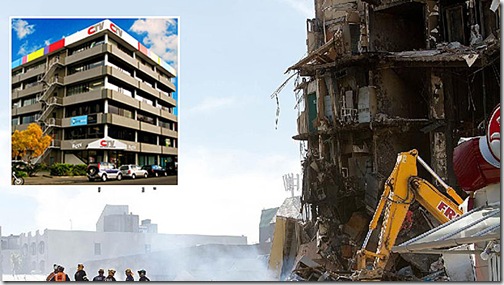
105132-ctv-building It is hard to say anything positive in the face of such a disaster, one that affected so many people. You can see a Japanese perspective from Asahi Shimbun  here and here.

The photo montage from the Australian, I can't give a precise link, shows the Canterbury TV building before and after the quake. This was the building in which the Japanese students died and which is covered in the two Japanese reports linked above.  

One thing that does come through is the raw courage as well as the terror generated by the moment. There are many disasters that go only partially reported because the media isn't there. We shouldn't forget that when we look at the coverage. That said, when the media coverage is there, the stories come through.

There have been so many examples. Just two here.

In Reduced to rubble, scarred by grief, Andrew Holden describes not just the quake, but the efforts to keep the presses rolling.  

Everything we've collected so far has gone straight to the web, but a paper gives people solidity, a touch of normality amid chaos. We don't realise it then, but with power out to most of the city, few people can watch television, or read the internet when their batteries run out. Communications will become increasingly tough over the next two days. Even those with home phones that need power are out of touch when their mobile dies. The old media stalwarts - print and radio - are all they have.

wedding Emma Howard Chrs Greenslade The second story is on the front pages across much of Australia today. This coverage is drawn from the Sydney Morning Herald. 

The photo shows Emma Howard and Chris Greenslade on their wedding.

On the day of the quake, Emma was working in the PGC (Pyne Gould Corporation) building. When the quake struck, she was thrown from her chair and trapped in the rubble where she spent the next six and a half hours. There she texted her fiance, fellow accountant Chris Greenslade, who raced to the building from his nearby workplace.

"He just ran to me, expecting to find me standing on the street, ready to take me home," she said.

Mr Greenslade dug among the remains, pulling out other people as he searched for his bride-to-be. He was photographed carrying an injured woman to safety in one of the first images that emerged of rescue efforts after the quake.

The couple decided to proceed with their already planned wedding on the due date, a celebration of life and hope in the midst of disaster.

A second thing that the quake has done, and this is a local perspective, is to remind Australians of the importance of the NZ relationship. The response to the quake in this country was quite emotional. New Zealand is family.

Taiwanese rescurers The last photo is from The Press in Christchurch. It shows Taiwanese rescue workers.

People who work together to save others build bonds. Bonds with each other and bonds with those they help.

It's a simple thing, but one that is quite important. These bonds build and can have profound effects. It is hard to hate or even distrust someone when you have worked together in the midst of fear, dust, sweat.

Australian aid to Indonesia during the tsunami transformed the relationships between the two countries. A simple thing really and very Asian where the prevailing cultural ethos is more collective than in many western countries. If you are there for me when I need help, then I have an obligation to respond.

I am not overstating this. However, I do think it worth remembering.

In the meantime, and as the media coverage of the Christchurch earthquake begins to dim, spare a thought for those in Christchurch who have a long and hard grind in front of them.

In disaster, the first reaction is courage and cooperation in the midst of despair. Then comes tiredness and a sense of despair. It becomes harder to cope. After that, comes the long and slow process of rebuilding. This is when things really get hard.

Wednesday, February 23, 2011

Christchurch earthquake

ChCh Cathedral

A Monday post, It all suxs, will give you a feel for the close relations between Australia and New Zealand. Australians as well as New Zealanders feel a sense of shock at the latest Christchurch earthquake.

The damage done to Christchurch and surrounds by the earthquake is quite profound. This photo shows the historic Anglican Cathedral in the centre of the city.

For those who don't know Christchurch, it is New Zealand's second largest city by population after Auckland, with a population of  339,000. I actually thought that it was third after Wellington.

The city lies at the edge of the Canterbury Plains on the eastern side of New Zealand's South Island. The plains stretch away to the spectacular New Zealand Alps in the distance.

In 1906, my paternal grandparents emigrated to Canterbury from Lancashire in England.

After working in various jobs, Grandfather Belshaw became a Primitive Methodist Home Missionary in Christchurch. My father, the youngest, was born in Canterbury. All three kids went to school in Christchurch.

Provincial Council Building Christchurch is a beautiful city whose central district was planned on similar lines to Adelaide.

The next photo from the New Zealand Herald shows the remains of the historic Canterbury Provincial Council building.

Originally the New Zealand provinces had their own parliaments. This was the Canterbury Parliament. It's not a large building, but was an attractive one popular with tourist. The building featured as the site of the inquiry in Desmond Bagley's 1975 avalanche disaster thriller, the Snow Tiger.

Christchurch is a popular tourist destination in its own right and as a stepping off point for those visiting the South Island; the city has an international airport. It is also a major conference centre. I have been there many times as a tourist, on marketing trips or to attend conferences.

New Zealand draws backpackers from around the world.Hotel Stonehurst

The next photo, also from the New Zealand Herald, shows the remains of the Hotel Stonehurst, popular with backpackers.

Measured by the Richter scale, this was a smaller earthquake than the one that occurred last September. However, it was closer to the surface, increasing the destructive power on buildings already weakened from the previous quake.

This quake also occurred in the middle of the day when central Christchurch was packed with shoppers, workers and visitors. More buildings were brought down including a modern office block, while falling rubble hit buses, cars and pedestrians.

Casualty figures are still unknown, but could be as high as 200.

The final photo from the New Zealand Herald shows the Catholic Cathedral. The scenes are reminiscent of World War II bombing damage.ChCh Catholic Cathedral

New Zealand is a well organised country, but it is also a small country, stretching resources. Australia is relatively close and can therefore respond quickly.  The country has also had experience in responding quickly to disasters such as the Padang quake.

ABC news reports that the first 40 specialists, along with rescue equipment and supplies, left last night from the RAAF base at Richmond, in Sydney's north-west, aboard a C-130 Hercules transport aircraft. In all, 148 Urban Search and Rescue specialists are now being sent.

"These rescue teams are experts at recovering people who are trapped or affected by structural collapse and consist of highly-trained emergency services workers, doctors, engineers and search dogs," Mr McClelland said.

"They have expert search, rescue, medical, engineering and support capabilities."

The impact on the people of Christchurch of the quake has been severe, more so because it came on top of the previous quake and all the subsequent aftershocks.

As so often happens, there have been remarkable stories of people responding on the ground with immediate action to help others despite the shock. I do find the human spirit a remarkable thing.  

Postscript

On Skepticslaywers, DeusExMacintosh in Christchurch Earthquake: Please Give Generously provided information for Kiwis who wished to donate. In Australia, I know that at least the Red Cross has an appeal underway.

Wednesday, January 12, 2011

Initial lessons from the Queensland floods

I didn't give an end-day update on Toowoomba flash flood because by then the normal media coverage was so intense. I maybe should have, because that post attracted a lot of hits.

End of the summer break today, so I don't have time for a major post, just a few comments on things I noticed in the context of the Queensland floods.

As you might expect, the heavy rain and floods affected the telephone system. On some reports, mobile coverage in parts of Brisbane seems to collapsed quite early under the combination of rain and traffic pressures. Loss of power affected ability to communicate.

These things aren't new. However, it does raise the issue of increased vulnerability associated with technology based systems.

  Border myopia was alive and well. We are dealing with a weather system that extended from north of Rockhampton as far south as the Macleay Valley. The coverage and maps essentially stopped at the border, with Northern NSW, the broader New England, dealt with as an add-on. I found this quite annoying.

Coverage was remarkably patchy, even scatter-gun. I found is hard to get a proper picture of just what was happening as it applied to individual centres or even areas. You had to listen all the time just to pick up passing references that then left things hanging up in the air.

I know the geography quite well, but even so I struggled to fit things together.

Flood mitigation is already back on the agenda.  Problems with the Wivenhoe Dam show upsides and downsides that are sure to generate a lot of discussion.

Finally, and especially interesting from my viewpoint, were the pattern of overall responses, including discussions generated on Australian resilience. I just not this one at the moment.

This post may seem a bit odd when the present big story is the floods rolling down towards Ipswich and Brisbane, but I just wanted to get it all down.

I have written a number of posts on Australian responses to natural disasters. I will link those in in a later posts. 

Tuesday, January 11, 2011

Toowoomba flash flood

Just last Friday in Australia's wet spell I reported that some people were asking if we were about to see a repeat of the 1955 floods. This was actually a New Englan237232-toowoomba-flooding 10d or Northern NSW reference. So far as South Eastern Queensland is concerned, the overall floods are now the worst on record.

  The rain and flood affected area is huge, stretching from Rockhampton in Central Queensland more than a 1,000 kilometres south to the Bellinger River Valley in Northern New South Wales, with flooding so far mainly concentrated in Queensland. 

Part of the problem for the authorities is that there has been flood event after flood event. 

Yesterday, a two metre high wall of water swept though the CBD of the Darling Downs city of Toowoomba.Toowoomba sits atop the Great Dividing Range.  The flash flood lasted ten minutes. The first shot from the Courier Mail flood photo gallery shows the force of the water.

People scrabbled to sa237188-toowoomba-flooding 11ve others, in some cases forming human chains. By the end, there were four confirmed deaths with three missing. 

You will find fuller coverage here.

The sheer geographic scale of these floods is difficult to comprehend. Last night Brisbane itself was on full flood alert with fears that the city could experience a full scale flood.

As I write, the weather forecasts suggest some easing of the rain, although further heavy falls are possible.

The economic costs of the floods are already very high, reaching $A5-6 billion. The problem remains that with saturated catchments, further rain quickly translates to rising river levels.

In my earlier post, I included the medium term forecasts from the Bureau of Metrology covering the period to end March. These suggest a 60-75% probability over that period for above average rains across North Eastern NSW and Southern Queensland. This means that further floods are possible.  

Postscript

Neil has put up a companion post, Queensland floods. Listening to the radio as I drove back from the city this morning, the news just seemed to get worse by the minute. It's not just Toowoomba, but the small communities at the base of the range as well that have been affected. The death toll from this one event has risen to eight, the number missing to some seventy, although hopefully many of these will be found.

I won't attempt to live blog developments, but will give a summary update tonight.

Tuesday, January 04, 2011

Droughts and flooding rains

One of Australia's best known poems, Dorothea Mackellar's (1885-1968) My Country says in part:

I love a sunburnt country
A land of sweeping plains
Of rugged mountain ranges
Of droughts and flooding rains

273507-rockhampton-floods Jan 2011 That is certainly what we are experiencing at the present time.

This photo from the Courier Mail shows the central Queensland city of Rockhampton, population 75,000. Flood levels have yet to peak here, although the city is already completely isolated by the waters.

It is difficult to comprehend the scale of these floods. However, to give international readers a feel for scale, the area now affected by flooding is much greater than that of the UK plus Ireland combined.

Unlike Pakistan and its floods, Australia is thinly populated outside the coastal hugging capital cities. Even so, more than 200,000 people have now been affected.

Coming on top of earlier floods, the damage to the Australian economy will be significant.

Coal mines and coal lines have been affected, with Queensland coal companies declaring force majeure on export contracts. Food crops have been affected; food prices will rise. Government revenues are down, while costs are up. The total cost to the economy is likely to be around one percent of GDP.

Ten people have died so far. Again, this is very small by the standards of the Pakistan floods. But it's still significant by Australian standards.

Inland Australia is very dry and very flat, an old much eroded continent. Waters flow slowly, creating a moving flood wall. 

During long droughts, the soil dries, ground water vanishes. During long droughts, people forget about floods. Some inland Australian children can be as old as seven or even ten before they actually see flooding rains.

As the rains come, the thirsty ground absorbs the moisture. The biggest floods come when the ground is finally moist, storage's full. Then, suddenly, all the water runs into the rivers. For months afterwards, floods come under hot, blue, skies. The heat haze shimmers, even as water rolls over the land. 

Most modern Australians are now remote from the Australian land. They live in hermetically sealed urban environments linked more to the rest of the world than to the realities of their own country.

To my mind, it's not a bad thing that they should sometimes be reminded of the real realities of their country.          

Wednesday, August 11, 2010

Pakistan's Floods

pakistan_floods_464 The flood in Pakistan are really quite terrifying in their sheer scale. BBC News has a good map that gives an indication of scale. The original comes with labels pointing to key features; I can't reproduce both the map and the labels at the same time.

According to the UN, more than 13 million people are now affected.

The coverage in the Australian media has not been especially good, far less than the coverage of the previous earthquakes. Further, there appears at time to have been a greater focus on the nature of the Pakistani Government response as compared to the nature of the tragedy itself.

If the newspaper reports are in any way correct, the long term damage done to Pakistan and its people by the floods could be very large indeed.