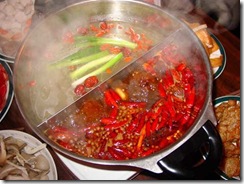
 Neil and Ben kindly left some informative and mouth watering comments on my post Personal confusions over Australian food. I did not realise either the variety or long history of steamboat or hotpot. This photo shows the Sichuan Hotpot.
Still on China and food, Yawning Bread had a fascinating post, Cantonese Sydney, that provides a picture of life in one part of Sydney from a visitor perspective. This got me thinking about some of the confusions in my reactions to China including food.
Before going on, one small correction to the history in Yawning Bread's post - the Chinese who came to Australia to mine gold and other mi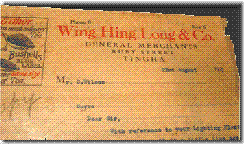 nerals including tin did not go just to Victoria. There were, for example, relatively large Chinese populations in the mineral provinces along the New England Tablelands. The photo shows Wing Hing Long & Co letterhead from Tingha, 1927. The big general stores in Tingha, Inverell and Glen Innes were all Chinese owned.
We all use labels - Chinese, Indian, Indonesian, Australian are examples - to describe things. We then attach meanings to those labels, bundles of attributes. This helps us simplify and understand the world, but it can lead to confusions and misunderstandings.
The first Chinese food I ate was Cantonese modified for Australian tastes from the first Chinese restaurant established in Armidale in the 1950s. The first Chinese I heard was Cantonese. The first Chinese I met were overseas born Chinese largely from Singapore, Hong Kong or Malaysia or, a little later, the Republic of China (Taiwan). I did not meet someone from mainland China for many years.
My first intense exposure to Asia came when I was twenty when brother David and I stayed for a week with an Indian family in Singapore, then for another week with a Chinese family in Taiping (Malayasia), before going onto Bangkok where our father was working for the UN. Upon our arrival in Bangkok the first thing we asked for was a steak!
Living in Canberra gave me a different exposure. I added other Chinese dishes, acquiring a taste for Sichuan food. One of my main friendship groups were Asiaphiles,far more knowledgeable than I about Asian - especially Chinese and Vietnamese cooking. Richard was very friendly with the owners of the Golden Phoenix restaurant at Dickson. We used to go there a lot, coming in through the kitchen, trying special things. This remains some of the best Chinese food I have ever eaten.
Yet again, we have the Cantonese flavour, the Cantonese language. I now ate many types of Chinese food, but the rise and fall of Cantonese - something that I tried to imitate, although I am dreadful at tonal languages as I had found when I tried to learn Thai - was central to my mental label "Chinese".
Track 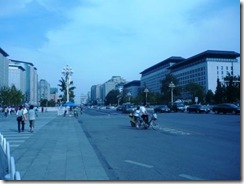 forward.
Arriving in China, I found Shanghai a Chinese city, Beijing not. This was partly a matter of cityscape - as indicated by the photo, Beijing is recognisably an imperial capital city along lines that Europeans would find familiar. However, it was also true that the mental label "Chinese" that I had in my mind with its Cantonese flavour was more attuned to Shanghai.
My confusion was compounded by the fact that after eating so much Chinese food of different types over such a long period, the label "Chinese cooking" had become an absolute pot pouri in my mind, a mixture of styles that had come together to be Chinese. I expected this to be the reality, and (of course) it was not.
One of the issues that I have explored from time to time on this blog is the way our perceptions of the world, the labels we use, are affected by our personal history. Here I have pointed to what I see as a fact, that current cultures and attitudes are like an archaeological site, combining things from different stages in the past.
The migrants who came to Australia brought with them all the mental mud-maps formed from their experiences. Upon arrival in a new land with its different experiences, those mud-maps became frozen in time. Still there, still important, yet no longer refreshed.
To say that the world changes is an obvious truism. Yet we do not properly relate this to our own experiences and those of others.
I do not think that I am mis-quoting Yawning Bread if I say that he found Cantonese Sydney somewhat alien, almost a time warp as compared to the modern Mandarin China and Chinese.
In Saturday Morning Musings - ethnicity and change in Australia I noted in passing that Sydney's China Town - the area that Yawning Bread comments on in particular - was only one of Sydney's Chinese areas. Now in Australia we have multiple groups of Chinese ancestry. The differences between those groups are as wide as any other part of the Australian community. The simple label "Chinese" is of no help in identifying and understanding these groups.
More broadly, and I will finish on this point, I think that we Australians are not good at understanding the archaeology, the derivation, of the labels that we use. We need different perspectives to draw them out.
 In the meantime, I hate not posting. Yet my personal petrol tank is also running very low because of projects and deadlines. Given this, I thought that I would simply share with you in a series of micro-posts a few of the things I have noticed.