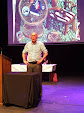
Just back from Armidale where I delivered a paper on Friday (13 April 2018) in the University of New England's humanities seminar series 'New England travels: journeys through space and time".The paper was described in this way in the blurb:
This paper explores key themes across 30,000 years of the history of Australia's broad New England region, the Tablelands and surrounding valleys, showing how the interaction of geography and events has moulded life and culture from the arrival of the Aboriginal peoples to the end of the twentieth century.
An historian and economist by profession, Jim Belshaw is writing a history of the broader new state New England from Aboriginal times to the end of the twentieth century. Jim, an alumnus of UNE, also writes the weekly history column for the Armidale Express.
It had been several years since I last spoke. These papers take a fair bit of effort in preparation and then there is the trip itself. I normally treat the trip part as a mix of professional, social and holiday, but this time it was harder work, partly because I was very tired when I drove out.
As always, I came back with things to do. This includes completing the footnotes so that I can provide copies to the people who have requested it. I will write up some elements in posts here and on the New England blogs; this post reflects on the trip. itself, sort of an aide memoir.
The Journey
I know the road very well after all this time. You can always tell Armidale locals because they know the shortest route. Going north it's up the Paciifc express way. This stretch is pretty boring, but its generally fast unless clogged by holiday traffic. 14k past Raymond Terrace you turn left onto
Bucketts Way. This runs in a north westerly direction through
Stroud, a historic AA (Australian Agricultural Company) town to Gloucester. . It's quite pretty country with lots to explore. .
At Gloucester, you turn left onto
Thunderbolt's Way following the Walcha signs. The road passes through the little town of Barrington where I usually stop for coffee at the
little post office cum general store cum petrol station cum restaraunt. It's a good little earner. Coming back this time tired, that Barrington stop was very welcome. I sat on the verandah savouring my cappuccino writing up my trip notes.
Just past Barrington, the road turns hard right passing through the the headwaters of the Manning River. This is a pretty road that meanders up and down, constantly swinging back and forth over the ridges and along the streams. Near the
Bretti Nature Reserve, the road climbs quickly up the escarpment. This road did not exist when I was growing up. The New England Highway was the only route to Sydney. The road was cut through in 1961 but was not greatly used until tared. I didn't really start using it until after we moved to Sydney in 1996.
Driving habits have changed. I grew up driving on country roads, often dirt. While I do like to get from point A to point B quickly, I enjoy variety, don't mind curves and am philosophical about delays including being stuck behind timber jinkers and cattle trucks. Drivers trained on city roads and expressways find it more challenging. That road, a friend said! It's a
very popular road with motorcyclists.
At the top of the mountain the little village of Nowendoc lies to the right just off Thunderbolt's Way. There is a little reserve with a hall and toilet.where I often stop This is fugitive country country. Most recently, the hall was the centre for the ultimately successful
police search for Malcolm Naden. Returning to the main road,
New England Cheese can be found a little further on to the left. I had one of their little freezer bags to return, but the gate was shut, so I drove on.
Often I find small adventures on this road (
Sunday Essay - early morning on a New England road,
Curious cows Walcha-Nowendoc Road). Again I had to stop for stock! I also spotted through the trees some homesteads that I had not noticed before.That was not wise, I wobbled dangerously. I didn't have time to stop, but you really have to if you are to investigate.You have to walk the ground.
Running north from Nowendoc you enter what is called the Three Falls Country where the head waters of three major coastal rivers - the Manning, the Hastings and the Macleay are co-located. Geoff Blomfield’s
“Baal Belbora: the end of the dancing” explores the frontier wars in this country. This is also an area where a number of Aboriginal language groups overlap.
Coming into Walcha, I noticed that some new pieces had been added to the Walcha s
culpture streetscape but did not have time to stop.From Walcha, the road continues to Uralla.
Julia Griffin, Rain on the Uralla Road, one of my favourite paintings. Fortunately, this drive was dry.
At Uralla, we leave Thunderbolt's Way, turning right to join the New England Highway for the last short stretch into Armidale.
Around Armidale
I was very glad to get to my motel to unwind. Accommodation had been a real issue, as it had been five years before when my delivery of a paper coincided with graduation. I described this a visit at the time in a photo essay.
The beauty of Armidale & UNE. This time it was worse because the TAS (The Armidale School) junior (under 12) rugby carnival was on. .
This is the largest carnival of its type in the country. This year it brought together 44 teams from 21 schools and 16 clubs from across three states with 108 games of rugby. It also brought national coach Michael Cheika to town.
Reporting in advance of the carnival, the
Canberra Times' the Cauliflower Column (
Folau fallout continues as Cheika) said in the context of the problems that have been facing Australian rugby::
The school will welcome an estimated 950 children from as far as Dalby, the Sunshine Coast, the Southern Highlands and even the Perth-based Western Spirit. It will be a rousing statement, particularly on the back of some flat participation numbers revealed in the 2017 Annual Report this week.
This must be the first positive story about Armidale to appear in that paper for quite some time!
I drove past the school grounds on my way home on Saturday just to look. It was a busy colorful scene with the multiple parked buses, multiple little tents and games, Sadly I could not stop.
While many of the players themselves were accommodated in school boarding houses, the teams also came with officials and parents adding to accommodation pressures associated with graduation. All motels in the immediate area were booked out as were Armidale's 128+ Airbnbs some able to accommodate as many as six people plus the caravan park. There were also "luxury" tents (their phrase) at the showground, although these were too pricey for me in any case! I managed a motel room for the Thursday night and the last available Airbnb room for the Friday night, a simple room in a two bedroom flat. .
I don't know the final visitor numbers, but the town really was packed. The TAS rugby carnival alone brought in an estimated $1.6 million in visitor spend. I went for a walk on the Thursday night past all the motels with their no vacancy signs to buy some takeaway food. All the takeaway places had queues.
As I drove out to the university on Friday morning, I wondered how many people I might get, given graduation. In the end, there were about 45-50 people, A lot were older and from town attracted by the topic as well as my role as a public historian, but I did attract some staff as well including Martin Gibbs, professor of archaeology. Nicholas Fuller, the
Armidale Express' newly appointed
arts and culture reporter, also came.
.
The questions were helpful in refining my views. Later over coffee in the staff room I was able to catch up with people including finding out out some of the latest research. Because I work so much outside the academy, I was a little nervous in talking. I form my own views, develop my own syntheses. I do expose this through the blogs and in the columns, but there is still a degree of caution when I come in contact with others with their own particular expertise. I think in practice I probably get more feedback and have greater freedom and more time for thought than those burdened by KPIs and growing teaching loads. .
Part of my mission is to try to create interest in New England history. I found the conversations with Martin particularly because it gave my new ideas, but also helped me understand the problems he faces in attracting students to archaeology in general and New England studies in particular. There is also a growing problem in getting approvals to dig from Aboriginal communities, something others including John Mulvaney have talked about. .
I will write more on this later, as well as the ideas that I picked up.I have already been sent two papers containing work that I had not seen before.
After the seminar I wandered around town a bit, sitting in Central Park for a bit to write up notes. It was quiet and beautiful. One thing I noticed there and elsewhere were the number of older people just sitting. This is a feature of an aging population. Again, thoughts came to mind for later writing.
After lunch I went into the
Express to do an interview with Nicholas Fuller. He also took photos of me standing next to the iron lacework outside the Armidale Folk Museum. We talked about his role, but also about the changes taking place in the newspaper world. I have written a little about this, but the discussion helped me extend my thinking
After seeing Nicholas I went out to see Bill Oates, head of the Heritage Centre. I then walked around the old Teachers' College building. This was managed by the University but was recently handled back to the State Government. I found this a profoundly depressing experience for reasons I won't go into here beyond mentioning that one side effect is the need to re-house or throw out archival records, books, newspapers previously stored at in the College building. The lack of periodic maintenance on the College building was clear to see. At a purely personal level, my intention to give key family papers to the archives may prove impossible.
Again, I may write something more when I have had a chance to process it all.
After seeing Bill, I went into town to look at the display at the Council community consultation centre and then back to my room to have some food and continue writing up my notes. Driving back the next morning I was generally pleased with trip, if still depressed about what I had seen at the old Teachers' College. I wondered what might be done to rectify the position without coming to a firm views. . .