Showing posts with label personal. Show all posts

Saturday, January 28, 2023

400+ Harry Potter Facts & Statistics from the Books, Movies, and More

Back in July 2011 in The end of Harry Potter I reflected on the last Harry Potter movie.  As eldest said at the time, "7 Books, 8 Films and 14 years of my life. In essence, my childhood!" 

As it happens, Netflix has all the movies on at present, so I have been revisiting them and especially the early ones. Coincidentally, Ella Trosden drew my attention to this piece by Rebecca Janacek on the vpnMentor blog, 400+ Harry Potter Facts & Statistics from the Books, Movies, and More. I think that it's worth a browse. Certainly, I enjoyed browsing 


Monday, September 12, 2022

Family memories of Queen Elizabeth's accession to the throne and subsequent Coronation

I am of an age to remember learning to sing God Save the King at primary school, to remember books and magazine articles on the royal family including the bombing of Buckingham Palace and the role of the princesses during the Second World War.

The death of Queen Elizabeth brought many of these memories back, as well as the Coronation, the Royal Visit in 1954 and subsequent festivities and visits. At the time the Queen visited Armidale in 1970 I was already in Canberra so missed the visit there, but was invited to a gathering at the ANU Union when Charles visited there. Not that we talked. I was just in the background while he moved elsewhere in the room. 

Later I watched his wedding and also saw he and Diana pass in Sydney, My old school had links with Gordonstoun and Prince Edward, links that continue to this day.  Given all this, I thought that I would indulge myself by taking you back to the early days of Queen Elizabeth's reign where there was a family linkage. 

In 1952-1953, my grandfather David Drummond visited the UK together with Gran and Aunts Kathleen (Kay) and Margaret. Fa, I always called him Fa because I couldn't pronounce grandfather, was then Member for New England having previously been a member of the NSW Parliament and a long standing Minister for Public Instruction (Education).  

King George V1 had died in February 1952 and the new Queen while not yet crowned had already assumed ceremonial duties including on 10 June 1952 the first presentation to court of the new reign. Lady White, the wife of the High Commissioner to the UK, arranged for the Drummond girls to be presented to court. By happenstance, and as reported somewhat  breathlessly in the Armidale Express, Kay was the first deb to be presented followed by Margaret.

I was struck by the bolded reference to the elastic dress-belts as the height of fashion. They along with deb presentations were about to pass into history! Kay would teach in London, elocution and drama, at a private drama academy. 


The following photo shows the dress Kay wore at the presentation.  


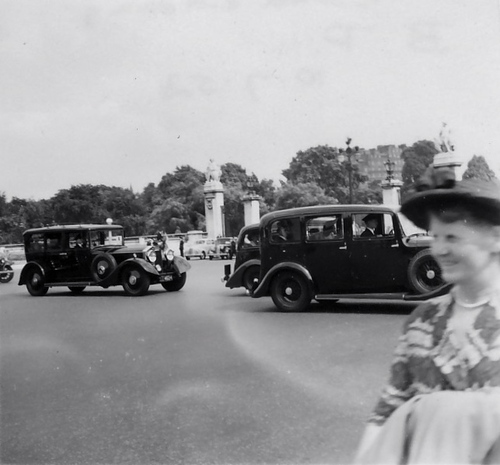
On 12 July 1952, there was a garden party at Buckingham Palace. This photo shows the Drummond family arriving at the Palace for the party. 


My grandparents. Things were definitely more formal then! 


Gran with the girls after the garden party. 


And here is a family shot taken at the party.


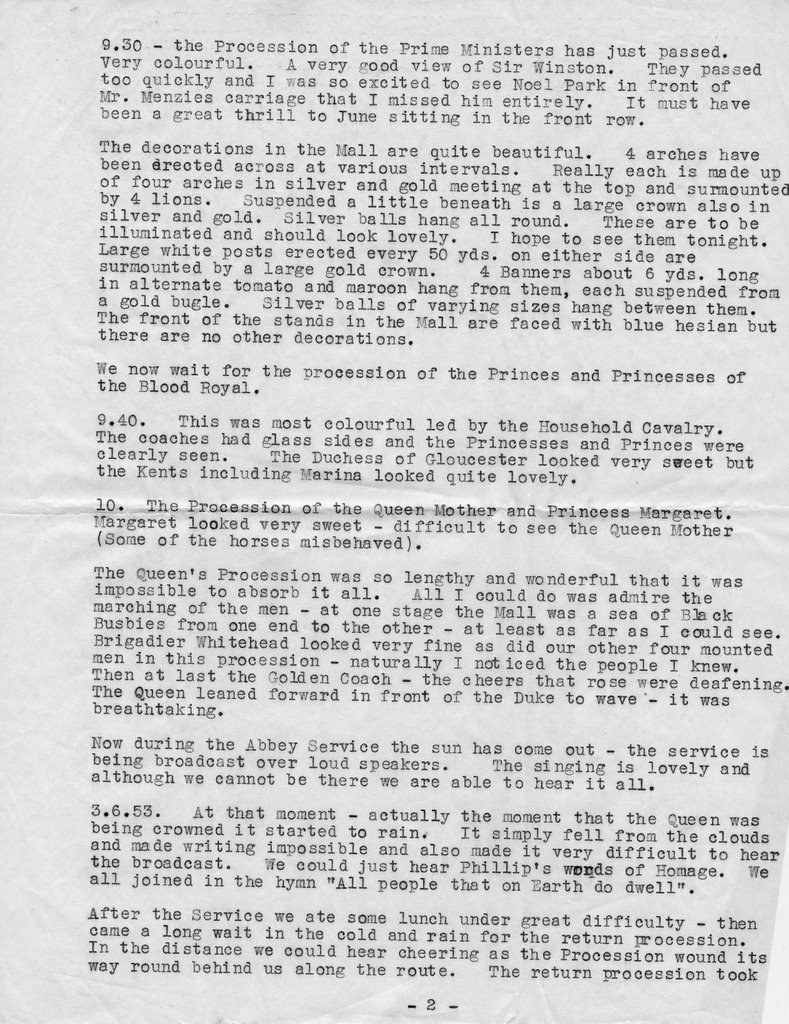
The Drummonds were still in London at the time of the Coronation, purchasing tickets to watch.


Kay took notes and typed them up later. Her diary follows.

Page One

Page 2

Page 3 

Page 4

One week later the final event was the Derby. None of them would ever forget the the collective experience


Wednesday, August 17, 2022

Moving woes

Rusden Street, Armidale. Playing with the house.

 I hate moving. Growing up, we lived first at Rusden Street. The house no longer exists, later demolished to make was for a New England TAFE car park. I do remember the house and nearby park, although I left there when I was around four.

When I was around four, we moved to 202 Marsh Street, the place that would be home until I left for Canberra in 1967. Well, that's not quite precise. While I was away I retained my bedroom and my books and constantly came back. Much later after I married, we moved back to the old house where my girls were born. There we lived until my wife took a job in Sydney in 1996 and we all had to move. 

Bath time. Both my girls were born at Marsh Street

Since we left Armidale I have lived in seven rental properties, now moving into a house owned by my partner making an eighth move. It would be nice if this were the last.

I mention all this because I have found this last move totally disruptive, It's partly a matter of age. I can no longer lift boxes in the way I once could. I can no longer go without sleep in the way I once could. I find it harder to motivate myself yo keep going.

My books are my love, the tools of my trade. During the many moves I have been forced to reduce my book and paper collection by perhaps two thirds. Now I am still unpacking books and trying to organise myself. I got thye computer and internet set up early, but the books are still going even with reduced numbers. I guess that reduced is a relative concept. I still have thousands of books!

To most Australians, printed books have been in decline. Many Australians actually have few or no books in the house. I remember a decade or so ago on a consulting job staying with a client. With the exception of a few Reader's Digest condensed books, there was not a single book in the house. On assignment, I hadn't brought any books with me. I became frustrated at not being able to read myself to sleep!

There is a myth that today we don't need printed books. We can get everything from the internet. The reality is quite different. The internet is wonderful. I use it all the time. It gives me access to material in hours, sometimes minutes, that would have taken me weeks when I started university. This may be true, but the internet is actually very limited in scope and focus. I work in niches, areas not covered by the internet except in most peripheral ways And here I come back to my books. 

 I know that I will get though by current moving ways, that I will be able to increase my writing, but for the moments it's very hard.

Thursday, July 28, 2022

A series of unfortunate events

 While I haven't been writing here I haven't been totally distracted, just a tad preoccupied. Since I wrote Can globalisation survive current shocks? (Monday June 6 2022) the world has continued to track in unfortunate directions, reminding me of Lemony Snicket's A Series of Unfortunate Events. I hadn't thought of that series for years! Somehow, the title seemed appropriate. 

In the eight weeks since I wrote that post, omicron has extended its reach; the WHO had declared a global monkey pox emergency; foot and mouth disease has reached Bali creating Australian consternation;   the war in Ukraine grinds on through a process of bloody attrition: exports of Ukrainian wheat and oil may or may not resume; inflation has exploded round the world with most Central Banks raising interest rates; Shri Lanka has imploded with other countries possibly following the same path; general supply chain shortages continue; and global recession seems very likely.

I find myself sucked into perusal of on-going daily, even hourly, events switching from outlet to outlet. It's very distracting. I must try to do better! 

Thursday, November 18, 2021

The Kitchen Garden

 I was flaneuring around Mosman, one of those leafy North Shore Sydney suburbs. looking at architecture and the pattern of life. The thing I most noticed was the absence of kitchen gardens. Houses had grown and gardens shrunk to mere decoration or, at best, extensions of indoor living. My mind was cast back…..

 In January 1885, Albert Wright purchased Kangaroo Hills, now Wongwibinda, in the Falls country east of Armidale. It had all been done in a rush.

They had been living at Nulalbin outside Rockhampton. The year before eldest son Bertie had died after a lingering illness. The death came as a shock, and Albert and wife May decided that they must find a home in a more temperate climate.

They left Nulalbin in December 1884 for Bickham, a Wright family home in the Hunter Valley. In early January Albert went north, buying Kangaroo Hills on the spot. At end January, the whole family shifted to the new property.

Establishing the kitchen garden

One of Albert’s first acts was to plant a large vegetable garden near the new house being built for his family. This was a common pattern on properties, for the kitchen garden and associated fruit trees were critical to the supply of fresh fruit and vegetables. It was a day’s ride to Armidale, so you could hardly buy there on a daily basis.

In town, people had more choices. Even so, most people had vegetable gardens, while much of the fruit and vegetables they might buy were grown locally. The Chinese market gardeners with their plots spread along the local creek were once a common feature in most Northern towns, part of the often unrecognised Chinese thread in the history of New England dating from the later 1840s.

There was much emphasis on the importance of the home garden for financial, health and indeed aesthetic reasons. The CWA (Country Women's Association) cookery book, long a kitchen bible, put it this way:

Home is not a Home without a garden. Plant one, and it will repay you.

Every wise housewife knows the value of the kitchen garden. It is a money saver, and a pleasure at all times. Nearly all vegetables are of easy culture. All soup vegetables should be grown at home. It is a great comfort to slip out and cut your own home requirements in your own back yard.

Digressing, Masterchef has been a popular Australian cooking show in which contestants compete by cooking particular dishes for judgement by an expert panel. Back in 2010, the challenge set for contestants in one show was to cook certain recipes from the CWA cookbook - scones, lamingtons, jam, a fruit cake - and then serve to 100 CWA ladies. An experienced CWA judge critiqued their efforts.

I was watching it with my family. Now we knew the CWA pretty well and had eaten a lot of country cooking. My then wife also learned to bake from her nan. I guess because of all this, we had a feel as to what might happen.

These contestants had cooked in challenge after challenge, managing often complicated dishes that I could never cook. There had been individual failures, but overall the results had been good. This time, with few exceptions, they bombed. It's just not as easy as it seems.

As the contest proceeded, I noticed that eldest had got out the cookbook I had given her. “I feel like scones”, she explained. Mixing bowls and ingredients appeared on the coffee table. With guidance from her mum, the process continued.

After the show finished, we discussed it over scones, blackberry jam and whipped cream. Our feeling was CWA 8, Masterchef 2. I digressed, but they were nice scones!

Developing a proper home garden was not always an easy task. At Kangaroo Hills, the spring of 1885 was a very good one. Albert planted onions, cabbages, lettuces, pumpkins, beans and fruit trees. Then came a sudden frost: “It seems useless”, a dispirited Albert wrote, “to try to grow anything in such a climate.” Nevertheless, he persevered, learning from experience.

Albert’s problems were not unusual. New England is marked by great variation in soils, temperature and rainfall from coastal subtropical to high country to semi-arid. The new settlers had to learn what would grow best, how to grow it. In many places, water had to be carefully rationed. Nevertheless, they persevered and finally succeeded. They learned how to create micro-climates through location, wind-breaks and walls. They also learned when to plant things to best effect..

Managing the kitchen garden

A reasonable size home garden could be a complex operation involving all the family. Herbs - lavender, thyme, marjoram, mint, sage, parsley and rosemary - were usually grown near the back door so that they could be easily picked for domestic purposes.

Further out were the vegetables grown in cycles depending on the growing season. Standard vegetables included onions, carrots, potatoes, peas and beans, sweet corn, pumpkins, lettuce, sometimes garlic although its use was then less common, cabbages, cauliflower, tomatoes, lettuce, silver beet, beetroot, parsnips and turnips. The compost heaps could normally be found near the vegetable garden, carefully maintained to provide a steady stream of compost to the changing beds.

The garden nearly always included vines and fruit trees. And then there were the flowers grown for decoration and to supply cut flowers to the house. Mum loved her flowers. She would go out with a basket and secateurs, bringing flowers back to the kitchen table (the working centre of the house) for shaping to fit the vases.

The exact mix of garden plants varied across New England depending on the soil and climate. In the case of our home garden - a large cool climate garden - there were the ubiquitous grape vines, three apricot trees, a rather superb plum tree, an apple tree, a fig tree, gooseberries, red and black currants, strawberries and raspberries as well as flowers and lots of vegetables. Sometimes In the mornings I would go outside and pick raspberries to bring back and crush with cream and sugar. Alternatively, I would pick a jar of preserves off the shelf made with the Fowlers Vacola outfit. This was stored in the garage for use during the flush times for various local fruits. I loved the black cherries.

 Many gardens also contained a chook (poultry) yard providing fresh eggs and the sometimes fowl for dinner. In our case, the chook yard had high wire fences enclosing a properly constructed hen house with laying boxes plus a large area for the hens to roam.

Even in town, many families maintained a milker to provide milk, cream and butter. Staying at Glenroy, my aunt and uncle’s property at Kentucky south of Armidale, we used to get up early to go with Uncle Ron to see the cow milked. The milk would be brought back in a bucket and then heated gently to raise the cream that would be collected and used to make butter. In Armidale, mum would sometimes send us out to get fresh milk that came from a cow a few blocks away.

There was a clear division of labour within the garden. Prof (we all called him Prof when talking about and sometimes to him; earlier he had been called Doc by locals) was in charge of the main garden, digging the beds, planting, clearing weeds and collecting produce for the kitchen, mowing the lawns and splitting wood to feed the fires, In these roles he was assisted by old Mr Wallace who came in one morning a week.

 As children we were fascinated by Mr Wallace. He told us stories about clearing the Dorrigo scrub for timber and to open the way for farms; he told us about bank crashes and showed us an old bank note from a now defunct bank; he also explained the evils of the papacy.

Mr Wallace believed that there was a papist plot to take over the world. While leaning on his shovel, he discoursed on the wickedness of Rome, the Pope and his cardinals. We had no idea what a papist was and only a vague idea of Rome’s location. Today, it is difficult for Australians to understand the depth of the sectarian divisions that marked much of Australia’s history, although conspiracy theories remain well entrenched.

Prof’s garden duties also included collecting the manure from the chook yard and distributing it across the garden beds or to feed multiple compost heaps. He was also responsible for trimming the hens’ wings to stop them flying, for collecting eggs and for preparation of the older birds for the table. This involved catching the bird and then chopping its head off on a chopping block kept for the purpose. This led the bird to run round in circles, something captured in the Australian phrase to run round like a headless chook (or chicken) meaning activity carried out in an uncontrolled or disorganised way without purpose. The bird was then plucked and its innards removed before it was ready for cooking.

This was not the only time that we saw animals killed for food. Apart from rabbits shot or trapped, some of my friends made their pocket money from trapping rabbits for supply to the local freezer, we also watched sheep being slaughtered for house meat on Glenroy, An older ewe near the end of its wool growing life was selected. This was then killed by a knife through the mouth into the brain. The animal was then gutted and skinned before being hung up for butchering.

As children, we took all this for granted. Today when I think of killing hens, sheep or the goats I I would quite like to keep, I feel a little squeamish. Our meat now comes neatly packaged. The actual act of killing seems remote, far removed, sanitised. I have to remind myself that it is part of life.

With the passage of time, maintenance of the chook yard became too time-consuming for our father. The chooks were removed, leaving the yard as part of our playground.

Harvest Time

The reliance on locally produced produce created a pattern of seasonal gluts and shortages. As children we knew every fruit tree in the immediate area, knew when they were coming into fruit. We also picked and ate from the garden, new peas, tomatoes, fresh beans and little cucumbers. No problem in getting children to eat fruit or vegetables.  Somehow things that we picked ourselves were just that much more satisfying.

For adults, hard work was involved. When produce was plentiful, people bottled, preserved or prepared for storage in cool, dry, dark places. It wasn’t just produce from the home garden. Fruit and vegetables now in abundant supply and therefore cheap were also purchased or given by relatives or friends. There was a considerable bottling ritual, a production process. The bottles were sterilised, the fruit cooked, the tomato relish made, the jams created, providing a steady stream of produce for the rest of the year. Some of the tastes were wonderful. Many of us would kill today for a jar of Aunt Kay’s tomato relish!

There have been many changes in Australian diet over the decades, changes that partially reflect changing fashions and the availability of food stuffs but also the tools available for cooking. Cooks have always had to match what they can do to the available equipment.

In our case, we had a substantial fuel stove that not only provided constant hot water but a substantial range of cooking options. It could be a bit cranky; you had to be able to judge the temperature, but that came with experience. The firebox was on the right. The temperature of the whole stove could be controlled by varying the intensity of the fire through a combination of fuel and dampers. The hot air from the fuel box ran along the top of the stove to the chimney on the left.

A hot plate ran the length of the stove with heat gradually diminishing towards the chimney. This allowed food to be cooked and then moved to a cooler place to set or stay warm. The ever present kettle could be moved from the left of the stove to the hotter right where it quickly boiled. The oven was on the left with a warming oven below, allowing food to be kept warm or plates to be warmed before serving.

Armidale can be warm in summer, cold in winter, In summer, the kitchen could be warm indeed with the stove adding to outside heat, leaving mum hot and sweaty. In winter, the stove came into its own drawing people into the kitchen warmth. This gave rise to the New England flick as the girls stood with their back to the stove, flicking up their skirts to allow the heat to circulate.  

Having harvested, we ate. The food we ate was influenced by what we had in the garden, what had already been harvested and stored, the more limited foods available locally in the grocery stores, butchers and greengrocers.

The standard main meal was two courses, three for bigger meals. The central dish was a meat dish presented in different ways usually with two to three vegetables drawn from the garden. Growing up in sheep country, sheep meat was a staple. Beef, the major meat across Australia, was less common because it was more expensive, chicken less common still. This was followed by a desert often of bottled fruit, sometimes with fresh cream. In some cases soup preceded the main meal.

The exact mix of meals depended on what was available. Soups, stews and casseroles were common because these made best use of available produce. I still love the taste of fresh field mushrooms, of rich casserole sauces.

There was great variety in homemade soups. Some soups like chicken, often made from the remains of a bird previously killed, were relatively light, as were the beef broths served to invalids. Some soups were major meals in their own right, served with crusty bread.

Today we waste much food. The earlier cook-books had many recipes to take advantage of left-overs. There were good, practical, reasons for this. Food took a much higher proportion of family income than it does today.

The roast chook became soup, the vegetables went into bubble and squeak, the roast lamb or beef was minced for a new dish. I still miss the cast iron hand-mincer I inherited from my parents. I don’t know what happened to its innards, they went missing in one of our many moves. It was actually much more efficient (and easier to clean) than modern devices.

The pattern with other meals was a little different. Breakfast was generally a bigger meal than it is today. As children, we normally had porridge or wheat bix with hot milk followed by a hot dish, often bacon or some form of eggs or, more rarely steak. For a period modelling my Scottish grandfather,  I ate my porridge with salt and cream. Later when things were busier, I would go outside and pick raspberries to bring back and crush with cream and sugar. Alternatively, I would pick a jar of preserves of the shelf or from the fridge and have it with cream.

Lunch, by contrast, was far more pedestrian depending on just what we were doing. In fact, lunch did not have a clear pattern because it varied so much depending on the main mea.. On Sundays then, as indeed now, lunch was often a roast dinner. The Sunday roast remains an enduring tradition in many Australian households. Where, as in this case, lunch was actually dinner, tea was a relatively light meal.

There were then no school canteens, nor were there the bars and other convenience snacks that today dominate the supermarket shelves. School lunches were sandwiches, a piece of fruit, often a piece of cake, and a drink. Looking back at some of the reminiscences from the 1950s, the memory of soggy tomato sandwiches seems to be a constant theme!

There were other meals and snacks, of course. The pattern here varied from family to family depending on income and taste.Then, as now, busy parents sometimes resorted to the very quick and easy. This was where tinned food came in handy. Tinned spaghetti or baked beans on buttered toast or tinned soups with bread fingers were common choices.

A Child’s playground

From a kid's perspective, one of the greatest things about the home garden was the way it provided trees to climb, places to hide, spots to dig in or to build camp fires. We were expert in fires, how to start them in the best way, how to build fireplaces. Potatoes cooked in the ashes were eaten, charcoal and all, with butter with the melting butter running down fingers. Nostalgia!

Beyond home, we also had access to our grand parents’ garden just a block away at 89 Mann Street, a large Federation style house. This was a much bigger garden.

Mann Street is one of Armidale’s grander streets, As the small city expanded, local businessmen, professionals and graziers started to build bigger houses on South Hill, first in Barney, then Brown and finally Mann Street. These houses were on big blocks looking north down to the shopping centre and then Dumaresq Creek, the small creek wandering through the centre of the town.

The blocks were large, often including stables, servant’s quarters, chook pens and cow byres for the milking cows, These features have disappeared now with subdivision, but Barney, Brown and Mann Street remain the heart of the Victorian city that is still one of Armidale’s architectural treasures.

Unusually, 89 was built from weatherboard rather than the more normal Armidale blue brick. The front of the house with its sweeping steps faced Dumaresq Creek. The back of the house with its formal garden and pine trees faced Mann Street. With time, this original distinction between back and front became confused. To us and indeed all visitors, the old back was now the front, the old front the back. It would be years before I discovered the reason

There were two garages facing Mann Street, one on each side of the block. At the Northern back (front!) of the house’ a hedge divided the main garden from the back yard. Beyond the hedge lay the tennis court, the kitchen garden and the old cow byre now incorporated in the chook yard. Our kelpie Rover used to love herding the chooks. He would divide them into two groups based on breed and then sit panting in the middle between the groups, satisfied with his efforts. For a period, there were also a few sheep really kept for sentimental purposes.

With the exception of the tennis court, we rarely went beyond the dividing hedge because this part of the garden was less interesting. From a young age, our grandfather and aunts taught us to play tennis using wooden rackets dating back to the 1930s. I have dreadful hand-eye coordination, but with practice became a reasonably competent player.

Mann Street was especially good for hide and seek because of its sheer size. The pedestals at the base of the front stairs acted as home base. The objective was to get there before the person who was in and then count 1.2,3 home. My favourite hiding spot was the roof of one of the garages where I could see the whole yard and thus sneak down to get to home first.

Our particular friends were the Halpin twins who lived half a block away. Father Bruce was a director of Richardson’s, the local departmental store, while mother Vee was a long standing friend of mum’s. We spent much time with them in our respective gardens and roaming the streets.

Growing up, my daughters loved the story of the three morning teas. We would start at 202 Marsh Street for the first, then to the Halpins for our second, finishing up at Mann Street for the third. 

The kitchen garden’s decline

The kitchen garden has been in sad decline. The gardening folk memories that we used to absorb from our parents have also declined as a consequence. The decline began slowly and then accelerated during the busy 1980s.

Walking around Armidale or Queanbeyan during the 1970s,you would still see kitchen gardens everywhere. Queanbeyan, the NSW town just across the border from the Australian Capital Territory where I was then living, was a fascinating place with a large immigrant community that had come to work on the Snowy Hydroelectric Scheme or on the building of Canberra. They brought with them farming and gardening techniques from Eastern and Southern Europe where the home garden had been a way of life. This was industrial scale kitchen gardening where the garden and associated livestock provided much of the food over the year.

It also provided the base for a range of home-made alcohols that could be a real trap if you were involved in local politics as I was at the time. That one drink for hospitality purposes could extend and be repeated on calls elsewhere, creating a degree of unsteadiness by the end of that day’s visits.

By 2000, the decline in the kitchen garden was largely complete. Many things contributed to that collapse. Neighbours and councils began to object to the noise and smells associated with the garden, including the omnipresent hens. Blocks became smaller, flats or townhouses more common. More people rented. The supermarkets brought a wider range of cheaper foodstuffs, reducing the incentive to garden. Time became more precious as two income families tried to balance the demands of more complex lives.

Can the kitchen garden come back? I think not, although the increased interest in sustainability and the rise in community gardens do hold out some hope. The difficulty is that these things appeal to particular niche views and lifestyles whereas the old kitchen garden was an integral element in normal life. 

Tuesday, October 12, 2021

Covid blues on "freedom day".

Monday 11 October 2021 was "Freedom Day" in Greater Sydney. In our case it's Restriction Day since the new rules actually restrict some freedoms we had Sunday.   A newspaper colleague commented: "It's a nightmare trying to keep up with these rules, which keep changing." 

That's true. I only realised the impact of the new changes on 6 October and then spent days trying to clarify the rules and their implications for the community activities I was engaged in. After multiple emails and phone conversations plus a rule clarification at the weekend, I think that we have come to a landing point although ambiguities remain. While I think that my involvement was  helpful to me and others, it also represented another set of lost days.

A friend commented how hard she had found it to concentrate on her PhD. I have found the same dragging effect on my writing. We both know that it shouldn't matter, we should be able to closet ourselves to focus on our work, but it has. Somehow, telling myself to start writing, to get on with it, doesn't work! Ah well, sad face.

I'm sure that we will do better. There has been some fascinating stuff happening. 

Wednesday, April 21, 2021

Covid 19 vaccinations at local level - a personal experience

When Australian  governments announced that those in group 1b ( essentially Australians over seventy) were eligible for covid-19 vaccination with the AstraZeneca vaccine I held off because I knew that supplies were limited. Then, with all the controversy over the AZ vaccine, the suggestion that supplies were available because people were refusing it, I decided to move. The results were instructive. 

I went to the Government website to identify local GP suppliers. The site said that my GP clinic was not taking bookings, so I went to another GP clinic that was. They said that they were only getting fifty doses per week. More, that they did not know how many doses they would get to the end of the week before. They were now fully booked to the end of May. They suggested that I try my own GP clinic even though they were not taking bookings. I did so. 

My GP clinic said that their supply was limited. They were working through from their oldest patients down and were now to 82 year olds. However, as it happened, they had just had a cancellation. If I came in immediately, I could be vaccinated. I did so and now am. 

I got in because  the dose would have gone to waste otherwise. As I got my shot, the clinic was full of much older Armidalians getting their jabs. The oldest was born in 1929. 

When I came home I listened to stories about metro based mass vaccination centres intended to speed the process up. Am I wrong to wonder why governments shouldn't fix up the existing distribution system first on the supply side?! Am I wrong to think that these centres will attract preferential supply and make the existing position in Armidale worse?  

Friday, January 15, 2021

Writer's Block


A weight on my shoulders

I have rarely suffered from writer's block. More normally, I have the opposite problem, too many ideas chasing to little time. Yet now I struggle to write anything really productive. The ideas and words won't flow.

I know that part of the problem is that I'm over-extended, a perennial problem that I can normally manage to some degree at least. It's partly that I have been pushing too hard, building frustration with myself. But beyond these two things lies a simple fact, my reading has collapsed. 

I don't know about you, but many of my ideas and some of my language comes from others. I pick up some ideas through personal interaction, more through books. 

Inevitably, a fair proportion of my reading is professional. Most recently, this has been strongly connected with my main history project, the history of New England, something I will write about on my history blog in my part completed annual review. This reading feeds into the community activities I have added since I returned to Armidale. I value these, I have objectives to achieve, but they do take time.

The reading outside that I have to do is the area of collapse. I used to read widely in what I call my train reading. This began with a conscious effort to pick books at random off my shelves that I had not read to read on the train. There were two rules: I had to finish the book and then write something about it. I found it very stimulating, forcing me in new directions. 

Many of the books were much older, some now 150 years old. I am not talking "classics" here, although some were. Rather, they were a varied range often inherited from my father or grandfather, most now long disposed of in the skips used by libraries to clear books considered as irrelevant or out of date. As I read the memoirs of a long dead foreign correspondent or a pioneering study of the classical world or an analysis of Chinese history, I absorbed "new" old ideas as well as new ways of writing. English style changes, but change does not always mean improvement. 

In truth, my train reading declined after I stopped travelling to Parramatta. It is one thing to read stuck on a train or bus, a second to allocate time in the morning or afternoon to read things not relevant to one's immediate concerns. Then the thought that you should really be doing other, more "relevant" things, constantly intrudes. However, I did retain other reading for a period. Most recently, that has dropped too, as have my general writing notes.   

I need to address this. Sitting in front of a computer trying to research and especially write when neither ideas or words will flow is not especially helpful. After a point, it becomes totally unproductive. Somehow I have to re-learn just how to read for pleasure without specific objective no matter what else I should be doing! 


Saturday, October 10, 2020

Saturday morning musings - struggling with my history of Australia's New England

From time to time I have mentioned the introductory course I am presently delivering through U3A on the history of Australia's New England, the New England Tablelands and the surrounding river valleys to the west, east, north and south, It's an ambitious course, far more ambitious than I fully comprehended when I started. 

I began by tracing the story of the Aboriginal peoples from out of Africa, the journey to the ancient continent we call Sahul, the spread across Sahul, the arrival in the area I call New England. We then explored the impact of the Last Glacial Maximum that came close to wiping the Aboriginal peoples out, the subsequent recovery finishing with an attempted synthesis of Aboriginal New England on the dawn of invasion. In delivering, I have attempted to integrate archaeological, genomic, linguistic and ethnographic evidence. 

Colonial New England began with the penal (1801-1840) and pastoral expansion (1820-1851) periods and then looked at the impact on Aboriginal society: the impacts beyond the moving frontier, then uneasy co-existence, active resistance and finally survival in the face of over-whelming disruption. I then turned to colonial history and society, mining (1851 to 1890s), agriculture (c1861-1910) and the rise of the towns. In all this I looked at themes including politics and self government, education, sectarianism, architecture and changing daily life.

We are now charging though to the end of the twentieth century. 

In delivery, I have tried to integrate the local and regional with the global story, outlining the linkages between the New England story and events elsewhere. Increasingly, I have devoted part of the lectures and discussion to summarising past discussions and to answering questions raised by my group, questions that often extend beyond formal course scope. Most recently, for example, I was asked about the history of Aboriginal voting rights in Australia. 

The story here is not as it often seems. Many people believe  that the 1967 constitutional referendum granted Aboriginal voting rights. That is not true. The story dates back to the 1850s when with responsible government Aboriginal males were actually eligible to vote in NSW, Victoria and South Australia so long as they met the general eligibility requirements. From there the story becomes complicated varying between jurisdictions and entwined with changing social attitudes that varied between jurisdictions. So last week I tried to explain all this. 

The course has been greatly disrupted by covid 19. When I began I scheduled 18 lectures plus twice monthly discussion groups with the first course finishing in June. Then everything stopped. I knew that the interruption was (hopefully) temporary. You would think that I would continue preparation, but I found it hard to do so.   

When we resumed it was under strict distancing requirements.  I had started with some 45 internal attendees. Some I knew had dropped out because the course did not suit them Now I had a maximum of 12 people that could be accommodated in one group excluding me. 

U3A found a second slot for me so that I could accommodate 24 students. I had to survey the group a number of times to find out what people wanted to do. Some dropped out entirely.  Some wanted to transfer to a first semester next year course, committing me to running again. Eighteen were keen to continue, requiring two weekly lecture sessions with capacity to switch between sessions since we were under the maximum levels. The discussion group could continue as was since we were below maximum levels. 

The net effect was that my face to face teaching hours went up by over a third. To try to extend interest in and knowledge of New England's history, I had planned to run an external group via Facebook but this hit the dust because of time constraints, However, I do hope to catch up here.  

To teach is to learn. My reduced cohort may be relatively small but they are enthusiastic. They push me by questions and also pressure me to provide the written material I have promised. 

This is fair enough, mind you, although I am struggling to deliver. Thursday/Friday I took them on a fast canter though political parties, groups from the emancipists/exclusives to the end of the twentieth century.   I did so because they were getting lost in shifting names, struggled to see how things fitted together. But they do need the slides to refer to as a reference    

The course has coincided with the most febrile period I have known in terms of issues and debates. This affects both the questions asked by the group and the words I use in presenting material.

I had intended to make this the central issue  in today's muse, but then got sidetracked into others things so will have to come back to it. An example, I suppose, is the use of the word British. What, actually, does this mean? Are the Irish British? 


This diagram from Wikipedia shows the changing political structures on the Isles. Technically, between 1801 and 1922 the word British could be applied to the Irish because they were part of the United Kingdom of Great Britain and Ireland. Even then, and as made clear by the name, Ireland was separate from Great Britain.    

The approach that I am trying to follow  is to explain my use of words, as well as my own biases.  In the case of British, I made my reservation about the term clear, generally limiting the use of the word to the British Government or at least official activities. Instead, in talking about European settlement patterns I refer to the English, Irish, Scottish and Welsh. 

There were, in fact, very few Welsh. Ranked by size, the new settlers were English, Irish, Scots, Chinese and then Germans. Each group had its own identity and culture. Their relative composition within the New England population varied compared to the rest of NSW or indeed the other Australian colonies. You cannot understand New England's history unless you understand these differences.  

My use of the term Germans is another example of labeling problems. Germany as a state entity did not exist until 1871. When I use the term Germans prior to 1871 I am referring to German speakers. I had to explain this in the context of immigration agent Wilhelm Kirchner, in so doing introducing the group to a little of German history.       

 I will come back to some of these issues later. For the moment, think of this as a progress report. 


Friday, October 02, 2020

Archaeology and the boilings frogs of media change - how to respond?


I must say I enjoy many of the memes and graphics that travel around Facebook. As someone who once wanted to be an archaeologist, this one made me smile, although I think that I have somehow jumped from the tadpole to dinosaur stage without going through the intermediate steps! It's only in recent years that I have gone back to archaeology and then as a student of results rather than a practitioner.

While I enjoy Facebook, the current debates about Facebook and Twitter as news sources strike me as very odd. I follow a number of news outlets on both, but the platforms are not of themselves news sources. 

Consider a simple example. Say that I decided to ditch all news sources and just rely on Facebook: I would get leads to news stories; I would find out what my friends thought; I would find out what sponsors wanted me to read; I would be exposed to a lot of crap with some nuggets; but in all this I would find out little about news beyond some high headlines. The same applies to Twitter.

For better or worse, I am a news junky. When I get up in the morning, I start by checking the BBC. Why the BBC? It's complicated. I want a non-Australian viewpoint. They also have a reasonable range of stories, although their international coverage is quite weak in some ways.And sometimes they are so very English! Then I check the ABC. After that I go to other sources. As firewalls have extended, as the content in news outlets has diminished, the length of time it takes me to review material has declined. What once took me several hours has diminished to 45 minutes.  

I think that I was best informed back in the eighties when I was a branch head at the industry department in Canberra. As a branch head, I had access to all the cables from Australia's overseas posts. Well, not quite all. While I had a top secret security clearance, there were need to know cables. If I were to see such cables they would be carried by hand, the security officer would usually stand by while I read them and then would carry them away. 

Many of my colleagues regraded reading the cables as a burden. They would simply sign the folders of and send them on. I always read them. I loved the country reports in particular even where they were peripheral to my ordinary needs. I learn't so much about sometimes arcane matters.

Those were print days. I matched the cables with what I read in the newspapers and news magazines. When the internet arrived there was an explosion in on-line material. By now my interests had shifted. My browsing expanded to include those new interests. 

For example, each week I would check dozens of newspapers and other sites located in Northern New South Wales. I would prepare consolidated material and analysis. I knew what was going on, as an analyst could consolidate into new interpretative material. Internationally, I would consciously check news sources in multiple countries to check the unconscious biases imposed by my Australian location. 

All this then declined. At a purely personal level, I found that print publications had declined, as had my ability to afford those that were available.  Entire levels of on-line journalism were now behind firewalls, while the print papers had become very thin. 

Covid-19 has added to my woes. I have just realised that the audience for my weekly newspaper column has been effectively wiped out by Australian Corporate Media instability and changes. Nobody knows where to find me! I knew that my reach was declining even among dedicated followers. 

The woman who has cut out everyone of my columns over the years can no longer do so because there is no print paper. Those on the internet or who have a subscription to the PDF edition of the paper cannot find me. The PDF edition has shrunk from twice a week to once a week and does not always have me. When I appear on the website. access is limited to three per month. 

The columns are also variously tagged. Once they were history or multiple tagged including history. Now it seems random. They could be found. Now they are lost. In saying this, I am not being critical of my colleagues. With diminished staff trying to maintain the ship, there is little room for thought or consistency. 

You know the story of the frog in boiling water? It just keeps getting worse but the frog is not conscious of that until it boils. I feel a little like that. 

It came to a head this week. I was talking to my history group. It's just a small group, part of my bigger audience. Most of them came to the course because they read my columns in the first place. Now I find that none of them have seen a column in three months whether on-line or in the PDF version of the paper. They didn't know that I was still writing. I find that depressing! Why am I bothering? 

I have written a fair bit on the media changes. Now I feel the need to get out of the hot water. I'm not talking specifically about the column, more about the general approach. I do have ways that I can build my independent approach despite the changes, but all that takes time and a new focus. That comes with costs. We shall have to see if I can do it!      

Friday, August 28, 2020

A tale of lost crackling - Welder's Dog leaves for Moscow

Since soon after covid-19 struck, we began getting fortnightly bunker boxes from the Welder's Dog. Welder's Dog is a local brewery and bar. When forced to close venues because of covid-19, they set up a cooperative on-line food delivery service using local suppliers.  

Even though it is yonks since covid-19 was anywhere near us, the practice has continued. We never know quite what we are going to get and that's fun. 

A week or so back we were promised a pork rack as part of our package along with a recipe for getting the best pork crackling. Now I love pork crackling and have mourned the increasing habit of trimming skin and fat from meat. 

Crumbed cutlets are delish but they need some fat. Pork chops are delish but you need the skin so that you can eat the chops with crackling.    

I first noticed this pernicious trimming practice down in Sydney when the health conscious super markets began trimming fat and skin, I am sure that this approach is very PC (politically correct) but it sent me in search of butcher shops that still provided the real thing. I found success at the local Chinese owned butcher's shop where pork chops were always on special and untrimmed! With baked vegetables they provided a luscious meal.

Sadly, this pernicious trimming habit has spread to Armidale. I guess that it's part of centralised service.delivery. The same problem problem afflicts some of our liquor outlets. I went into a local Liquorland to buy a bottle of wine. Struck by a sign saying "local wines"  I rushed across to find not a bottle of New England wine. To the marketers in head office, local means NSW. Now if I want to buy a bottle of Mudgee or Riverina wine I can do so, but its not local wine.

I digress! 


Imagine our distress when our bunker box came with a pork rack with all it's skin trimmed! We were not alone.

The Welder's Dog in Disgrace    

The following statement appeared on one of the Welder's Dog Facebook pages.

'Crackling Bungle Forces Bunker Box Boys Into Hiding'

After sending out skinless pork roasts for a crackling competition, it has been reported the shame was too much for the owners of Bunker Boxes and that they have gone to ground. A spokesperson for the company earlier today released this statement:

'We are sorry to everyone from the bottom of our heart. The competition will still run, just send in a picture of your roast, or even better just roast us in a message, we deserve it. We have gone on a soul searching journey to get to the bottom of what has happened and take out anyone we find removing skin from pork, which is a capital sin. This goes all the way to the top. We're thinking probably Trump or Putin has their grubby mits all over this. Please buy a Bunker Box this week to fund our return tickets as we left in a hurry with no forethought whatsoever.

A little later came this email. Headed "TOPSECRET COMMUNIQUE: the crackling investigation continues", it read:

Our beloved email subscribers who we forced to subscribe, we write to you this week deep behind enemy lines. 

As you may have seen on facebook, we have set off on a mission to discover who skinned this week's pork roast, an obvious and deliberate act of sabotage against our crackling competition. We take full responsibility however it was definitely not our fault and we take no responsibility. So far we have followed the money through the hands of many crooked butchers millions of kilometers into Russia after a reliable tip-off from Dales' greek uncle.

We hope this message finds you well, the cold winters in Petrograd are hard on the postal service, however they have absolutely no effect on the internet at all so there's really no reason you shouldn't get this. 

We hope the fact that your pork is some of the most succulent we have ever tasted is some recompense for the lack of skin, although even saying the words 'lack of skin' reminds us that it is not. We will bring back the skin of the culprit as punishment and send you all a small square. Except the vegetarians. Actually, bad idea, except everyone. 

As our mission here continues and we seek justice, please order next week's Bunker Box, we will email again tomorrow with the delicious ingredients however we thought you deserved an update on the crackling competition. Please still email in your roasts and we will choose the best one and award the Bunker Box. 

spokoynoy nochi

goodnight

We do forgive you, but please get your act into gear. We need you. All is forgiven. 

Saturday, August 08, 2020

Saturday morning musings - have collectivist societies managed covid-19 better than individualist societies?


One does wonder sometimes. Although the latest round of Australian restrictions have become very wearing for many people. I have no patience for those people who consciously argue that the restrictions do not apply to them. However, there is a real danger now that public tolerance will wear very thin.  

There are so many variations in approach between jurisdictions around the world that it becomes hard to monitor what's right, what's working. 

There are clear cases of what's not working. The US comes to mind. There it's not just the virus, but the dysfunction in the US system of Government. I am not talking about President Trump especially, but the dysfunction between the executive and legislative branches and indeed between the centre and the states and local governments. 

I was thinking here, among other things, about the inability of Congress to agree economic support measures. I blame the Democrats as much as the Republicans, perhaps more so, because their approach strikes me as a bit crazy in political and social terms.   I don't mean that their proposals were wrong, I don't know enough about the details, but sometimes better to take a portion of cake when the alternative is the removal even of crumbs. Accept under protest and then use that in campaigning for more.   

 I referred to varying approaches in jurisdictions around the world. Only time will tell which approach work best. Sweden has adopted a relaxed approach with subsequent increase in cases. This approach has been much criticised,  There has been some tightening, but their daily cases have been trending down and on 7 August 2020 dropped to 41 for the day. Sweden's population is a bit over 10 million, bigger than Victoria's.  

In Denmark where new cases have been trending up, reaching 146 on 6 August, daily life is close to normal. Denmark's population is just under 5.8 million. Eldest lives in Copenhagen with her partner. Her Facebook posts show a near normal life style. They are just off to Crete for a break. Greek cases have been trending up, but Crete itself had one new case on 7 August. Safe? I don't know, but it is a relief to read details of normal life after Australia.  

Pandemic Game. I suppose that it was inevitable that the current pandemic would create a board game. Apparently it's very good, especially with a glass of red wine!

In all the variations around the world, the only conclusion I have reached is that collectivist societies do better on average than individualistic societies. It's not sufficient to be just collectivist, but collectivist in taking individual responsibility for the effects of your actions on others. This is totally different from imposed action, although that may be necessary for reinforcement.    

My course is underway again and I feel the better for it! I am not working at present and I miss the discipline. I know that as a writer I should organise myself but I have been finding it very hard in current circumstances. The course fits with and reinforces other projects, so it's good to be moving.

A final note. Google has changed the writing software on its blogs. One change has been a shift in the comment delete button from bottom to top. Today I attempted to delete a range of spam comments only to realise that I was actually deleting substantive comments that I wanted to retian. My apologies.    

Monday, August 03, 2020

Putting covid-19 into perspective


Just for a mental break. Source unknown.

Like most of us, I am still struggling a little with that rolling crisis that is covid-19. This is not helped by the increasingly clouded international environment. 

On July 7 2020 I wrote It makes me proud to be Australian: short reflections on just how well the Australian system of Government and our people have worked in managing covid-19. This remains my view despite the new outbreak in Victoria. However, I have noticed that blame and blame shifting has started to enter the equation. That's hardly surprising. There have been mistakes, some critical. Again, that's hardly surprising. Fatigue is setting in, making it harder to respond, easier to blame. 

Talking to a friend, she commented that Victorian Premier Dan Andrews needs to take a break. I think that's right. It's very hard to respond sensibly in the face of almost over-whelming tiredness. It need not be a long break nor does it need to be presented as a break, simply days to recharge, leaving it to others to present and plan. Something similar applies to Premier Gladys Berejiklian in NSW. She is looking tireder and tireder. 

Tiredness cascades down from the top. Think of the health workers especially in Victoria who have been under constant stress. Tiredness leads to mistakes. They may not be able to take breaks, but we have to recognise that constant strain leads to error and longer term personal and structural problems.

At a purely personal level, I am finding the constant tension wearing and very distracting. I have become very tired of the sometimes breathless media coverage. It locks me in the present when I am trying to look forward. It gives me information and opinions that does not help because there is nothing I can do about it. There is nothing I can do to change what I am doing in ways that might help.

I have been working at getting my introductory course on the history of Australia's New England restarted. This has been a complex process. First, U3A Armidale had to work out covid-safe practices taking changing Government regulations into account. This placed additional responsibilities on all course leaders.

Then when the decision was made that U3A would re-open under the regulations for  a covid-19 safe workplace, I had to survey course members to see who wanted drop out entirely, who wanted to continue, who to transfer to semester one next year. When the number who wanted to continue exceeded the maximum room numbers under the covid-19 rules, I had to wait to see if we could get a second room slot. That done, there was another round to allocate people to different groups and then check the allocations. In the midst of all this the new Victorian shut-downs with possible flow-on effects, raising the question of whether we could proceed or, if we could, whether people would want to come. After another survey we are proceeding, assuming no further changes in NSW. 

In many ways, this is a minor local example of the complexities introduced by the pandemic. More people actually wanted to either drop out or defer than to continue, but the seventeen or so who wanted to go on were very enthusiastic. In the end, and I think that this is the important point, they felt that we cannot make life dependent upon covid-19. This does not mean breaching regulations, simply setting plans based on what we might want to do, then modifying if required. The alternative is to set plans based on ever-shifting regulations. It can't be done. 

We can't control what might happen, we can only control our responses, doing what we can. I, for one, will not let responses to covid-19 dictate my life. Again, this does not mean breaching regulations, just taking a degree of control over my own responses. I have allowed covid-19 to distract me far too much, putting me far behind on the things I can do. 

As I write, the news is on in the background. I know that all this is a big story, but after ten minutes I have learned nothing useful. The over-whelming message is be afraid, be very afraid. Enough!      


Saturday, May 23, 2020

Armidale Diaries 8 - cold, council, chooks and bunker boxes


Snow, Armidale, 1949, Gary Bryant family photo

I had just had my shower this morning when next door neighbour Dave knocked on the door to collect me for a wood run.

It's been cold in our little city. Summer and autumn were warmer than average, but that warmth has been replaced by below average temperatures. Yesterday, the maximum stayed firmly below 10. At 10am the temperature was 3.8C, equivalent to -4.8C after taking wind chill into account. With the cold, I have had the wood heater in the lounge room going steadily from late afternoon, chewing through the wood.

We have have fallen into a routine. Dave has a ute, so we take that down to Ducats to pick up a load. At Ducats, the ute goes onto the weighbridge, then we go to the large wood heaps to load, back to the weighbridge to measure the new weight and then to the office to pay It's quite easy and not very expensive. A full ute load costs about $76 and keeps both houses going for several weeks.

Ducats' wood zone was  crowded. The firm gets much of its wood from trees cleared as part of road widening works, as well as wood from dead trees on properties. There is a fair bit of this because of the drought. The wood is split, trucked, and then dumped in big piles at the back of the lot. This morning there were half a dozen utes and cars, often with trailers, with more arriving all the time. Dave manoeuvred the ute between the piles and other vehicles and we started loading.

There is a lot of opposition in Armidale to wood fires, especially in the old city where the smoke collects in the valley along Dumaresq Creek. While I generally support moves to improve the efficiency of wood heating, I can't share the opposition to wood fires in general. I could mount a rational argument for this position, but in reality I just like fires!

I find that this love of fires is shared among those of us who grew up in Armidale. It exists even among those now living in areas such as Queensland's Sunshine or Gold Coasts. 

It's not surprising. Armidale can get quite cold, houses were generally weatherboard and not insulated, so wood fires and stoves were normal.

Central Park Rotunda in snow. Photo Caling Collection

We used to call it the Armidale flick. My girlfriends would come into the kitchen at Marsh Street, stand with their back to the fuel stove and then flick up the back of their skirts to allow the warmth to reach their bottoms!

Fires extended far beyond heating. We all lit fires in backyard and bush to cook or just to play. There were bonfires for cracker night, fires in 44 gallon drums cut in half to provide heat outside shearing sheds where dances were being held. Even though cold draughts came up through the gaps in the sheering shed floor, the cold wasn't too bad when dancing, but between dances the girls in their dresses used to huddle round the fire drums. 

My girls were young when we moved to Sydney.  My habit of building fires in the backyard continued after our move. Then I would dig a hole in the lawn, surround it with bricks and call it a BBQ, but it was really just a fire. My family laughed at me, although my daughters and their friends did enjoy things such as toasting marshmallows. 

I had to laugh, by the way. I received an email from Judy Grieve. President of the Armidale and District Historical Society to say the Society had held a committee meeting on the Central Park Rotunda. While not as cold as in the above snow photo, it's still pretty chilly. I suppose that's one way of preserving social distancing!

Armidale Regional Council Mayor Simon Murray

On other matters, while we were loading wood, Dave asked me what's the story with Armidale Regional Council? 

By way of background, a group of councillors (we used to call them alderman) unhappy with the management of Mayor Simon Murray and new CEO Susan Law moved a successful motion to dismiss the Mayor. The Mayor responded that the Council had no power to dismiss him and effectively ignored  the motion. The dissidents then moved a motion to dismiss the CEO. The Council (aka Mayor and CEO) obtained a court order blocking the move. The State Government then gave the Council notice to show cause why it should not be suspended and an administrator appointed. Meantime, Council and local government rules on public comment by Councillors effectively prevented dissident Councilors from public comment.   

I explained all this to Dave and then added that since our local newspapers were effectively suspended I had only Facebook to rely on for news. Here I am FB friends with most of the dissident groups plus members of many local organisations, so the slant I was getting was slanted. My personal view was that the conflict was all about the changing roles of Council and that nobody was really addressing this issue.         
  
In an odd way, this links to another issue on my mind, the humble chook.

I grew up with chooks. We had them in the backyard when I was young, most people did, Then chooks largely vanished from back yards, in part because we were all wealthier and more time poor, in part because the increasingly urbanised town and city dwellers on their smaller blocks objected to their neighbours having chooks on the grounds of noise and smell, in part because council regulations made chook keeping more difficult.

Now, in our covid-19 era, chooks are back. The idea of producing one's own eggs, of having the Sunday roast available in the backyard, has suddenly become attractive once again. Those producing chickens for sale are selling, out while thieves have discovered a new niche market, stealing home chooks for on sale.

Nostalgia can be a bad thing. While I am thinking about installing a chook pen, I also remember the downsides. I wondered how many people shared my nostalgia, so asked on the Armidale Families Facebook page. After 57 comments, it appears that many do!

One of the nice things about the covid-19 shutdowns is the way that regional businesses and locals in combination have focused on local and regional supply via on-line ordering.

One example, not the only one, is the way in which the Welder's Dog has combined with local producers to supply bunker boxes. This photo shows the contents of our first order. We have just ordered a second, attracted by the slogan "lamb shanks, lamb shanks, lamb shanks."  I really like lamb shanks. It's just the food for this cold weather.

I would like to think that this local and regional focus might continue as the shut-downs ease. If there is one lesson from this pandemic, it is the importance of local businesses and local supply.

Postscript 9 August 2020

Google has changed the blogger writing/editing tool. One part of the change is that the control comment  element including delete has been shifted from the bottom to the  top of comments. Clearing spam comments in a hurry, I managed to delete a number of real comments including one here.

My commenter here made the point that clearing dead trees from properties for firewood could have negative effects in reducing habitat for animals and insects