Wednesday, September 27, 2017
Barry Stone's Secret Army, a real story about the original Stalky from Kipling's Stalky& Co
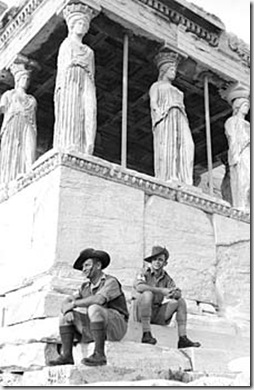
Episodic in form, it is set at an unnamed boys boarding school referred to College or the Coll based on the United Services College (photo) in Devon which Kipling attended. Founded especially to educate the sons of military officers, it had a focus on preparing pupils for military service, many going on to Sandhurst and Dartmouth.
The books three central characters are Beetle partly based on Kipling himself, the charismatic leader Stalky based on Lionel Dunsterville and M'Turk, based on George Charles Beresford. The three form a team and engage in various exploits, often at the expense of Mr King, the master of a rival house. While they did respect the headmaster and indeed the padre, they had a very cynical attitude to life and very little respect for formal authority or indeed rules. This is not a gentle book. When the padre asked them to help a younger boy whom he suspected was being badly bullied, they did so by applying the same techniques to the bullies that had been used by them, techniques that would now attract a significant prison sentence.
I wasn't especially happy at school when I read the book for the first time. I identified at once. The broad patterns of life were familiar so I could understand, and I really identified with their escapades and their successes.
The school sergeant who knew they were up to no good was not fooled when they sauntered out one day. He knew that they planned to break bounds. I followed with them as they burrowed through the gorse to find the little clearing on the top of the cliff overlooking the sea where they could have a quiet smoke. The sergeant's attempts, binoculars in hand, to find them were quite funny and would ultimately lead to total defeat in a very funny scene indeed.
I mention all this because of a newsletter from Allen and Unwin referring to a new book by Barry Stone, Secret Army, subtitled "An elite force, a secret mission, a fleet of Model-T Fords, a far flung corner of WWI".
This is a real life story of that Stalky from Stalky & Co, Lionel Dunsterville, the story of 'Dunsterforce'.
The publishes have kindly put up a sample chapter on ScribD. It's.a story that somehow fits exactly with the image I had formed of him from the original book.
Postscript
In a comment, Sue pointed me to this English blog To the Manor Born by Lucy Fisher on the English class system. She had just been reading an interesting post on it about boarding schools and thought I might find the whole blog entertaining. I did.
While it's tangential to this post, I thought that I would add the link here because other readers might find it interesting. .
Sunday, October 06, 2013
A day at the Fleet Review
Saturday a bit after eight I headed out for Mosman for my day at the Fleet Review (Sydney's International Fleet Review). I left early because a million or so people were expected to attend, and I thought that the roads would be crowded and parking impossible. As it happened, I needn't have worried. The main crowds (1.7 million was a later estimate) were going elsewhere, and there was very little traffic
For those who don't know Mosman, it is located about eight kilometres north east of the Sydney CBD on the other side of the Harbour. The suburb is named after Archibald Mosman (1799–1863) and his twin brother George.
They moved onto a 4-acre (16,000 m2) land grant in the area in 1831, establishing a whaling station. The area was then known as Sirius Cove, but later came to be called Mosman Bay. One building survives from the Mosman period. Just for the hell of it since this post is part about light and water, this is a 1914 painting by Arthur Streeton of Mosman Bay.
Saturday was hot early, with a real haze in the air, making decent photography difficult for someone as unskilled as I. My friend and I set out in the still early light for the vantage point we had selected to see the day's events. As we walked, I kept stopping and looking, filing away mental images for later use.
Mosman is a wealthy suburb that has, In many ways, been less affected by the changes that have taken place elsewhere in Sydney. Its population is on average older and less diverse. You can get a feel from the destination Sydney web site.
With harbour views in the distance and pretty streets lined with glamorous homes, Mosman is a stylish shopping destination. Military Road and surrounding streets have plenty for the keen shopper from fashion and homewares, to accessories and antiques.
The highly desirable Accoutrement homewares shop is here, the cool and sleek Scandinavian designs in Nordic Fusion and the fabulous Mosman Interiors. Bespoke Art houses the best homewares from around the world, for bedding to cutlery head to Pond Home. Popular fashion brands range from Seed to Lululemon, Mimco to Carla Zampatti.
This is typical tourism speak, and is actually unfair. No tourist is going to go to Mosman for the shopping. Mosman is more than this. However, the architecture is attractive. Many of the often large houses were built in the early part of the twentieth century. This is an example of Mosman architecture. Love those verandahs.
We walked on ,ending at Georges Heights. This is a former military base One of the main streets in Mosman is called Military Road. I hadn't actually realised the significance, for this was indeed a military road.
When we arrived at our destination with its panoramic views, there was almost no-one there. You can see this from this photo with its views towards the heads Note also the military remains. These are gun platforms.
As we waited for the fleet to arrive, numbers increased a little, with the kids playing on the old guns. One of the constant themes in conversation over the day, a theme perhaps triggered by the military flavour, was just how lucky Sydney had been to avoid terrorist or indeed other attacks. This is really a very peaceful place.
The Australian Navy ships were to come in two waves, We could see the first wave, the small ships, crawling along beyond the heads. They seemed to take for ever. Meanwhile, a Navy Seahawk helicopter circled the harbour with a giant naval ensign hanging below, stretched out in the slipstream. My instinctive reaction was just how hard if must be for the pilot to keep the copter stable. We also watched the boats on the harbour. It looks positively tropical!
The lead ship in the first contingent came through the heads and then stopped to allow the other ships to form up properly. From that point, the convoy proceeded directly below us, accompanied by a Manly ferry that had somehow gate-crashed the show! later I would learn that many of the pleasure craft were actuslly stranded by the exclusion zones to the sometimes distree of thier passengers.
The ships really were quite close.
As we waited, we could see the bigger ships forming up beyond the heads.
All the sailors were lined up on deck; the distant strains of a brass band could be heard.
One of the really interesting crowd reactions, one that I shared, was just how small the fleet was. This is the Australian aircraft carrier HMAS Sydney, arriving in Melbourne in 1949. This was the first of Australia's two aircraft carriers. one of three aircraft carriers (the others came from the UK and the US) to serve in Korea in 1951. Accepting that technology has changed, there is something a little worrying about Australia's inability even to keep up maintenance on its main supply ship to the point that it had to be withdrawn from service as unseaworthy.
It had been a long morning, and we wended our way to get some copy (in my case a beer!) as the air display began. That was fun too, the air display I mean, something of a blast from my past.
Friday, May 03, 2013
3 May 1917 - remembering a family death at Bullecourt
The Second Battle of Bullecourt began early on the morning of Thursday 3 May 1917[1]. The offensive had originally been intended to support a failed attack to the south.. The French attacked on 15 April 1917 but failed. However, both British and French leaders agreed to continue operations, one of which was a combined British and Australian attack on the Hindenburg Line around Bullecourt where the previous attempt to capture and hold sections of the German line had failed so disastrously on 11 April 1917. The objective was to capture the railway embankment at Reincourt, thus damaging German transport while opening an immediate front beyond German fortifications.
The battle was a confused one. Two hours after it started, the centre of the 2nd Australian Division had reached its second objective, but with troops barely able to hold it, let alone to push onto Reincourt at the scheduled time of 6am. Around 7am Colonel Murray and some of his men from the Australian 18th were pinned down in shell-holes facing O.G. 1, the first of the defensive lines. CEW Bean, the official Australian War historian, described the following events in this way:
A little later, Lieutenant M. C. Drummond (Petersham and Leichardt) N.S.W), the intelligence officer of the 18th Battalion, succeeded in reaching from the rear the shell-holes in which Colonel Murphy and a number of men were lying in front of O.G.1. On learning of the situation Murphy decided to attempt the rushing of the trench. On rising to make the charge, however, the gallant Drummond, a sergeant, and two men were instantly killed. Seeing others also fall, Murphy gave the order to dig in and hold on.[2]
This view of Morris (photo) was shared by others. On 6 May 1917, three days after Morris’s death, a fellow officer (Lt. Jim Harrison) wrote to brother Will: “Maurice was ... the most fearless officer in the Battalion, he was exceeding his duty at the time, very typical of him.”
The story that ended here began in 1914. On 4 August, Britain declared war on Germany. The Australian Prime Minister declared Australia’s support the following day, offering an expeditionary force of 20,000 men to serve in any destination as required by the Home Government. On 6 August, London cabled its acceptance.
There was a rush of patriotic support for the war. On 25 August 1914, Will, the oldest of the Drummond boys, enlisted[3]. It had been an agonizing decision. His Christian beliefs would not allow him to take life, but he also felt that he must do his duty. His solution was to join as a stretcher bearer: 'I have tried to play the game and to live up to the ideas Jesus has set before me', he wrote to Morris on the day of the Gallipoli landing (25 April 1915).
Morris and David Drummond did not enlist immediately. The three brothers had agreed that David, as the only married one, should stay to be in a position to look after their sister Ellie should that prove necessary. Later, when David did try to enlist, he would be rejected twice, probably on the grounds of his deafness. He couldn’t have heard orders in the battlefield din.
For Morris's part, he followed events closely, finally deciding in August 1915 that he too must enlist. “Perhaps you will not be altogether surprised”, he wrote to David in August 1915, but I have felt it coming on - like a bad cold... while I have the conviction that men are really required I cannot hang back and let someone else carry my bundle... I've taken the step and hope it won't be labour in vain, but at any rate I've no delusions about the fun and glory of it.”
Morris was offered an immediate commission, but declined it.. His sister recalled later that officer training would have delayed his passage, and he also wanted first to know something about the men he would command[4].
I wondered about this, for family stories are always uncertain things and especially long after the event. However, the official Australian War Memorial form required for inclusion in the Roll of Honour includes this reference: “Refused to accept any promotion in camp & again in France until he had served in a battle.”[5] The information was supplied much earlier by Brother William, but is consistent with his sister’s recollection.
Based on this and other records, Morris was clearly a remarkable man.
The death came as a huge blow. The three brothers had always been very close, with Morris and Will forming a close knit team providing support to both David and Bid (the brothers' pet name for sister Ellie). Throughout the war Morris had written regularly to David; cheery letters full of details, such as descriptions of French farming methods, intended to interest the younger brother. However, they also gave a clear picture of the hardships and dangers associated with the war.
Brother William survived the war. He was repatriated home and had to spend some time in convalescence. The photo shows him during that period. For his part, Morris’ memory as a remarkable man was carried down through the generations to this day.
[1] C.E.W. Bean, 'The Australian Imperial Force In France 1917', Volume IV, The Official History of Australia in the War of 1914-1918, Angus and Robertson, Sydney, 1933 p412f
[2] Op cit, Note 88, p456
[3] The Australian Army's Central Records Office (CARO) provided original enlistments details for Will and Morris Drummond. (CARO to author, 5 February 1982.)
[4] Interview with Mrs Morris, 1 October 1982
[5] Australian War Memorial Records, http://www.awm.gov.au/collection/records/awm131/awm131-15-0676.pdf, accessed online 3 May 2017.
Wednesday, April 25, 2012
ANZAC Day, Toynbee & impermanence
This is the seventh ANZAC Day since I started writing this blog. Looking back, I have largely ignored the celebration. In my one and only post on ANZAC Day prior to last year, I wrote:
"I have very mixed feelings about ANZAC Day
As I wrote in an earlier post written on Remembrance Day (11 November), 416, 809 Australians enlisted for service during the First World War, representing 38.7 per cent of the total male population aged between 18 to 44. At almost 65 per cent, the Australian casualty rate (deaths, wounds, illness) proportionate to total embarkations was the highest of the war.
All Australian families were affected.
Uncle Will's Christian beliefs would not allow him to take life, but he felt that he must do his duty. His solution was to join as a stretcher bearer. On the day of the Gallipoli landing he wrote to brother Morris:
"I have tried to play the game and to live up to the ideas Jesus has set before me."Will survived the War, Morris did not.
Morris did not enlist immediately. Then on 7 August 1915 he wrote to brother David (my grandfather):
"Perhaps you will not be altogether surprised but I have felt it coming on - like a bad cold .... while I have the conviction that men are really required I cannot hang back and let someone else carry my bundle... I've taken the step and hope it won't be labour in vain, but at any rate I've no delusions about the fun and glory of it."Morris was offered an immediate commission but declined it. Officer training would have delayed his passage, and he also wanted to know first something about the men he would command.
In May 1917 came the news that Lieutenant Morris Drummond MC had been killed in brave but futile attempt to force the German lines in front of Reincourt. Lt. Jim Harrison, a fellow officer, wrote to Will Drummond on 6 May:
"Maurice was ... the most fearless officer in the Batallion, he was exceeding his duty at the time, very typical of him."Many in my generation, that affected by the Vietnam War, had reservations about ANZAC Day because we saw it as a celebration of war. While my own views have changed over time, I still have mixed feelings.
All nations require symbols to unify their peoples. I find it a little sad that a military event, that Australia's military tradition, should become so dominant in symbolic terms. Still, in typical wry Australian fashion, we celebrate a defeat!"
This is a personal blog. The title I chose for it, Personal Reflections, accurately reflects its intent. Those who know me personally will know that my personal moods and experiences drive my writing. In it's own way, this blog is a personal diary.
Unlike previous years, ANZAC Day had a special meaning for me last year.
In September and October 2010 we visited Greece and especially the Greek Islands. This is a photo of Denise, Clare and I taken at our hotel in Athens.
It was a happy time. It was also a time that allowed me to indulge my love of history. As I walked the cobbled streets, looked at the buildings, gazed at the seas that Homer had recorded, some of the history that was interested in had a new visual and geographic expression.
As Australian soldier John Learmouth travelled on the troop ship towards his still unseen death on Crete, he wrote:
I have forgotten what little ancient history I ever read; but I fancy Ulysses must have sailed in theI had not heard of John Learmouth When I visited Crete. However, I was aware of the deaths of New Zealand and Australian soldiers in the Battle of Crete. They were just the latest in a long line of deaths in this contested arena.se seas. I wonder did the Sirens live on one of those little islands over there, now slumbering so peacefully in the warm laughing sea; and do those rocks hide the caves of Cyclops, the one-eyed giant? What history has been made among these seas; what sagas of the human race have had their setting here. Thousands of years ago men have sailed these seas to go to war, and we sail them today for the same purpose.
This led me to visit the war memorial museum at Iraklion.
I saw last year's ANZAC Day through the prism set by these experiences. It led me to write a number of posts linked in some way to ANZAC Day. This year, I find that my mind is running on a different track.
My historical research and writing means that I am constantly aware of the fragility of the human condition. I have no especial expectation that anything that I love or am just familiar with can survive. History shows that the reality is different. This does not make me a pessimist.
If we start from the premise of impermanence, we also find that individual action defers the dire day, that it can lead to longer term improvement. We can do things, but we must have realistic expectations.
The recent discussion thread on this blog has centred on civilisation and progress. Train Reading - introducing Toynbee's Civilization on Trial introduced the work of Arnold Toynbee. I don't want to say a lot further on Toynbee here, just a few notes relevant to this post.
Civilisation on Trial was published in 1949. The collected essays in the book were written over a twenty year period from the 1920s to the immediate post second world war period. The cold war had begun, although the USSR had yet to get the bomb. Europe was exhausted, drained by the two great wars that form the centre piece of ANZAC Day. The first war had seen the collapse of the old dynastic order, the second had begun the dismemberment of the European empires. The western centre of gravity had shifted to the United States.
Much of Toynbee's writing focused on the rise and fall of civilisations. Civilisation on Trial addresses one of Toynbee's concerns, could western civilisation itself avoid the decline experienced by all previous civilisations? The key audiences addressed are the middle classes in western countries. Despite the wars, this globally tiny elite still believed that, for them, history had ended. The comfortable assurance that their systems and values were right and enduring survived. Not so, said Toynbee. The world is different now.
I will look at Toynbee's reasoning in a later post. My present point is that the comfortable assurance that Toynbee refers to is still there. It pays us to remember that in considering ANZAC Day. After all, it is a celebration based on a defeat!
Saturday, November 05, 2011
Pubs, daughters & the Fuzzy Wuzzy Angels
As someone fascinated by the idiosyncrasies of human life, I love the sometimes randomness of it all.
I have mentioned before that eldest works on a part time basis at the Newmarket, a hotel not far from where we used to live in Rosebery. Those who live in Sydney may well know the pub and the bowling alley next door - it's owned by the same people - because it's on the corner of two main drags, Botany and Gardeners Roads.
It's a very busy pub with a significant local clientele. The tour buses from the Blue Mountains and outer suburbs visiting the factory outlets that dot the area also call there for lunch, making for a very busy bistro. Helen has been working there for several years now, part time during term, more during holidays.
My work as a management consultant means that I have had to learn to watch and listen. To improve things, you really have to understand how things work in the first place. If, as is so often the case, you change things without really understanding what actually happens on the ground, then mess results.
I don't spend a lot of time at the pub. However, I do sit at the bar sometimes when waiting for her.
Helen is one of the still small but growing number of urban young without a driver's license, put off by the time, cost and hassle now involved in getting one. This worries me from time to time, for absence of a license can be a significant problem in an emergency.
Monday night was a case in point.
Helen plays netball two nights a week. On Monday, one of her friends (Grace) took Helen to netball in her car. During the game, Grace fell heavily, so another girl drove Helen and Grace to hospital in Grace's car. Helen then rang her mum who drove across to Royal North Shore Hospital to stay with them until Grace could be seen and then bring Helen home. It turned out to be a late night. Then early the following morning, I drove Helen to Mosman to collect her mobile on the way to work. Grace's mobile battery was flat, so Helen had left the phone in case Grace needed to contact her parents.
A small story, but it does illustrate the importance of driver's licenses. Mind you, I don't mind driving Helen. It actually gives me at least the illusion of the usefulness I once had when the girls were still at school!
Sitting at the bar nursing a light beer with my management consulting hat on while Helen finishes up is quite interesting. Dear that girl's efficient. There is no wasted effort. It's not just a question of pouring a beer or serving another type of drink. Some customers pay in cash, some with EFTPOS. Most have membership cards that need to be swiped. These cards provide special benefits. All this is mixed with transactions from the Sportstab area.
From a pub viewpoint, turnover depends upon fast service. It also depends upon courteous service, especially to keep the regulars happy.
Serving up to five people at a time, mostly regulars, Helen has the process down to an art form with no wasted effort.
I said that I was fascinated by the randomness of it all. Yesterday, I was due to pick Helen up at six. She rang me a bit after five to say that the Fuzzy Wuzzy Angels were visiting the pub, and I might like to come and watch. She didn't have many details, but knew that I was interested in the history. I hopped in the car and drove off. In due course, the Fuzzy Wuzzy Angels appeared and danced.
Now there is a back story here that took me a little while to put together.
Most Australians know the Fuzzy Wuzzy Angels as the Papuan villagers who helped the Australian troops in the often dreadful fighting against the Japanese along the Kokoda Track in 1942. One of the most iconic photos shows one of the Angels helping a wounded Australian soldier. ![]()
While the work of the Fuzzy Wuzzy Angels was well known in this country, it took a long time for the Australian Government to formally recognise their help. That recognition was aided by the growing interest in Australia in the story of Kokoda Track and the opening of the Trail to walkers. The terms Track and Trail are used interchangeably.
This year 3 November, the date in 1942 on which victory was unofficially declared on the Track, was officially dedicated as Kokoda Day. To mark the event, a group of dancers from Kokoda village plus one of the original Fuzzy Wuzzies, the son of a second,were brought to Australia with support from QANTAS. As part of their visit, they were also involved in the unveiling of a commemorative statue at the Kokoda Track Memorial Walkway at Rhodes in Sydney's Inner West.
It was this group that was to perform at the Newmarket. Now sitting at the bar, I had no idea of all this background. Indeed, I had no idea what to expect at all!
The main bar at the Newmarket has a small stage in the corner, with an open area in front. As I waited, chairs were place on the stage, and a group of dancers came out dressed in traditional costumes including bare breasted girls, accompanied by three Papuans in suits who sat on the stage.
The dances began, accompanied by hand held drums and singing. I was quite fascinated, as were most of the other patrons. 
I hadn't seen Papuan dancing, nor heard Papuan singing. I suppose that I had expected it to be like the Aboriginal equivalent, but it had a more African feel because of the drums and rhythms.
I was also struck by the small stature of those involved.
The Papuan and New Guinea people I have known (a number started coming to my old school on scholarship as boarders during my last years at TAS) were generally shorter than some of the taller local students, but I have actually never been to PNG.
I suppose my eyes have been conditioned by the big boned Polynesians who have a significant presence in Australia and especially in Rugby Union.
At the end of the performance, the group leader introduced everybody and explained the significance of the visit. It was then that I realised the importance of the back story. Me being me, this led me to go off and check details, and then too write this story.
I still have no idea how the group came to perform at the Newmarket. Presumably someone knew someone. I do feel honoured and grateful to have been there.
Tuesday, August 02, 2011
Spectacular colour photos London blitz
My thanks to Maximos62 (and @maximos62) for this one. The London Daily Mail has released some spectacular colour pictures of London under siege from Nazi bombers during World War II.
I mention them because I know that some readers will find them interesting.
Monday, May 16, 2011
Ripping yarns - the story of German raider Pinguin
Reading World war II Day by Day I was struck by regular references to ships destroyed by the German raider Pinguin. Then I read that it was finally destroyed on Day 616, May 8 1941.
Curious now, I followed the link given through to the story of the ship. It's really a ripping sea yarn, so thought that I would share it with you.
Thursday, May 12, 2011
The WA Premier's ANZAC tour
In ANZAC Day wrap-up I said in a postscript:
"Tim wrote in a comment:
There are a group of Western Australian school students taking part in the the ANZAC commemorations in Greece and Crete. They won the Premier's 2011 ANZAC essay competition.
My congratulations. What a wonderful opportunity."
Following that post, I received a kind email from Robyn Cleaver, Principal Consultant - Secondary Directorate, WA Department of Education. Robyn wrote:
Hi Jim
Saw your blog and your question. The WA Premier's ANZAC Student Tour travelled to Athens, Greece for ANZAC Day and then on the 26th journeyed to Crete for a 6-day study tour. Souda and Retimo sectors covered; the evacuation to Sfakia and through Preveli; the students and staff hiked both Imbros and Samaria Gorges; and a number of informal commemorations undertaken.
If you are interested, have a look at the 2011 web diary at www.det.wa.edu.au/anzac - click on tour diary under the 2011 Tour.
The group will be attending local Battle of Greece/Crete commemoration in Perth this Sunday as the conclusion to the program.
Robyn
There were ten students plus two teachers on the trip. This is the official photo of the group.
The party flew out on Emirates to Athens via Dubai, on 23 April.
The trip diary entries are well written by the students. They work backwards like a blog, but you can click on the oldest and then follow through in date order.
I don't want to steal the student's thunder, but a few excerpts just to whet your appetite.
Day 1 and 2: Saturday, 23 April and Sunday, 24 April 2011: Jake Morrison - Mindarie College
So it’s the day that we have all been waiting for 12 months of hard work (18 months for Robyn) is about to pay off as our trip to Greece has finally arrived.....As we all made our way to the airport the excitement had well and truly set in, most of us arrived earlier then our scheduled meeting time, coming together as a group suddenly made the experience so much more real and we all knew that an amazing journey was about to begin. As we said goodbye to our loved ones and headed through customs all we wanted to do was get on the plane and get into the air.....Six more hours of flying and we finally were able to view our destination. Ours eyes were all glued to the windows of the plane, for those who had window seats, as we approached Athens we could see clearly the Greek Islands, all knowing that we wanted to be back one day. Within an hour of arriving in Athens reserve energies were found as we headed off to explore the incredible city.
After an initial exploration of the city and a first taste of Greek food, the group was to bed to prepare for the next day, ANZAC Day. As I said in an earlier post, this appears to have been the first official ANZAC Day ceremony in Athens.
Day 3: Monday, 25 April 2011 (ANZAC Day): Hayley Pring - Perth Modern School
The day began for us at 3.45am as we awakened and readied ourselves for the first dawn service in Greece. It was a day that had significant importance for all of us, particularly to be commemorating the Anzacs in Greece right by their very graves. We arrived at the Phaleron Commonwealth War Cemetery at 5.00am, where we sat shivering from the unexpected cold. Attending the service were several tour groups, along with a number of Australian travellers seeking somewhere to commemorate ANZAC Day.
Just to set a context and as I reported in Allies surrender in Greece, this ceremony was held just three days before the Allied forces surrendered in Greece: at 5.30 AM on 28 April 1941, Allied resistance on mainland Greece effectively ended when 8000 British, ANZAC, Greek and Yugoslav troops surrendered at Kalamata, Peloponnese peninsula.
As I commented in my own reactions to Greece last year, the links between Australia and Greece are strong, and not just because of the large number of Greek migrants that came to this country.
The photo shows the Athens dawn service. Following the dawn service:
Another touching moment for the group occurred as we assisted an elderly Greek lady as she endeavoured to place an Australian flag on the grave of each Australian serviceman. The service ended and we headed down to the Poseidon Hotel for a reception hosted by the Australian Embassy. We were able to talk with many of those who had attended the services, sharing stories and discussing further our thoughts of the day. The close knit group who joined us for Anzac Day and the intimate stories we shared highlighted that there were many people who wished to preserve and remember a part of our history that is often forgotten: the Anzacs in Greece.
Day 4: Tuesday, 26 April 2011: Sophie Prober - Mount Lawley Senior High School
The party explore Athens and then fly to Crete.
Day 5: Wednesday, 27 April 2011: Mehdi Nawa - St Norbet College
Mehdi records the party's first day in Hania (Chania) and the things they saw.
I am not going to give a detailed report from this point. Instead, I want to stand back and make some general points that I think are important.
This photo shows the German Military Cemetery at Maleme which commemorated lives of 4460 German service personnel who were killed during the Battle of Crete and the subsequent occupation. To quote Mehdi:
The cemetery was different in its appearance and layout to Commonwealth cemeteries that we had seen but the message of loss on all sides was clear. Not only do these cemeteries commemorate the loss of life but they also signified the greatest call for peace. If war teaches us anything it is that peace, love and harmony are worth striving for in our lives.
When we were in Crete last year it was warm and dry. The students found it cold and damp, with snow on the mountains. The German invasion of Crete was still a little way away - it began on 20 May 1941 - but already you can see how harsh the conditions were.
The students also found, as I had, that the past was still alive in Crete. Here I want to quote from Lachlan Blair (Wesley College) on their visit to Rethymno.
Upon arriving in Stavromenos we surveyed the area, imagining with the assistance of maps and photos how it must have looked in the mid 20th Century prior to modern developments. Shortly thereafter we visited the Greek-Australian Memorial that appeared to be undergoing maintenance in preparation for the 70th anniversary commemorations in May. Here Jade and Medhi laid a wreath and Tyran recounted the Ode as part of a small ceremony in honour of the service of both Greek and Australian soldiers.
Hayley shared the stories of Australians in the Rethymno sector and Sophie revealed the tale of Arthur Leggett, a Western Australian signaller in the 2/11 Battalion who fought in the Rethymno area before becoming a Prisoner of War. His story was particularly relevant considering that we were fortunate enough to meet Arthur during the March briefing and could imagine how he would have battled tooth and nail in a landscape that offered little cover aside from a few groves of olive trees.
En route to our next destination, we briefly stopped at a memorial on Misiria Beach, which commemorates the Cretan Resistance movement. We learned of German reprisals against resisting Cretan peoples and Robyn encouraged us to consider the longer-term effects of war on the communities in which conflict takes place.
We then travelled to the small village of Perivolia to visit St George’s Church, the site of the last stand of 8 Bren gunners of the 2/11 Battalion, who died on 27 May 1941 attempting to force the Germans from their position on the strategically important hill. Lauren recounted this story in greater detail, with Jake also adding his personal connection to the events of the Rethymno sector through his Pop, Sergeant Dominic Knowles. The story of the eight Bren gunners was especially poignant considering that we had visited the graves of many of the men the previous day at the Commonwealth War Cemetery at Souda Bay.
I hope that I have given you enough of a taste to encourage you to visit the trip diary.
Just finishing with a little bit of a personal muse.
One issue that has been discussed recently on this blog is the extent to which Australians have become insular internationalists. I have indicated that I think that this view is correct. However, it has to be balanced.
Younger Australians have the opportunity today to travel in ways that were simply not available to their parents or especially grandparents. Places that were once just names on the map become visually real. This changes things in ways that we don't properly understand.
Links are created that lap and overlap. An Indian Australian, for example, has links to home that form one thread. However, that Indian Australian also has links through Australian history to very different worlds. As an Australian, that Indian Australian is also linked to Crete and the events of the Second World War in Europe.
I suppose my point is that many Australian young live in multiple worlds in a way that was not true of their parents or grandparents. Much of this is simply accepted. Yet how it is harmonised, how it knits to form a coherent whole, is quite important. But that's a matter for another post!
Saturday, May 07, 2011
6 May 1941 - a day at war
Reading World War II Day-By-Day, one of the things that I still find a bit staggering is the sheer scale of the conflict. Sure I know it's a World War, but its still a bit staggering.
To illustrate this, I have just taken 1 day, May 6, 1941, Day 614 since the war began.
On Crete, the Allied commander, New Zealander General Freyberg, receives accurate intelligence (Ultra intercepts of poorly-coded Luftwaffe signals) on German plans for an airborne invasion of the island by 2 divisions on May 17. Freyberg does not believe a parachute attack is likely and continues to focus on the threat of amphibious landings with tanks.
After some delays, the German airborne invasion will begin on 20 May. Freyberg commands 14,000 British garrison troops plus 25,000 British and ANZACs evacuated from the Greek mainland and 9000 Greek troops. However, many are unarmed and most guns & vehicles have been abandoned on the mainland.
I covered the Cretan conflict in two of my Greek posts, Arrival in Iraklion and then An Australian dies in Crete.
That same day in Paris (May 6), senior German diplomat Otto Abetz and French Foreign Minister Admiral Darlan negotiate a preliminary agreement to send Vichy French war materiel in Syria to the Iraqis. The Paris Protocols also allow Germany use of airbases in Syria to transport aircraft to Iraq. Luftwaffe Colonel Werner Junck is ordered to establish Fliegerführer Irak with 12 Messerschmitt Bf110 fighters and 12 Heinkel He111 bombers.
The Germans have in fact been a bit slow to get their act together.
In Iraq, Iraqi forces who were attacking RAF Habbaniya withdraw from the plateau overlooking the airfield having suffered 1000 casualties from RAF attacks.They are pursued by the King's Own Royal Regiment which routs the retreating Iraqi troops at the village of Sinn El Dhibban on the road back to Baghdad (433 Iraqis taken prisoner). British casualties are 7 killed and 14 wounded. The 21st Infantry Brigade, 10th Indian Infantry Division, disembarks at Basra to reinforce the British presence in Iraq.
As Nigel Davies pointed out in The deployment of Allied land forces in 1942, the potential German threat to Iraq in 1941 and 1942 required the continued deployment of Imperial and Commonwealth troops in a theatre away from immediate conflicts.
In Ethiopia, East Africa, troops of the 3/2nd Punjab battalion are recovering after their failed attempt the day before to attack the Italian stronghold at Amba Alagi. They attacked as dawn broke on May 5, but got held up in barbed wire and are pinned down by 12 Italian machineguns only 500 yards ahead (8 killed, 28 wounded). They wait all day under fire to retreat after dark.
Much of the fighting around Amba Alagi has been done by Indian troops. In addition to the 3/2nd Punjab battalion, fighting has involved the 5th Indian Division and 6/13th Frontier Force Rifles battalion. The 1st South African Brigade was also involved, moving towards Amba Alagi from the south.
That same day, 5 May, Ethiopian Emperor Haile Selassie triumphantly returns to his capital Addis Ababa, 5 years to the day since fleeing the Second Italo-Abyssinian War.
Further north, the siege of Tobruk continues. Following the failure of German and Italian attack on Tobruk, General Paulus, representing the German High Command, had suggested to Rommel on 4 May that he abandon the attacks at Tobruk in favour of a passive siege to starve the defenders into submission. Rommel creates a ring of posts to limit Allied sorties outside the wire, while the Luftwaffe will try to prevent resupply of the Tobruk garrison by sea.
The next day, the besieged Allied garrison at Tobruk is resupplied by Navy warships for the first time when Australian destroyers HMAS Voyager & HMAS Waterhen complete the round trip from Alexandria to Tobruk overnight.
Elsewhere, the war at sea continues.
Off Sierra Leone, U-103 and U-105 sink 3 more British freighters (12 killed, 100 survivors). U-103 rights a swamped lifeboat to accommodate more survivors from one steamer. 500 miles West of Ireland, U-97 sinks British ocean boarding vessel HMS Camito and Italian tanker SS Sangro which she is escorting to Britain (28 killed, survivors picked up by corvette HMS Orchis). Off the coast of Italy, British submarines HMS Taku and HMS Truant sink Italian steamers Cagliari and Bengasi.
This brings on my count the number of ships sunk in seven days by submarines or bombing to 28 - 15 British, 8 Italian, 3 German and one each from Sweden and Norway.
You see what I mean by scale, recognising that war with Japan was still some months away.
Saturday, April 30, 2011
Allies surrender in Greece
I did not record this, although I should have given my interest in things Greek. The daily diary of World war II, World War II Day-By-Day, records that on 28 April:
Allied resistance on mainland Greece effectively ends at 5.30 AM when 8000 British, ANZAC, Greek and Yugoslav troops surrender at Kalamata, Peloponnese peninsula. The evacuation is over, although men will be collected from various small Greek islands over the next few days. Germans take 6508 British, 2030 Australian, 1614 New Zealand prisoners, plus 3806 Cypriots and Palestinians. Allied support of the British government commitments to Greece (executed mainly by NZ and Australian troops) has cost 2250 killed and wounded and 14,000 taken prisoner (out of 58,000 sent to Greece). In addition, 104 tanks, 192 field guns, 164 anti-tank guns, 40 anti-aircraft guns, 1812 machine guns, 8000 trucks are lost plus 209 aircraft destroyed (72 lost during the combat phase, 55 bombed on the ground by Luftwaffe, 82 destroyed or abandoned during the evacuation). Germany has overrun Greece in 23 days with 1318 killed and 3360 wounded (plus 166 killed and 392 wounded in Yugoslavia). In contrast, the Greco-Italian war in Northern Greece and Southern Albania (which was ended by the German invasion) costs Greece and Italy each about 14000 killed with 60,000 wounded. Most British troopships crowding Suda Bay, Crete, are sent on to Alexandria, Egypt, avoid attack by Luftwaffe bombers which sink 2 Greek steamers.
Rommel is still having trouble in Tobruk.
Tuesday, April 26, 2011
ANZAC Day wrap-up
In yesterday's post ANZAC Day, national identity & the power of images I mentioned the blog World War Two Day-By-Day and that at this time in World War II ANZ troops were engaged in the defence of Greece, while at Tobruk besieged Australian troops were playing a key role in holding Rommel out.
At the time, I didn't know that the first ANZAC day ceremony was being held in Athens to mark the Greek campaign, while there had also been plans to hold a ceremony in Tobruk before the Libyan troubles intervened.
In this post, I just want to round off the previous post to pick up a few of the ANZAC Day stories I saw in my travels.
A story in the New Zealand Sunday Star Times, the forgotten Anzacs by Rob O'Neil, provides a New Zealand perspective on one element of the Greek campaign.
I mentioned that an ANZAC Day ceremony would be held at Villers-Bretonneux in France. This photo of the ceremony is from the Australian.
A number of bloggers provided family perspectives, such as Neil Whitfield's Anzac Day scans. I wrote A New England family war story.
As has been the case for many years, the Gallipoli ANZAC Day ceremonies were attended by many young Australian. This photo from the Australian shows part of the crowd.
I mentioned the war memorials that dot Australian and New Zealand towns. I should have added countryside. A story by Jennifer Ingall on ABC New England North West, 16 dead, but who were they?, gives an insight at a purely local level.
One thing that I did not mention in the original ANZAC Day story is of Australia until quite recently to recognise the role played by its Aboriginal and Torres Strait Islander Diggers. The photo shows Grace Gordon Archibald with Frank Richard Archibald's WWII medals.
The contribution of the Archibald family is actually well recognised in Armidale. However, Michelle Hoctor's story in the Armidale Express, Family’s plea to put a brave man at rest, provides a human face to the story of one digger.
In the previous post, I mentioned that the strange nature of ANZAC Day - celebration of a defeat on side, of a victory on the other - laid the basis for unexpectedly close relations between Turkey, New Zealand and Australia. In a tweet, tahir gürsoy wrote:
@phbarratt @JimBelshaw i wish to be there again my heroes and anzac soldiers sleeps together in my land, RIP all.
To finish this wrap-up with another photo from the Australian. This photo members of the Turkish Air Force acrobatic team perform over the Turkish Navy Warships sailing near Turkish Memorial at Gallipoli.
Postscript
Tim wrote in a comment:
There are a group of Western Australian school students taking part in the the ANZAC commemorations in Greece and Crete. They won the Premier's 2011 ANZAC essay competition.
My congratulations. What a wonderful opportunity.
Wednesday, February 09, 2011
Why generals failed
For those interested in military history (and in management), Nigel Davies in rethinking history had two interesting posts discussing first US and then British generals who failed during the Second World War. He concluded:
The key point to be made from these examples is that even the best men need to be carefully shaped into their rolls as competent battlefield leaders. The vast majority of Western Allied generals during the Second World War had little chance to develop their skills before being thrown into a situation for which they were often not ready. The fault was usually that of their superiors, particularly those who lacked the ability to assess the real capabilities of the men they were promoting in an objective fashion. (However it must be pointed out that sometimes the higher ups had little choice. Democracies almost always go to war ill-prepared, and those in charge often have to assign the best fits they can. Throughout the war Brooke lamented that he did not have enough good leaders, but that he could not find better alternatives.)
Good generals do not spring magically out of the ground. They have to be nurtured. This requires not only an opportunity for slow and well supported development, but also the fortune of having a superior officer who knows which people are best suited to what sort of development. Ideally there will also be an opportunity to give them the time they will need to be ready.
I don't think that the role of experience and of good oversight in the development of managers can be overstated.
Australia does pretty well in the management of responses to natural disasters because we have people who have had lots of experience in the area. Conversely, if you look at some of the recent delivery failures at Commonwealth and state levels, they can be traced back to inadequate management experience of the type required for successful delivery.
Friday, July 17, 2009
Multi-ethnic communities - Adolf Hitler's contribution
I finished my last post, Multi-ethnic communities - history's lessons, with this comment:
Now that I have got this particular obsession (the capacity of very different
ethnic groups to live together in harmony), it might be interesting to see just
what history tells us about multi-ethnic success stories, as well as
failures.
Dealing with a failure first. The picture that Mark Mazower paints of the administration of Hitler’s empire in occupied Europe is absolutely chilling. Hitler should not have lost this war. He lost because his own narrow racist obsessions destroyed the very things he required for success.
The difference between Italian leader Mussolini and Hitler can be simply summarised: whereas Mussolini was driven by visions of Rome recovered, Hitler was driven by visions of Race. Other things came in, but that really sums it up.
Hitler’s only contribution to civilised life, and it is not an insignificant one, is that in his mad obsession he crystallised, took to their logical extreme, ideas that had been built into European thinking and thus discredited them. In doing so, he laid the basis for the Nuremberg trails and for subsequent international action against war crimes.
No matter how weak and conflicted present international approaches to problems like Ruanda or Darfur, the very idea that the international community has the right to intervene to try to limit genocide is largely due to Adolf Hitler.
In The importance of international law - a note, I noted the importance of international law in constraining blind national self interest as well as human savagery.
This remains my view. International law is the first building block in encouraging different ethnic groups to live together in harmony because it imposes sanctions especially on official leaders who want to play the race or ethnicity card.
Of course they will continue to do so, but it is a start.
Note to readers: You will find a full list of posts in this series here.
Friday, March 27, 2009
Milan Deroc and the rules of war
In The importance of international law - a note I pointed to the importance of international law in constraining blind national self interest as well as human savagery.
Some years ago I was given a fascinating insight into this topic through conversations with Milan Deroc. Milan and I were both working on our PhD theses at the University of New England and shared a room for a period.
Milan's thesis, The Serbian uprisings of 1941 and the British response / (1985), covered a particular episode during the Second World War. This was real cloak and dagger stuff set within a context of Balkan politics and the evolving relationship between the Allies and the Soviet Union.
Milan himself was a fascinating bloke.
I am not sure when he was born, I guess around 1918, because he entered the Royal Yugoslav army in the last officer intake before the start of the Second World War. He became a POW,then (much later I think) came to Australia from Yugoslavia.
Milan's story emerged in snippets as we chatted. Individual points emerged - I think an Uncle had been PM of Serbia at one point prior to the First World War; the links between Belgrade and Paris; visits to pre-war Paris as a young man; sipping drinks in Paris watching the world go by.
At the time we shared a room, Tito had only recently died. Yugoslavia, literally South Slavia or Land of South Slavs, still existed.
The politics of the Balkans are incredibly confusing to an outsider. Their interpretation is also much affected by ethnic, national and political positions, and not just within the Balkans themselves.
I know of no easy way of summarising Balkan history. There are, however, two key points to remember.
The first is that the area has been a zone of competition between rival interests for a very long period; between the Roman later Byzantium Empire and invading peoples; between Byzantium and the emerging Ottoman Empire; between the Ottoman Empire and the Holy Roman later Austro-Hungarian Empire; and between Austro-Hungary and the Russian Empire.
The second point is that this history created an ethnic and religious patchwork quilt. Within this, forces of ethic nationalism and irredentism warred with each other and with the ruling power. The Austro- Hungarian Empire in particular faced the problem of maintaining unity in the face of religious division and ethnic unrest. World War One was one outcome.
At the time Milan was born, his country had only just been formed as an outcome of the peace settlements. It was then known as the Kingdom of Serbs, Croats and Slovenes, combining the Kingdom of Serbia with other parts of the the former Austro-Hungarian Empire.
The new Kingdom was an uneasy combination of the pan nationalism of the south slavs with more specific ethnic nationalisms and especially Serbian nationalism. It was also still marked by religious divisions - Muslim vs Orthodox vs Catholic. There was also resentment within the new country at the dominance of the Serbian ruling classes.
Milan would have been at primary school when the Kingdom changed its name to Yugoslavia. He was both Serbian and Yugoslavian at the time he entered the Military Academy.
The country he returned to after release from POW camp in the USSR was very different. In The importance of international law - a note I said of the First World War:
The use of propaganda and dirty tricks on all sides during the war intended to damage the enemy while maintaining home morale created a climate that both prevented peace moves during the war and then poisoned the aftermath. Attempts to destabilise Governments in other countries exported revolution and later civil strife in ways none foresaw.
The Second World War was no different. During the War the Allies had shifted support from the Royal Yugoslav Government in exile to the Communist partisans. For their part, the Germans played to Croatian nationalism through the creation of a Croatian puppet state.
Milan returned to a communist Yugoslavia. He also returned to one in which ethnic and religious divisions had been further inflamed by the War.
Like my own thesis, Milan's work was in some ways an exploration of his own past. Again like mine although much more so, he faced a difficult task because he was writing outside - indeed challenging - commonly accepted views.
Milan was multi-lingual. Prior to the War he spoke Serbo Croat, French and some German. During the war he learned Russian. He needed all these languages to pursue his investigations through German, Austro-Hungarian, Russian, British and US archives.
The work was painstaking and sometimes difficult. Painstaking, because he needed to check precise dates and orders of events, cross-tabulating between different accounts. Difficult, because he needed access to very specific records of still sensitive war time operations.
Take, as an example, the question of a radio. As I remember, this was carried into Yugoslavia by a British operative. The official story was that he had been killed by the Chetniks. While the Chetniks denied this, it was used as one of the ostensible justifications for the switch in British support to the Partisans.
By careful checking of records in four national archives, checking that went down to the log-books of a British submarine as well as unit records within the German Army, he traced the radio's journey. The final clue came from USSR archives. Here he was able to establish that the radio in question was being used in communications between Moscow and the partisans at a time when it was alleged to be in Chetnik possession.
Milan's work focused in part on the laws of war and the way they were observed. This included questions such as the legal position of a defeated army where their Government had surrendered.
In all this, two examples stand out in my mind.
The first is a unit level example.
The Germans announced that for each German soldier killed, so many Yugoslavs were to be executed. In the case of one attack, the German unit records say something like this. So many German soldiers killed minus the number of attackers killed = the number to be used in calculating the number to be executed in reprisal.This is a very precise and legalistic way of doing things.
The second is a little more complicated.
As I remember it, under the rules of war, a defeated army must lay down its arms. Units that keep fighting have no legal protection. Once the Royal Yugoslav Government was established in exile and recognised by the British, then its fighters were recognised as soldiers. By contrast, the Partisans were treated as what we would call today terrorists. They had no protection.
Now the odd thing here is that when the British Government switched its recognition to the Partisans, the Germans also changed their position. Now the Partisans were soldiers, those on the other side including especially the Chetniks would be classified as terrorists if they fought the Germans.
I am not sure that I have all this right. It's a long time ago. However, it does illustrate my starting point, the importance of international law (and conventions) in constraining blind self-interest and savagery.