Friday, November 19, 2010

Fair crack of the whip

Fair crack of the whip is an Australian phrase meaning give everybody a fair go. If used in a particular tone, it means that the other person has not done this.

I had thought that fair crack of the whip was just an Australian phrase. Searching around, I could not find out when it was first used, but it does seem to have been British as well, if not first.

I mention all this because the other night I learned something about the actual crack of a whip that I had not known.

The Australian stock whip is made up of a handle with a long leather tail split at the end.

The tail could be pretty long. A bullock driver, for example, needed a long whip to reach the front bullocks. Experts could crack the whip so that the split at the end reached an exact spot on the leading bullocks.

The term crack came from the sound, a cracking noise.

My brother and I were townies, town dwellers. Still, the whips were around and we tried them.

It's actually very hard to make the whip crack. You are likely to get it tangled around yourself or anything else in the neighbourhood. Still, I did get it right sometimes.

I was fascinated to learn the other night from a British TV show that the actual crack is, apparently, a mini-sonic boom brought about by the speed of the split end.

I am not sure about this because you can get something of the same effect by cracking a beach towel. This can be quite painful properly applied! I very much doubt the towel gets to the required speed. Still, it's interesting.  

Thursday, November 18, 2010

Coping with New England's decline

I mentioned yesterday that my next focus in the New England history project was an examination of social change in New England during the second half of the twentieth century.

My main post today, Social Change in New England 1950-2000 2: Don Aitkin's What was it all for?, is on the history blog. This post is a consolidation and slight extension of two earlier posts on this blog where I reviewed the book, an examination of social change in Australia through the prism set by the Armidale High School Class Leaving Certificate class of 1953. From my viewpoint, the book has been something of a godsend because it deals with broader trends while retaining a New England flavour.

I realised as I was writing, that I really need to do some broad brush stuff on the patterns of structural change in Australia. I have actually written quite a bit on this topic for other reasons, but haven't consolidated the material.

New England is quite an interesting case study because its major industries in 1950 - agriculture, manufacturing, forestry and mining - were all affected in different ways. The closure of the BHP steel works in 1997, for example, signposted the end of an Australian era. The BHP as it was known in Newcastle had cast a very long shadow.

New England proved to be especially vulnerable to structural change because it had old industries and lacked head office jobs. In 1950, new state New England was larger in both population and economic terms than Tasmania, South Australia and West Australia, and was not far behind Queensland. Over the next fifty years, its position slipped inexorably.

Its relative economic decline was greater than its decline in the population rankings because of the rush to the coast, another part of the pattern of social change. The rise in the coastal population created jobs in areas such as hospitality, retailing and health services, but these were generally lower paid jobs. By 2000, coastal New England contained some of the poorest areas in Australia measured by average incomes.

As a commentator, I rail against these changes. As an historian, I have to track the changes independent of my personal views. I may not like it, but what was is what was.

I still find this hard. I don't like writing about failure where I am emotionally involved. I constantly want to move from analysis to comment.

A little of this is not a bad thing. When I finish, I want a readable book. Giving some emotional content to New England can help here, even if it's a sad story.

In a way, the poet and writer Judith Wright is a microcosm of the changes that took place and at many different levels.

She was born in 1915 into the then stratified world of New England's pastoral dynasties.  She died on 26 June 2000, right at the end of my period.

Her relationship with her father, a significant figure in New England's history, and with the land itself, forms a key theme in her life, letters and writing. Her views on issues shifted over her life, but the land remained constant. As a woman, she could not inherit in a world where properties generally went to the oldest son. Her distress at the end of her life when the main station was lost was quite palpable.

I cannot pretend to be totally objective. While I did not know Judith, I did know her father, brothers and nephews. I grew up at the end of the stratified world she was born into. There were elements in that I did not like, yet I cannot help but find it, overall, a good thing. I, too, share her sense of loss.

I sometimes wonder if I will ever finish this book. It's just such a big task.

Wednesday, November 17, 2010

Meander, with a special focus on Ulrich Ellis

No post yesterday. I had a part completed one, but was just too busy with other things. This morning, just a short meander.

During a chat with Noric Dilanchian about the on-line world, he made the point that the thinning out of organisations and the consequent loss of in-house knowledge made then increasingly dependent on the internet as a substitute.

A simple enough point, but it's an interesting one nevertheless. The internal knowledge domain used to be, indeed still is, central to organisational operation. But what happens if you effectively halve it? To what degree can you rely on the internet?

From time to time, I have mentioned the collective GeoCurrents blog. Now the group has started a blog within a blog, the GeoCurrents community blog, with all the entries written by student's in Martin Lewis's seminar on the history and geography of current global events at Stanford University.  As part of this, students are being asked in part to write blog posts instead of the conventional essay. So far, there is some interesting material. I like the way that both the parent and student blogs use maps.

A note to myself on my New England's history blog, Social change in New England 1950-2000 Introduction, signals my latest focus on the New England history project. I have in mind the completion of a seminar for delivery some time, some place, next year.

The segment is important to the general history, but I also think that It's likely to be interesting in fleshing out one element in the broader history of Australia through the prism set by a broader region with its own history.

For a long time, I found this particular task just too daunting. Part of the problem is that it's quite hard to be objective about events you have lived through, participated in. Part of the problem is the sheer scale. This was a time of huge change that worked itself out at local level in a variety of ways.

During the week, Max Ellis kindly sent me a copy of his father Ulrich's autobiography, A Pen in Politics.

The book was written under considerable difficulties.

I hadn't realised that Ulrich suffered from aphasia, a disease that can destroy the ability to communicate. In 1971, the year he turned sixty seven, Ulrich suffered a severe attack that left him unable to understand spoken or written words. He had to learn to speak and write again. This finally led him to write his autobiography, 500,000 words at the end, as a way of regaining control. The book was edited down to its current form by a fellow journalist, the late Elgin Reid.

As you might expect in the circumstances, the book has its patchy spots. It is also quite fascinating.

In his introduction to the book, Professor John Warhurst actually quotes me, something that I had not known. He wrote: "James Belshaw has described him colourfully, but accurately, as 'journalist, political agitator and theorist, public servant and historian'." The quote comes from the title of my obituary of Ulrich.

I was seventeen when I first met Ulrich, he was fifty seven and campaign director for the New England New State Movement. That age gap was a big one, too big for me to become close. While I knew him, knew something of his life, I had no idea of the span of his career until I came to write his obituary.    

In February of this year when I was researching the history of new state symbols, I read Andrew Moore's Australian Dictionary of Biography entry on Ellis for for the first time. New England New State Symbols 1 describes my reaction. This was a put down of the first order. 

Ellis suffers because the causes he supported, many of the things he wrote about, were to later thinking on the periphery of politics. He suffers, too, because his more famous brother Malcolm was a warrior of the right. This led Professor Moore to remark: "Ellis is sometimes remembered as less reactionary than his brother Malcolm Ellis. None the less...."!

Interestingly, a third brother used his pen to support Labor. 

Anybody who reads this blog will understand that I am unlikely to support Professor Moore's views. It's not just that I knew Ulrich, but the interests that Andrew regards as peripheral were central to my life. Still, if we stand back from both views and just look at the detail of Ulrich Ellis's life, you can see that he was an interesting man.

Ulrich was seventeen when he became a cadet journalist in 1921. His career really ended with the loss of the New State plebiscite in 1967, although there were later developments including the writing of his autobiography.

In the forty six years between 1921 and 1967, Ulrich was variously a political journalist; a Canberra public servant and community activist whose activities helped establish not just basic services in the ACT but key political freedoms for public servants; private secretary to Country Party Leader and Deputy PM Earle Page; a key writer and agitator on country causes including new states and constitutional reform; and an historian whose books on the history of the Country Party formed part of the corpus of the early histories of the Australian political parties.

Ulrich's book draws some of his experiences out: we see Australian journalism as it was during the 1920s; we learn what it was like living in Canberra in the very early days; we see what it was like to be a ministerial staffer in the days when a Deputy PM warranted a single personal appointee who had to combine multiple roles that would today require a total office; we see the operations of one party from an inside perspective. These are all interesting things.

I will write more on Ulrich's life because there are snippets there that I think are interesting stories in their own right while showing aspects of the tapestry of Australian life. Like, for example, the industrial roundsman appointed for a new Melbourne daily paper established by the Victorian Country Party.

A strong communist, he knew the union movement like the back of his hand, but had very little journalistic experience. Here he relied on on the young Ulrich for advice. As part of this, he came to Ulrich with his first claim for expenses. This included a claim: liquor for strikers, five pounds. Ulrich took one look, and redistributed the five pounds to other expense categories likely to be more acceptable!  

Monday, November 15, 2010

The lost art of Cabinet government

Paul Barratt had an interesting post, The trouble with Presidential rule, that provided two case studies relevant to some of the questions I discussed in Is Julia Gillard going the way of Kevin Rudd?.

In my writing, I have tried to distinguish between specific problems with the Rudd Government or NSW approaches, and what I see as broader systemic problems. To my mind, the two feed on each other. Paul's examples are interesting because both date from the Howard period.

Sir Robert Menzies was a great believer in Cabinet Government. A naturally arrogant man, he had learned to temper that arrogance during previous political turmoils that almost destroyed him politically. He was also working with very strong ministers and a very strong coalition partner. Under the Menzies approach, he was first among equals. Minsters had very real powers, with Cabinet the final arbiter on critical issues.

Malcolm Fraser also believed in Cabinet Government. However, in his case he used Cabinet as a device to assert his control. While he consulted assiduously, the growing volume of matters going to Cabinet both reduced Ministerial authority and clogged Cabinet. Ministers really did not have time to properly consider matters.

During the first period of the Hawke Government, there was an initial reversal of this pattern. Although Mr Hawke adopted a presidential style, Ministerial authority was restored. There were some jokes that whenever Mr Hawke felt obliged to intervene in a matter, things would go wrong, there was generally a more open style.

In the latter period of the Hawke and then Keating Governments, things became more centralised. This was in part connected to changes in the underlying structures of, and approaches to, public administration itself, but also reflected Mr Keating's own dominating presidential style. Both Cabinet and ministerial authority contracted.

Central to both the examples cited by Paul is the willingness of PM Howard to over-ride previously considered positions on an arbitrary, ad-hoc basis. I am not such a purist as Paul, but this type of ad hoc response is very much the antithesis of the idea of Cabinet Government. It introduces uncertainty into decision making processes that undercut the very idea of either Ministerial or Cabinet responsibility.

Prior to his election, Mr Rudd stated that he wished to restore the Westminster system. In fact, he seems to have taken the diminution of Cabinet government one step further by centralising all power in his hands or in that of his small kitchen cabinet. In both the Howard and Rudd Governments, we saw these types of prime ministerial approaches lead to errors; the Australian Wheat Board is an example from the Howard period, Pink Batts an example from the Rudd period.

Julia Gillard indicated from the beginning that she wanted to follow a more collegiate approach. She is also operating in an environment that limits her capacity to act in a presidential fashion. We will have to see how this works out.           

Sunday, November 14, 2010

Last day in Rethymno

Greek Trip, Day 5, Wednesday 22 September 2010, Rethymno

I deliberately left my last post, Knossos and the Minoans, up in the air with the Minoans riding high. I will return to the story when we get to Santorini. You see, there was arguably something rather volcanic about the fall of Knossos.

By the time we got back our friendly Hotel Leo from Iraklion the night before, I was very tired. All the travel was catching up with me. We gathered for snacks and a drink from our own supplies, and then went out to dinner. It was quite a nice restaurant in the usual narrow alley way. I lasted just the first course, and retired to bed.

Day 5 dawned warm and bright. This was our last day in Rethymno.

We had breakfast in our hotel alleyway to discuss the day. Each day, the hotel served a different breakfast for its small number of guests. There was always freshly squeezed orange juice and Greek yogurt, but beyond that it varied.P1100418

As always, shopping was on the girl's itinerary for the morning, and then wife, daughter and mother-in-law decided to go the beach, one that we had seen on the trip to Iraklion. This is the beach in question;  pretty enough, but not enough to make we want to stir. Call that sand?

Wandering down the stairs on our first day in Rethymno, I had found a strange sight on the first floor lounge: an ice bucket filled with a champagne bottle, a plate of fruit in cellophane, plus sitting neatly beside them a copy of John Marsden's Tomorrow When the War began. It was a strange combination, for this is a very Australian book.

The morning of day 5 I found the book sitting in the hotel's book box. Since  had just seen the movie, I  promptly borrowed it. I decided to spend the rest of the day just pottering and reading, something I really enjoyed.

P1010265 That night we went out to dinner at yet another restaurant.

Before going on, this is a rare photo of youngest in demure pose. It's a bit blurred, I accept, but demure? Compare it with this shot!

I haven't spoken yet about Greek food. in my guise as a travel writer, I was going to take detailed notes on food and wine. In practice, other things kept intervening.

I also thought that a lot of Greek food was very ordinary indeed. I really don't want to write something that focuses on the ordinary.

There were exceptions, and this night was one. I did promise the owner that I would write a story and will do so. However, I am going to do so as a short separate post so that the search engines will pick it up.

As we walked back to the hotel through the still crowded alley ways, I thought that I like Crete, I like Rethymno. We had barely touched the surface, and now we had to move on.

This view grew as we travelled through Greece. I really would like to return to Crete, with Rethymno as base. This next time, I will see if I can really dig into ordinary Cretan life. 

Is Julia Gillard going the way of Kevin Rudd?

I will bring up the next Greek post later today. However, I could not resist making some brief comments on current political and public issues in Australia.

It seems to me that the Gillard Government is in danger of falling into the same policy traps that bedeviled both the NSW Labor Government and then the Rudd Government. Central to this is a lack of clarity in policy objectives, along with a tendency to confuse the political and the policy. Let me illustrate by example. 

When Opposition Treasury spokesman Joe Hockey made his initial comments on the Australian banks, I thought that he had made an error of political judgement. Apparently not, because the Government itself seems to have delivered the field to him.

If you look at Government statements on the banks, they seem to mix together two very different things.

The first is the need for competition in the banking sector. This is a public policy issue, one that the Government has been pursuing for some time. Whether their approach is sensible or not is open to debate, but this is a policy debate.

The second thing is the temerity of the banks in raising interest rates. This is a political response, but it is also one over which the Government has no real control. By talking tough in the way it did, the Government set itself up for failure, blurred the competition issue, and essentially validated Mr Hockey's stance in many people's minds. It also created a problem to some degree because it created an apparent tension between bank bashing and the Government's international argument that the Australian bank's deserved special treatment in the new international regulatory arrangement.

During the election campaign, Julia Gillard rejected the idea of a big Australia, campaigning on sustainability, suggesting that population targets might be agreed. This played to popular concerns in this area.

To my mind, the question of sustainability and population is a legitimate matter for debate. It's a genuine public policy issue. However, in phrasing it the way she did for immediate political purposes, the PM created a tension between her rhetoric and the underlying demographic realities. Now newspaper reports suggest that the approach is going to have to be abandoned or at least significantly modified following advice from Treasury.

There is nothing profound about the Treasury analysis. The variables it points to are just those that I outlined in my own simple analysis at the time. However, the whole issue has now become a potential problem for the Government.

The MySchool website has become another problem for the Government. The difficulty here appears to lie in part in a new way of calculating socio-economic disadvantage, in part in the definitions associated with the calculation of school finances. Again, we have the same mix of public policy and the way that policy is packaged in political terms.

The public policy issues associated with the website were disputed at the time, including on this blog. However, in its responses to the debate, then PM Rudd and Minister Gillard talked tough, to my mind promoting the importance of the site beyond that which could actually be achieved. They also mixed together two very different sets of arguments; the right of parents to have information and the impact that the site would have on improving the delivery of school education. 

I accept that this is an opinion. However, the likelihood of the site striking trouble was always substantial simply because of the way that changes in reporting were likely to affect individual schools. The difficulty with over-promotion lies in the way it affects subsequent reporting of, and responses to, specific problems.

The reliance on a very specific measure, in this case socio-economic disadvantage, points to another problem in current approaches, the overall reliance on measurement and on a sometimes proliferation of often fragmented performance indicators.

I have written on this one a fair bit. One key problem is that what is measured then becomes a key driver, with sometimes perverse results. A second difficulty is that it can actually set policy up for apparent failure.

The problems currently faced by the COAG (Council of Australian Governments) system are a case in point.

The new COAG arrangements were meant to enhance cooperative working; give greater delivery flexibility to the states and territories; reduce administrative complexity through streamlined arrangements; and ensure transparency and accountability. The actual result was a myriad of agreements, each with its own sometimes complicated set of performance measures, that made life very complicated indeed.

The way the new COAG arrangements worked in practice reflected the style of the Rudd Government, including its desire for control. Steps are underway to reform the process. However, the problems flowing from the previous approach are going to be with the Government for some time yet.

One of the big general problems with the Rudd Government, one of which COAG is an example, lay in its almost uncanny ability to fragment and complicate things. In some ways, it got the worst possible balance. Messages were simplified and tailored to meet political needs, while the underlying polices sometimes went in the opposite direction. A disconnect emerged between the two.

To illustrate, consider the question of GPs. Forget the political arguments and focus instead on the underlying policy structure. This is actually quite simple, although the solutions may be complicated.

  1. Australia doesn't have enough GPs. We need measures to increase the number.
  2. The geographic distribution of GPs in Australia is wrong and does not reflect varying needs. We need measures to address this.
  3. No matter what the Government does, both the number of GPs and their distribution are going to be a problem for the foreseeable future. We need measures to help us get by in the meantime.

If you look at the Government's policy measures, you will see that they can all be grouped under these three headings. Of course other factors are involved. These include quality issues, the relationships between GPs and the other specialities and the relationships between GPs and the hospital system. Still, the basic policy structure is simple enough.

One of the key challenges facing Prime Minister Gillard, one that will determine whether or not she follows in the path of PM Rudd or Labor in NSW, lies in her ability to simplify and clarify not the political, but the policy and policy messages. A second key challenge will be the ability of she and her Government to actually integrate policy across areas.

So long as immediate political messages dominate, so long as policy remains fragmented and complicated, then Ms Gillard is likely to fail.                     

Saturday, November 13, 2010

Fire swords

Youngest is a member of the UNSW Circus Society.  Fire sword Bondi 2010 2One night earlier this week they gathered on Bondi Beach with other pyromaniacs to put on a fire display. Bondi Beach has the advantage of space and the necessary darkness

This one is called a fire sword. I couldn't resist posting it. 

Knossos and the Minoans

I fear that not everyone shares my current obsession with things Greek. I quote my cousin: "I do wish you would get over Greece as I am finding it all rather tiring!" Jamie, I promise to speed things up!

My last post in this series, The remarkable story of Arthur Evans, told the story of the discovery of the Minoan ruins at Knossos. Two things were critical to intense human settlement on the Greek Islands, agriculture and sea transport.

It was the Australian prehistorian Gordon Childe who coined the phrase "Neolithic Revolution" to describe the transformation in human life that occurred following the domestication of animals and the development of farming. Starting around 10,000 years ago, this revolution progressively replaced hunter-gatherer societies with larger farming communities.

There is a bit of a myth that this revolution automatically increased standards of living. We actually know from the Australian Aborigines that hunter gatherer societies could have a more varied diet achieved in less hours work than their farming equivalents. What it did do was to create a food surplus that allowed for greater populations and for people to work full time in activities other than food gathering or growing. The town had arrived.

Sea transport facilitated the growth of human settlement on the Greek Islands because it allowed not just food but other products to be distributed as well . Humans from all ages have attached value to particular artifacts for religious or ceremonial reasons, for practical use, for decoration. The agricultural surplus allowed full time artisans whose products could then bP1010526e shipped. The merchant had arrived, to be followed by the banker.

The photo from Santorini shows a model of a Minoan ship. To our eyes it may not look especially sea worthy, but those ships carried goods right across the Eastern Mediterranean. 

Agricultural surpluses plus larger populations also allowed the creation of organised military forces that could be kept in the field for longer times, while providing increased incentives for warfare. Power rested on control of the agricultural surplus and of livestock, while the presence of artifacts with a market value provided ample incentive for individual or group endeavour. Both organised warfare and piracy had arrived.

Two overlapping Neolithic civilisations arose in the Aegean Sea.

The first has been called the Cycladic centred on and named after the group of islands now bearing that name. The islands form a natural circle around Delos. Their closeness to each other and to the Greek and Turkish mainland's gave them a natural trading advantage.  Their stone and especially obsidian resources provided an export valuable when stone tools were still critical, a resource later valuable for building. The earliest Cycladic civilisations date frP1100229om perhaps 3,200 BC, reaching their peak between 2,800 and 2,300 BC.

The Minoans were the second civilisation. While farming appeared on Crete around 7,000 years BC, what is now called the Minoan Civilisation first arose around later 3,650 BC. From around 2,700 BC, bronze first appeared on Crete following the invention of smelting and came to be used for weapons and implements. The  photo from Clare shows some of the bronze artifacts recovered from Knossos.

Thinking of Jamie, I suspect that all this sounds excruciatingly dull, yet its quite important.

The sea giveth and the sea taketh away. The Cyclades' strategic position gave them wealth and sometimes power from 3,000 BC to the twentieth century, yet made them vulnerable to invasion. They often became pawns in other people's strategic games, as well as victims to the piracy that infested the Eastern Mediterranean.  In this case, they fell within the growing orbit of Minoan influence.

The Minoans were seriously wealthy. This wealth allowed them to build towns, palaces and administrative centres on Crete and elsewhere.

The Palace at Knossos sits on the top of several hills.P1100362 This provided a degree of protection, while giving access to the resources of the surrounding countryside. This photo from Clare will give you a feel. Part of the reason for Minoan wealth and power lay in the combination of access to both a relatively large land area and the sea.  

The site is large, over five acres, occupied by some thousand rooms, corridors, walk ways, workshops, open areas and storage areas. The labyrinthine nature of the complex  gave rise to Evan's name for the whole civilisation because it reminded him of King Minos's fabled labyrinth.

While Arthur Evans called it a palace, it was more than this; a religious centre, residences and administrative centre. In the centre was a paved Central Court perhaps 25x50 metres square linking the wings.  From the Palace a narrow road stretched down to the sea flanked by merchants' and other residences.

To modern eyes, many of the rooms and walkways here and on other ancient sites are small and must have been very dark in buildings that could reach three stories. Toilet, water collection and drainage systems were built in. Population sizes can be difficult to estimate. However, one population estimate based on nearby cemeteries suggested that the city had a population of around 100,000 at its peak. That's a seriously big P1100388 place by ancient standards.

The scale of the Palace itself is actually difficult to comprehend, not just because of its size but its sheer complexity. I found myself constantly comparing view with map just trying to work out where I was. Perspectives keep shifting as you walk around.

If you have time, I suggest that you start with a walk around the outer perimeter of the place just to get yourself oriented to some degree. While we chose not to do this, a guided tour can help.

I mentioned in my previous post that some aspects of Sir Arthur Evans' work on the site had been seriously criticised. Essentially, he re-built parts of the site to show what it might have looked at when alive. Knossos today is actually a meld of original ruins with Evan's reconstructions. Further, and as happened in other parts of Greece during the Second World War and Post War period when funds were very tight, both original ruins and reconstructions suffered significant damage. Greece's 1979 accession to the European Union brought access to EU funds that has played a major role in the preservation and restoration of aspects of Greece's past. 

P1100366 Whatever the arguments for and against, whatever the degree of difficulty for the visitor in knowing what is original, what reconstruction, I cannot begrudge Sir Arthur Evan's decisions.

This photo from Clare shows one aspect of the Palace. Original? I'm not sure.

Without Evans, we would know far less about Knossos and the Minoans. Without Evans, the site may well have been robbed or damaged.

Beyond this, Evans' reconstructions give a feel for the site as it might have been.

With a site of this size, it took quite a while to gather the whole party together. As we waited, we drank freshly squeezed orange juice and wrote postcards. To Australian eyes conditioned by our supermarkets, Cretan oranges look small and blemished. They sure are sweet.
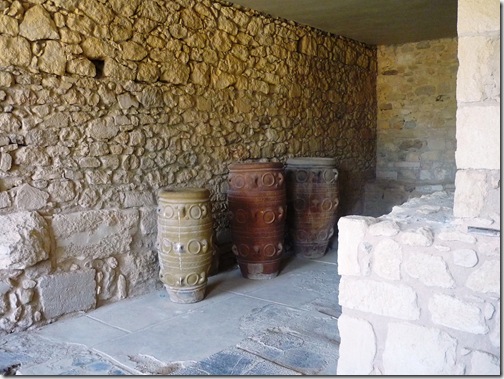
P1100375 Party finally gathered, we drove back to Rethymno through the late afternoon sun, well satisfied with our day in Iraklion in general, our visit to Knossos in particular.

I will leave you with a final Knossos photo from Clare.

One of the things that struck me here and in other parts of Greece was the sheer size of the pottery jars used for storage. I was going to say amphora, but that is just one type.

If you look at these ones here and think of them filled with, say, olive oil, you can imagine just how hard they would be to move around.

Friday, November 12, 2010

Earthquakes, Mt. Merapi, Lorenzo & the dark ages

I am P1010510working on my next Greece post. But just for something both Greek and Minoan, the photo is from excavations of a Minoan town on Santorini. Notice how the stone steps are buckled. That reflects the force of the earthquake that destroyed the town. The subsequent volcanic eruption buried it, preserving it for today.

Congratulations to North Coast Voices on turning three. I may disagree with the collective from time to time, but I am always glad that they are there.

Congratulations, too, to Paul Barratt on visitor 35,000 to Australian Observer. The blog only began in February 2009, so that's not bad at all.

In 7/11 in Burma: the shelves are bare, Paul repeats a comment on the Burmese elections by former Australian Ambassador Garry Woodard. It makes for depressing reading.

In the The Eruption of Mt. Merapi, Niar provides an interesting and very human picture of this natural disaster. Niar, by the way, is now working for the ASEAN Secretariat, thus achieving one of the objectives she blogged about while she was still at University in Jember.

I hadn't really read Lorenzo's blog Thinking Out Loud until we had a discussion on one of the Skepticslawer posts. While I have yet to respond as promised with comments on one of his posts, I have been reading the blog with interest.

I wasn't sure of Lorenzo's background beyond his blog description as a free-lance educator, Clearly he had a very impressive historical knowledge, so I followed the links through to Multisensory Education Pty. Ltd. This "offers a wide range of educational programs, including our extremely comprehensive range of history incursion programs for schools under the trading name 'Medieval Education'." From the front page, I then followed through to the Directors, where I found Michael Warby.

In one of my Greek posts, Mad, bad and dangerous to know, I commented that I grew up in an Australian world that was saturated with history in a way that was, I thought, not true today. That's good. I also noted that the historical view I absorbed was partial, fitting into a particular view of historical progression. That's not necessarily bad, history is always partial, but it does need to be corrected, challenged, by the evidence.

One element of that partial view I grew up with can be simply summarised: medieval = dark ages. Rome fell, and Western Europe was plunged into darkness. I was never totally comfortable with that view, but it was quite pervasive. Part of Lorenzo's mission, if I can put it that way, is to bring the medieval period out of the dark, to present it as it was, a time of change. I quote from one of his posts:

There is surely no period of European history that is loaded down with more misconceptions than the medieval period. It is regularly dismissed as centuries of social stagnation, fearful of change, an intellectual desert.

Lorenzo argues the alternative view quite persuasively. To see what I mean, have a look at these posts in order:

In his professional capacity as Michael, Lorenzo states in part that his "specialty is analysis of how social structures develop over time". I wouldn't claim this as a speciality, but it's certainly an interest. As part of this, both of us use our historical knowledge to inform our commentary on social structures, social change and the present.

Now this is, I think, where there are differences between us flowing from our different experiences and world views. Our different frames affect our use of history in present discussions.

I make this point cautiously because I have not yet read enough of Lorenzo's thinking to fully understand his underlying positions. I think that it will be interesting to find out more.   

Thursday, November 11, 2010

The remarkable story of Arthur Evans

My last post on out Greek trip, Mad, bad and dangerous to know, finished with the observation that my interest in Minoan Crete lay not just the sense of discovery going back to Ceram's Gods, Graves and Scholars. More importantly, here was a civilisation that did not quite fit in, that pre-dated the historical models that I had absorbed. Greece wasP1010199 more than just Athens or Sparta.

There is always an issue in visiting ancient sites whether to go to the site first or to the museum. In our case (Arrival in Iraklion), circumstances dictated museum first. I actually think that's better. A ruin is a ruin. It becomes more as you add life, populating the buildings with the people who used to live there; how they slept, how they dressed, what they did, what happened to them.

Where, as in my case, you have wanted to visit for a long time, there is also a risk that reality may disappoint. This actually happened on this trip at spots, but not at Knossos. The Minoans really were a remarkable people whose life displayed grace and complexity.

The site at Knossos lies on the outskirts of modern Iraklion. As we drove through the crowded streets full of people busy with their daily concerns, I mused on the remarkable story of Sir Arthur Evans. You see, we don't know what the Minoans called themselves. It was Evans who named the civilisation after King Minos because the structure of the palace at Knossos reminded him of the famed labyrinth.

There appear to be two different versions of the Minos story.

In the first version, Minos reigned over Crete and the islands of the Aegean Sea three generations before the Trojan War. He lived at Knossos for periods of nine years, where he received instruction from Zeus in the legislation which he gave to the island. He was the author of the Cretan constitution and the founder of its naval supremacy.

The view from Athens is very different. In Attic tradition and on the Athenian stage, Minos is a cruel tyrant who exacts tributes of Athenian youths to feed the fabled Minotaur.

This second tradition forms the base of part of Mary Renault's The King Must Die, the story of the early life of Greek hero Theseus. Bull jumping

Renault takes the mythical stories and turns them into the type of historical story that might have formed the base for the later myths.

As part of this, the Minotaur turns into the Minoan bull dance in which dancers have to catapult themselves across the bull's back. It looks all very graceful in the fresco, but must have been quite difficult and dangerous. A new extreme adventure sport for New Zealand perhaps?

Arthur Evans (also here) was born in England in 1851. This was a very particular time in English history when a passion for the past combined with an interest in collecting was transforming antiquarianism into the new disciplines of archeology and philology. It was also a time of growing wealth flowing from the industrial revolution.

John Evans, Arthur's father, was a business man with a share in a paper mill. This was important, for money from the business would ultimately help fund excavations at Knossos. John Evans was also an antiquary, numismatist, geologist and archaeologist, publishing works on all these topics. Arthur inherited these interests from his father.

To my mind, Arthur Evans was something of a restless soul. He had a good education, but was more interested in adventuring into the wilder parts of Europe. In company with his younger brother or a friend, he visited Lapland and explored through the Balkans, sometimes with gun in hand. Between Between 1877 and 1882 he was Balkans correspondent of the Manchester Guardian, reporting on a revolt of the Serbs against the Ottoman Empire. He became an expert in what was called the Eastern Question, the issues and problems created by the dP1100201ecaying Ottoman Empire.

From the beginning, Arthur Evans kept detailed notes, along with drawings and maps. He also collected historic gem stones, an interest that finally led him to the site at Knossos.

Evans did not discover the site. That honour belongs to  Minos Kalokairinos, a Cretan merchant and antiquarian who found the site in 1878. Kalokairinos conducted the first excavations. However, the difficulty that he and others faced at the time was the refusal of the Ottoman authorities to grant the necessary excavation approvals.

Things eased once Crete became an independent country. Evans saw his chance. He purchased the entire site!

Excavations began in 1900. Assisted by Dr. Duncan Mackenzie, who had already distinguished himself by his excavations on the island of Melos, and Mr. Fyfe, the British School at Athens architect, Evans employed a large staff of local labourers as excavators; within a few months the team uncovered a substantial portion of what Evans named the Palace of Minos. The results wereP1100209 a treasure trove of buildings  and artifacts.

There is considerable controversy about certain aspects of Evan's work, something that I will talk about in my next post. For the moment, you can see why I found the story of Knossos so fascinating as a child. It, along with the parallel stories of Mycenae and Troy, had everything that a boy could want. Adventure, the lure of the unknown, buried treasure.

We can see this today in Indiana Jones, Lara Croft or the books of Andy McDermott. It's odd, actually, for these books or films are also wrapped in their own mythology. There seems to be a need in our modern secular society for something that will take us out of the mundane into a world that's just as strange and complicated as the original Greek myths!

In my case, the childhood fascination took me on a journey that almost, not quite, ended in me becoming a professional archaeologist, if with a specialisation in Australian prehistory rather than Europe or the Middle East. Had I been less interested in other things, had I got the marks that would have allowed me to go straight to a PhD, then the world would have been different. The need to do a masters first was just too much of a hurdle. So events shape us.P1100346

Now, all these years later, Clare (youngest) is doing Ancient History at Macquarie University and talking about becoming an archeologist. As part of this, she is planning her exchange at a Greek University.

I don't know whether this will in fact happen. Like her father before her, Clare has many interests, including a passion for writing and for all the possibilities opened up by the new media.  Like her father before her, she has too many interests and a tendency to go all over the place. What I am sure, is that he interests will take her in directions that none of us can forsee.

In Arthur Evan's case, Knossos became the defining moment of his life. He became a rampant Cretanphile, spending the rest of his life focused on Knossos and the Minoans.

Evans and Knossos are inseparable. It's not just the academic interest in the Minoans, but the millions of tourists who visit. The Minoans are alive in the present because of Evans. His contribution to the modern Cretan economy is huge. It's not a bad end result for a man who failed to get an Oxford fellowship! 

Wednesday, November 10, 2010

Mad, bad and dangerous to know

I had wanted to visit the Minoan site of Knossos for many years.

As a child, C W Ceram's Gods, Graves and Scholars fascinated me. First published in 1949 and still in print today,  this history of archaeology played to my love of adventure and of discovery. Those early archaeologists were strange and fascinating folk. The discovery of the previously unknown, the possibility of treasure, was quite intoxicating. The excavation of Knossos by Sir Arthur Evans was part of that story.    

  I grew up in an Australian world that was saturated with history in a way that is, I think, not true today.

The Bible was one element of this. More people went to church and to Sunday School. By their very nature, the Bible stories stories provide an introduction to one slice of history. It may have been a partial view, something that I will return to in a moment, but it was a view.

In this context, it was interesting watching visitors from modern secular Australia struggle to come to grips with the continuing importance of faith and religion in modern Greek life. It wasn't just the number of churches or priests, nor the shops selling icons and beads, but the visible expression of religious faith, especially among older Greeks.  

Religion and the history of Greece are inextricably entwined. Religion divided, but faith and the Orthodox Church were critical to the survival of a Greek sense of identity and culture through constant turmoil.P1110100

This photo is actually from Paros. It is a crowded photo, but it does give a feel for the age, the ornateness, of Greek religious expression.

A second element in that past sense of history was the Empire and Commonwealth itself. The Empire may have been in terminal decline, on the point of dissolution, but  much of the map was still coloured pink when I was a child. When, as at the Battle of Crete Museum, I see the phrase "Commonwealth troops", it has meaning that extends far beyond the modern attenuated concept.

The effects of Empire and Commonwealth on thought and the sense of history were still quite pervasive. This is actually difficult to explain to a modern Australia sometimes obsessed with its own sense of identity where everything has to be squeezed into, or at least interpreted through, a purely local frame. History then did not begin in 1788 or a bit before, nor was it limited to just that taught. It came through in family connections, in books and comics, in popular novels, in the language and concepts used.

One element in that thought was a love of things classical. The English in particular fell in love with things Greek; not the Greece of today, but an idealised version of classical Greece. The English were not alone in this, it was a Western European phenomenon, but it was the English version that affected not just Australian thought, but Greek history itself.

Earlier I commented in the context of Bible stories that the history around me, while pervasive, was partial.

In this world, the combination of Christianity with love of things classical created an historical perspective that saw history as a process moving from the early great civilisations of the Middle East through Greek civilisation to Rome. Greece and the Greek city states were bulwarks against invasion from the east. Greek civilisation was central to the formation of the modern (read European) world. A truly educated person knew Greek as well as Latin.

By the time I was bLord_Byron_by_Thomas_Phillipsorn, this view was in sharp decline, but it was still there.

My secondary school in Armidale (The Armidale School) no longer taught classical Greek (Latin was still compulsory in the A stream), but it was less than thirty years since TAS had presented one of the classic Greek plays in Sydney in the original language.

The English poet Lord George Byron (1788-1824) may, as Caroline Lamb famously said, have been mad, bad and dangerous to know, but he truly encapsulated and indeed became the symbol of the English love of things Greek.

To Byron, Greece was an ideal; the final fall of Constantinople to the Ottomans and the subsequent loss of the Greek mainland and Greek Islands to the Ottomans a disaster. He travelled to Greece to throw himself into the Greek rebellion against the Ottoman Empire. His death from fever in Greece added to his allure.

The Greeks justly regard Byron as a national hero, but it is a little more than that.

On the English side, Byron added emotional force to the Greek love affair. British policy in the Eastern Mediterranean was not driven just by geopolitical concerns, but also by the English love for and idealisation of things Greek. English attitudes were riven with contradictions, contradictions not limited to the political.

In the moralistic world of the Victorian Empire, there were deep suspicions about sexuality and especially sexual relations between males. This contrasted with attitudes in classical Greece where sex between men, and between men and young boys, was seen as normal.

This played itself out in the complicated world of the English (and Australian) boarding school. There a contained environment contrasted rigid Victorian morality with very contrary Greek thought and attitudes; the resulting tensions can be seen clearly in books such as E F BenP1020099son's 1916 school story David Blaize, a book of my father's that I read as a school boy.

On the Greek side, the European and especially English attitudes towards classical Greece became an element in the highly emotional cocktail involved in the creation of modern Greece.

Greece was a new entity, one that had not existed before in political terms. in creating Greece, the Greeks' combined a vision of classical Greece with that of the Byzantine or Greek Empire. They were recreating Byzantium on a classical base.

This vision affects Greece today. That strangely named political creature, The Former Yugoslav Republic of Macedonia, is named that way because Greece will not, cannot, accept another country with that name.

To the Greeks, Macedonia is both enemy and part of Greece. Macedonia sat on the outskirts of classical Greece. Philip of Macedon and especially  his son Alexander were conquerors, outsiders, but also people who spread Greek influence. Modern Greece rests its claim for existence, its historical role, on the combination of classical Greece with the Alexandrian and Byzantine Empires. To accept a country simply called Macedonia is to deny that historical imperative.

I may seem to have come a long way from my starting point to this post, Knossos and the Minoans, and in one sense I have. However, there is a link.            

My interest in Minoan Crete is not just the sense of discovery going back to Ceram's Gods, Graves and Scholars. It's rather more that here is a civilisation that did not quite fit in, that pre-dated the historical models that I had absorbed. Greece was more than just Athens or Sparta.

I will continue the story in my next post in this series.         

Tuesday, November 09, 2010

Just a meander

A brief post tonight while I am working on my next Greek travel post.

In Can New Zealand catch up to Australia?, Winton Bates discussed whether or not New Zealand could bridge the gap in living standards with Australia.

I fundamentally disagree with the argument that Winton quotes from Philip McCann; McCann essentially argues that it is all due to relative city size. I think that Winton is right to reject McCann, but then I disagree with Winton's own conclusions. As someone who had been interested in New Zealand economic development for many decades, I feel a response coming on!

On demography.matters, Scot's analysis in Type II Diabetes and India looks at the reasons why India has had such an explosion of this type of diabetes. It's not just a change in diet, but also the exact composition of the previous diet.

Staying with the demography.matters collective,  Canadian Randy McDonald in his live journal kindly picked up one of my Greek posts, Rethymno and the complicated history of Crete, although he has it firmly in his mind that I am a Paul rather than a Jim! In turn Hans Connor, a Canadian from Prince Edward Island picked the post up in Islands Nations in the Pre-National Age. Han's describes his blog, Nissology, in these terms:

Nissology is a fancy word for Island Studies. Nissology PEI is a blog about Island Studies and Island Issues from my own personal lens as an islander and a Prince Edward Islander with an academic interest in Nissology.

It looks an interesting blog.

Like many bloggers, I have been wondering about Pip Wilson's condition. Pip was savagely bashed back in August. I see from comments on one of Lynne's posts back in early October, GLOBAL EVACUATED, that he was slowly recovering then. At that stage Bird Jensen asked if anyone was interested in helping buy a laptop for Pip to help his brain recovery. I don't know what has happened since. Anybody else know?

   Just at present, my Train Reading has switched to Paul Kelly's The Hawke Ascendancy. It's not a bad read. You can expect comments on it because it bears upon some of the things that I have been writing about, including a recent post, Scoping the decline in organisational performance. Sadly, I haven't had any response to my request for comments on that post. Anybody care to comment?

Looking at my Train Reading posts, they essentially collapsed after I stopped travelling by train end December. That's actually a bit silly. The need remains independent of the mode of transport. Expect more here.

Well, that's all tonight!